
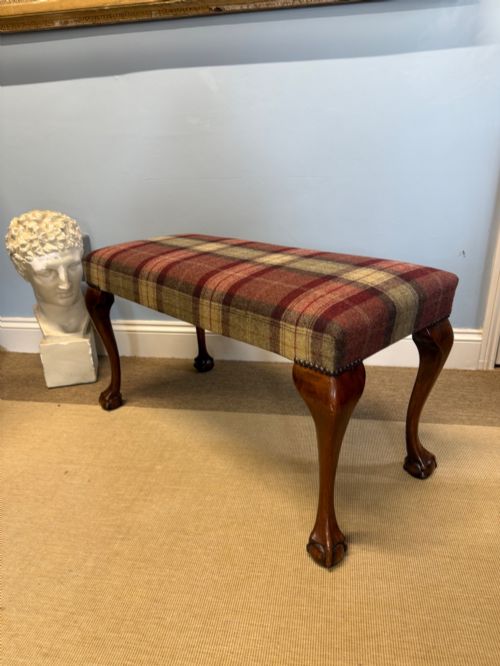


Mahogany Long Footstool
These mahogany long footstool pieces offer generous seating and rest, shaped by centuries of cabinet-making.
Mahogany Long Footstool
A mahogany long footstool brings together solid timbers and extended proportions, appearing across Georgian, Victorian, and Edwardian periods. Pieces on this page span formats from plain frames to elaborate window seats, piano duet stools, and carriage rests.
The form stretches from compact 18th-century examples to expansive Edwardian designs. Buyers encounter variations covered in wool, cotton, velvet, tweed, and kilim textiles, alongside cane-seated versions.
Makers shaped these long stools in styles ranging from George III and Chippendale Revival to William IV, Arts & Crafts, and Queen Anne. The overarching characteristic remains the timber frame paired with a long upholstered or woven top.
How they were made
Makers constructed the primary frames using solid mahogany, often highlighting the natural grain of the wood. Brass details, such as studding, frequently appeared on upholstered leather examples.
Upholstery techniques involved traditional fillings covered in diverse textiles including velvet, cotton, wool, and tweed. Some variants incorporated cane seating or hinged mechanisms for internal storage.
Some Victorian piano stools hide secret compartments under hinged seats, ready to catch rogue sheet music.
What varies in quality
Proportion and drawing distinguish superior examples, particularly in how legs and rails relate to the overall length. Well-drawn pieces exhibit balanced curves, such as cabriole legs or ball and claw details, rather than heavy or static lines.
The integrity of the mahogany frame and the quality of the upholstery textile set individual pieces apart. Hand-stitched leather with brass studding or specialist fabrics like Morris & Co. velvet elevate the finish of certain long stools.
The Mahogany Long Footstool Glossary
- Mahogany
- A durable tropical hardwood valued for its rich reddish-brown colour and stable grain. Cabinet-makers relied on it for structural strength and fine surface finishes.
- Kilim
- A flat-woven carpet or textile used to cover furniture surfaces. These woollen covers introduce geometric patterns to traditional timber frames.
- Duet stool
- An extended bench designed to seat two players at a piano. Many incorporate hinged seats concealing internal storage for sheet music.
Mahogany Long Footstool: Frequently Asked Questions
What periods do these long stools come from?
The pieces span the 18th, 19th, and early 20th centuries. Evidence includes Georgian, Victorian, and Edwardian eras.
Craftsmanship methods evolved through these periods, shifting from classical George III proportions to later Arts & Crafts and revival styles.
How were these long stools originally used?
They served multiple domestic functions including fireside rests, window seats, and carriage stools. Piano duet variants accommodated multiple musicians.
Their elongated proportions allowed them to double as low benches or window furnishings in formal rooms.
What upholstery materials appear on these stools?
Coverings include wool, cotton, velvet, leather, tweed, and woven kilim textiles. Some examples feature cane seating.
Textiles often reflect specific design movements, such as William Morris prints or traditional buttoned leather.
How do I identify a George III long stool?
George III pieces date from the late 18th century and display refined proportions and elegant timber framing. They frequently incorporate details like brass studding.
Later Victorian and Edwardian examples often introduce heavier frames or distinct revival styles.