
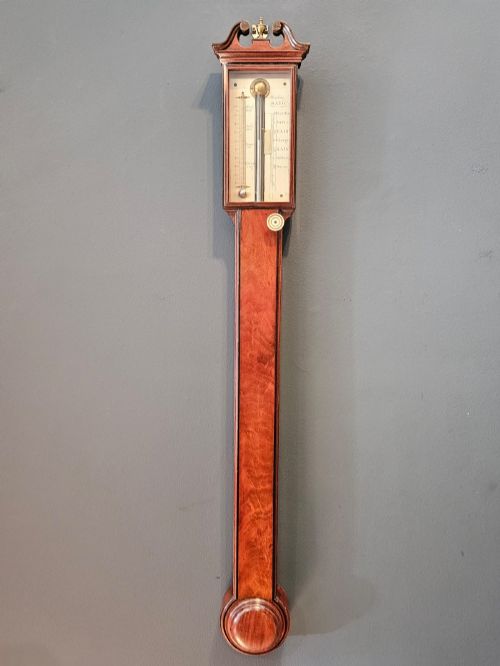


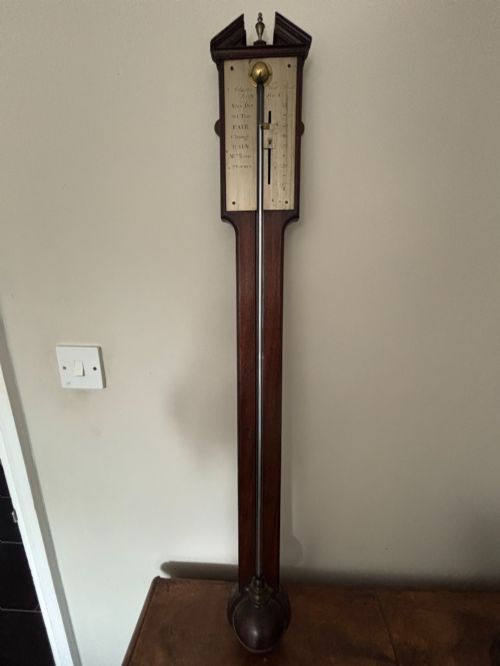


Mahogany Cistern Barometer
A mahogany cistern barometer brings fine cabinet work and scientific ambition together on the wall, offering a tangible link to Georgian and Victorian domestic interiors.
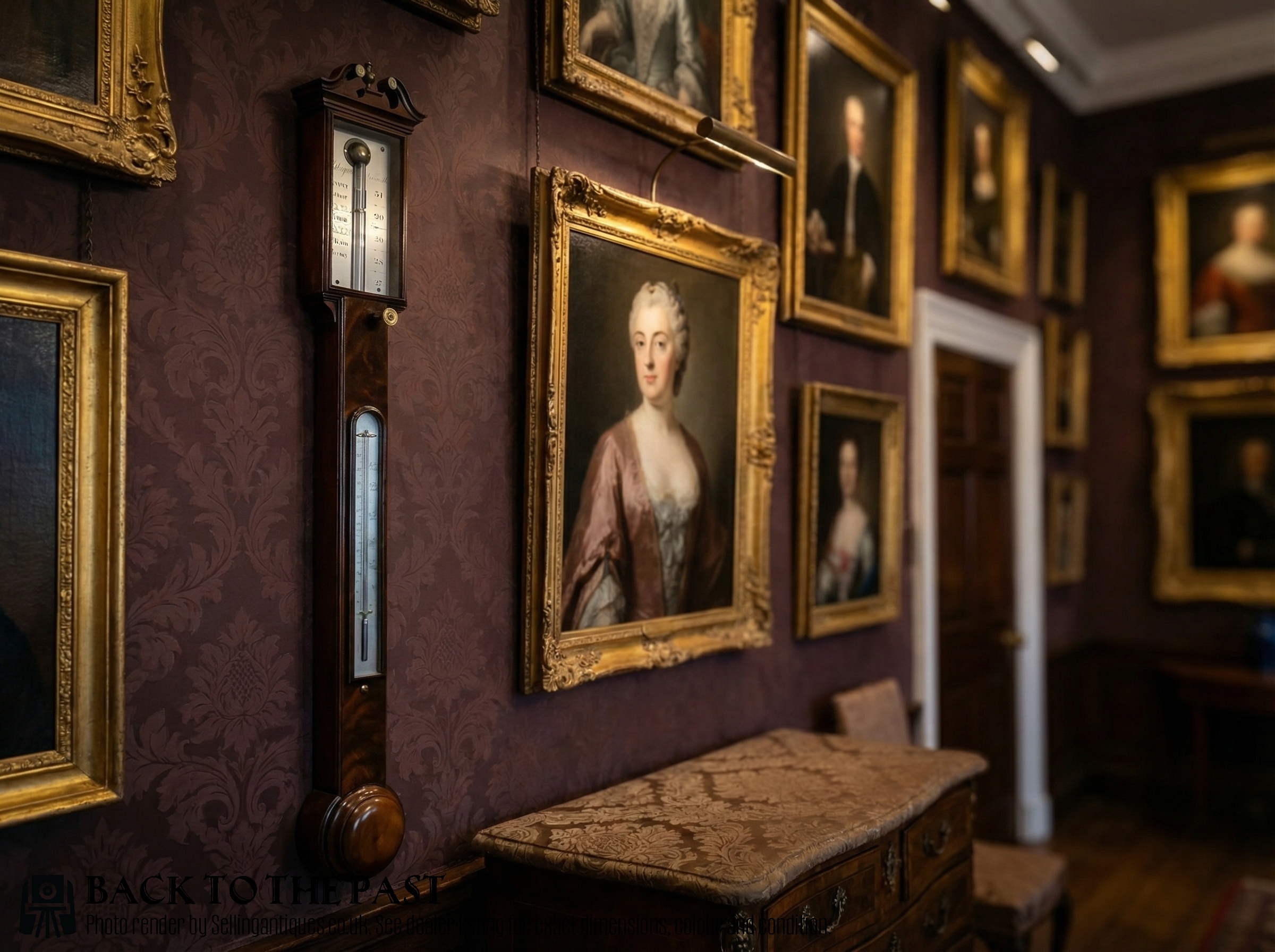
Mahogany Cistern Barometer
A mahogany cistern barometer is a precision instrument designed to measure atmospheric pressure, housed in a timber case that reflects the prevailing taste of its period. The pieces seen here span the Georgian, Regency, and Victorian eras, alongside examples from around nineteen hundred.
The form typically presents as a tall, slender wooden trunk carrying a exposed or protected glass tube, often finished with a visible cistern cover at the base. Most examples rely on straightforward mahogany cases, though occasional pieces introduce bow fronts or boxwood stringing.
Makers from London, provincial England, Dublin, and Glasgow signed these works, placing them in domestic halls and libraries where guests could observe changes in the weather. They survive today as functional antiques that combine cabinet-making skill with early instrumentation.
How They Were Made
Cabinet makers selected dense mahogany for stability, shaping the timber into straight or bow-fronted trunks that protected the fragile glass tubes within. Boxwood inlay appears on selected pieces to outline the grain and frame the instrument board.
Instrument makers integrated silvered brass or silvered metal scales to display the barometric readings clearly, often pairing them with movable vernier pointers. Glass shielded the delicate engraving, while brass fittings secured the cistern covers and suspension points at the top.
The listings span the Georgian, Regency, and Victorian periods, utilising mahogany, silvered brass, boxwood, and glass.
What Varies in Quality
Quality rests upon the precision of the maker's engraving on the silvered brass scale and the crispness of the cabinet work in the mahogany case. Signed instruments by notable makers command attention for their documented lineage and superior dial layout.
The treatment of the timber case marks the divide between standard provincial work and high-end London production, particularly where bow fronts, figured veneers, or subtle boxwood stringing are introduced with restraint.
George Adams London·Blunt·Dollond of London·JB Bergna·Alexander Wright·Negretti and Zambra London·Gilbert London·Bate·James Gatty·Alexander Adie·S P Cohen·Pinchetti and Co·Tarone Gally and Co·Malacrida of Dublin
The Mahogany Cistern Barometer Glossary
- Cistern barometer
- An instrument that measures atmospheric pressure by balancing the weight of mercury in a glass tube against a reservoir or cistern at the base.
- Stick barometer
- A tall, narrow barometer design where the mercury tube is exposed or partially glazed down the length of the wooden trunk.
- Silvered brass
- A metal dial plate treated with a silver composition to provide a bright, readable surface for engraved weather scales and maker signatures.
- Vernier
- A small auxiliary scale that slides alongside the main barometer scale to allow precise readings of fractional pressure changes.
- Bow front
- A convex curve to the front profile of the wooden case, softening the vertical lines of the instrument.
Mahogany Cistern Barometer: Frequently Asked Questions
How do I read a stick barometer?
Read the level of the mercury column against the engraved scale, using the sliding vernier pointer to note precise measurements.
Changes in the height of the column indicate shifts in atmospheric pressure, which traditional weather notes on the dial help interpret.
Where should I hang a barometer?
Hang the instrument on an interior wall away from direct sunlight, radiators, and drafts to ensure the wood and internal mechanism remain stable.
A stable indoor climate prevents timber movement and helps protect the fragile glass tube and mercury reservoir.
Can these barometers still be calibrated?
Many surviving barometers retain functional tubes that respond to local pressure changes, though historical instruments are often appreciated primarily as decorative antiques.
Professional restoration can sometimes re-establish working order if the mercury column has separated during transport.
How do I distinguish Georgian from Victorian models?
Georgian instruments often feature restrained mahogany cases with simple architectural lines, whereas Victorian examples frequently introduce heavier proportions or more expansive weather station formats.
Examining the style of the maker's signature and the construction of the cistern cover also helps clarify the period of manufacture.