


Regency Mahogany Barometer
A regency mahogany barometer brings domestic science and polished cabinet-making together, offering accurate weather readings inside a warm timber frame.
Regency Mahogany Barometer
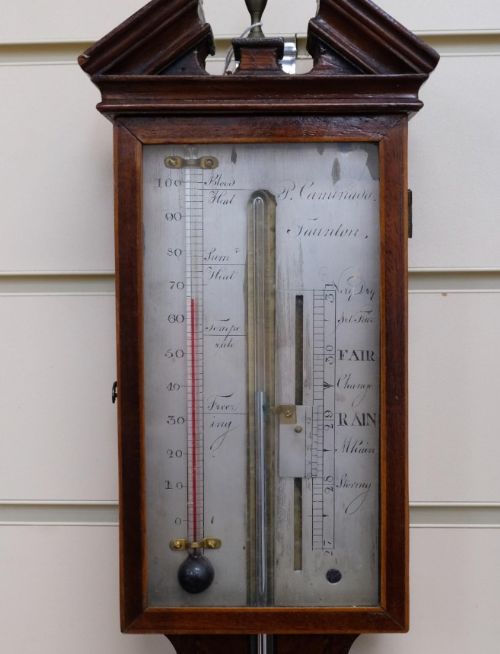
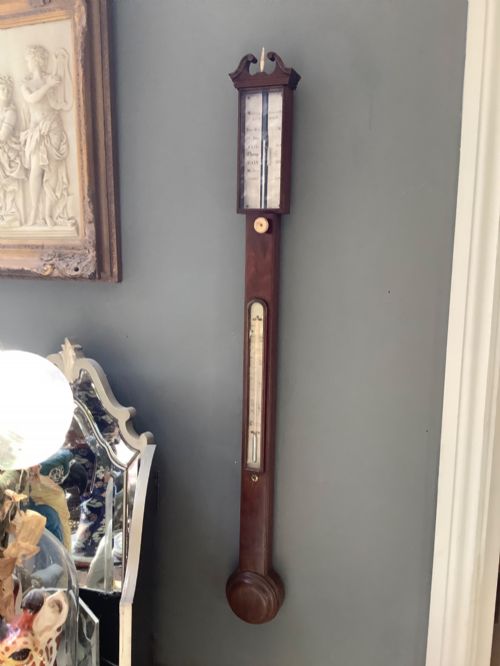
A regency mahogany barometer is a domestic scientific instrument designed to measure atmospheric pressure, housed within a rich timber case. These pieces primarily appear as stick barometers with long vertical shafts or wheel barometers featuring circular dials.
The versions met on this page date predominantly from the nineteenth century, including the Regency and Georgian periods. Makers constructed these instruments to serve both a practical domestic function and to decorate the principal rooms of polite homes.
Most examples utilise solid mahogany, frequently paired with silvered brass dials and glass columns to protect the mercury. Buyers encounter various regional British makers alongside London firms, showing how widely distributed these instruments became.
Materials and construction
Makers built the cases from dense tropical hardwoods, selecting mahogany and occasionally incorporating rosewood, boxwood, or satinwood stringing for contrast. This timber was planed, curved into bow fronts, or veneered onto softer woods to create stable housings for the delicate glass tubes.
The dials and vernier scales were typically formed from silvered brass or silvered metal, engraved with weather descriptions and numbers. Brass bezels, finials, and occasionally bone adjustment knobs completed the external hardware, securing the glass components safely in place.
Regency Mahogany Barometer Retail Price Guide 2026
Typical asking prices for regency mahogany barometer among the pieces listed under this phrase on Sellingantiques today, from the lower quarter to the upper quarter. They describe what is for sale here now, not the wider market.
Makers recorded on this site worked across various British hubs, from London and Liverpool to Norwich, King's Lynn, and Dublin.
Distinctions in craftsmanship
Quality separates through the crispness of the brass engraving on the dial and the refinement of the timber case work. Superior examples display carefully chosen grain patterns, such as flame mahogany or bird's eye figuring, matched symmetrically across the instrument.
The presence of an identifiable maker's signature engraved upon the brass plate or dial elevates a piece considerably. Finer specimens also retain their original mercury tubes, cast brass fittings, and unbroken architectural pediments.
P. Caminada·Dollond of London·Ganthony of London·JB Bergna·Molton of Norwich·Bate of London·L Casatelli·Roncoroni·H Marks·Sandrino·Vecchio & Co·Bate·A. Rivolta·Alexander Adie·Bassi·J C Moretti·F Salteri & Co·Dominic Gatty·Malacrida·Russell of Liverpool·L. Malacrida·George Dollond·Schiavi·Harris·C. Bellatti
The Regency Mahogany Barometer Glossary
- Stick barometer
- A vertical instrument where the height of a mercury column in a glass tube indicates atmospheric pressure against a graduated scale. This form provides a direct reading without mechanical multipliers.
- Wheel barometer
- A circular instrument where changes in mercury level float a weight attached to a silk thread, turning a spindle and pointer around a dial. This layout resembles a clock face and often includes a thermometer or hygrometer.
- Banjo barometer
- A popular domestic wheel barometer shape featuring a bulbous lower body and a tapering upper stem that resembles a stringed musical instrument. These often incorporate decorative stringing and damp-reducing dampening cisterns.
- Silvered brass
- A brass plate treated with a silver compound to produce a bright, matte finish that takes fine black engraving clearly. This material forms the legible face behind the indicator needles.
- Vernier scale
- A small auxiliary sliding scale invented by Pierre Vernier that allows fractional readings of the barometer scale to be taken precisely. It typically operates via a small brass knob on the instrument's face.
Regency Mahogany Barometer: Frequently Asked Questions
What is a stick barometer?
A stick barometer is a narrow vertical instrument that uses a sealed glass tube filled with mercury to measure atmospheric pressure changes. The height of the column rises and falls directly against a marked scale.
These pieces were hung in hallways or libraries where household members could check approaching weather patterns before travelling or farming.
How does a wheel barometer work?
A wheel barometer translates the movement of mercury inside a concealed U-shaped glass tube into the rotation of a pointer on a circular dial. A small float rests on the mercury surface and connects to a pulley system.
These instruments offered a much larger, easier-to-read display than traditional stick barometers and often included auxiliary dials for temperature.
Where should I hang my barometer?
Barometers perform best on internal walls away from direct sunlight, central heating radiators, and damp exterior stone. Stable indoor temperatures prevent the metal and timber case from expanding or contracting.
Ensure the instrument is fixed securely to a sturdy wall plug or stud, as historical hanging rings can be fragile after centuries of use.
Can these barometers still predict weather?
Yes, historical mercury barometers function just as accurately today as they did when first made, provided the glass column remains unbroken and free of air bubbles. They measure real atmospheric weight continuously.
Reading the instrument involves tapping the dial gently before noting the position of the main hand and setting the brass indicator needle over it to track movement.