
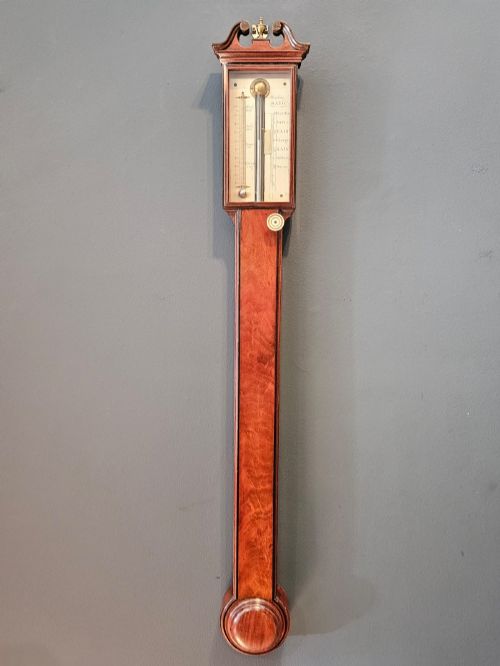


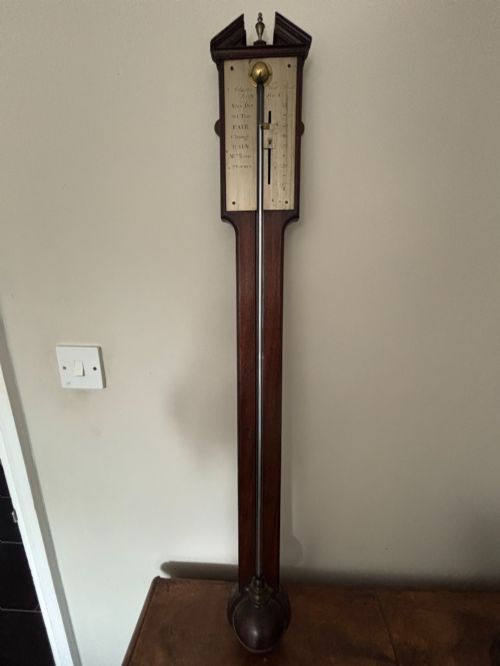


Cistern Stick Barometer
A cistern stick barometer is a sensitive scientific instrument housed in timber, prized for precise atmospheric measurement and understated decorative elegance.
Cistern Stick Barometer
When you examine a cistern stick barometer, you encounter a tall, slender weather instrument designed to register atmospheric pressure through a column of mercury. These pieces belong predominantly to the Georgian, Victorian, and Regency periods, spanning from the early eighteenth century into the twentieth.
The most common formats on this page are housed in mahogany cases, sometimes with bow fronts or boxwood inlay, alongside examples in oak, walnut, and ebonised wood. You also find specialised variations like Fortin types and long range instruments originating from workshops across London, provincial British cities, and continental makers.
How they were made
Cases were constructed from dense timbers such as mahogany and walnut, shaped with straight or bow fronts and occasionally enhanced with delicate inlay. These wooden chassis were engineered to protect the vulnerable glass tubes and the mercury contained within them.
The vital measuring components combine glass tubes with silvered brass or silvered metal scales, often engraved with vernier dials and maker details. Exposed components like cistern covers and pointers typically utilise brass or bone, securing the internal physics with stable metalwork.
Cistern Stick Barometer Retail Price Guide 2026
Typical asking prices for cistern stick barometer among the pieces listed under this phrase on Sellingantiques today, from the lower quarter to the upper quarter. They describe what is for sale here now, not the wider market.
Several Victorian models were marketed specifically as farmers' barometers, proving that even rural weather watchers demanded a touch of brass.
What varies in quality
The distinction between standard examples and the finest work lies in the refinement of the timber selection, such as heavily figured mahogany or early walnut, and the crispness of the cabinetmaker's joins. Superior instruments display harmonious proportions, elegant mouldings, and restrained decorative flourishes rather than heavy ornamentation.
On the scientific side, the quality of execution shows in the precision and legibility of the silvered brass dial engravings and the reputation of the maker inscribed upon it. Signed pieces by established instrument makers demonstrate superior calibration hardware and more meticulous attention to the internal cistern architecture.
George Adams London·Negretti and Zambra·Blunt·Dollond of London·JB Bergna·Alexander Wright·J Hughes London·Sandrino of Liverpool·Gilbert London·S and B Solomons·Bate·James Gatty·Ciresa of Milan·Alexander Adie·S P Cohen Glasgow·Pinchetti and Co·Tarone Gally and Co·Corti of Exeter·Malacrida of Dublin
The Cistern Stick Barometer Glossary
- Cistern
- The reservoir at the base of the barometer that holds the mercury pool open to atmospheric pressure. Its design dictates the baseline accuracy of the instrument.
- Silvered brass
- The metallic alloy plate treated to achieve a silvery matte finish, carrying the engraved weather scales and numerical graduations. This surface catches ambient light to ensure the tiny divisions remain legible.
- Bow front
- A convex curving front profile to the wooden instrument case. This styling offers a softer aesthetic and accommodates wider cistern housings.
- Vernier
- A small auxiliary sliding scale attached to the main barometer plate that allows fractional readings of the mercury height. It transforms a simple reading into precise scientific observation.
- Fortin stick barometer
- A specialised cistern design featuring an adjustable leather base and ivory or metal point, allowing the mercury level to be set to a zero mark prior to reading.
Cistern Stick Barometer: Frequently Asked Questions
What is a cistern stick barometer?
A cistern stick barometer is a tall, narrow weather glass that measures atmospheric pressure using a column of mercury balanced against an exposed reservoir at the base.
These instruments combine functional science with decorative woodwork, serving as both precision tools and elegant furnishings in historic interiors.
How do you read a stick barometer?
You read the height of the mercury column against the engraved silvered brass scale, noting the position of the meniscus relative to weather descriptions like rain or set fair.
Using the sliding vernier scale allows you to measure fractional changes in the mercury level with greater precision.
Where should you place a stick barometer?
You should hang a stick barometer on an interior wall away from direct sunlight, central heating radiators, and frequent draughts that cause thermal expansion.
Keeping the instrument in a stable ambient temperature protects the wooden case and ensures the mercury responds solely to atmospheric pressure changes.
How do I identify the period of a barometer?
You determine the period by examining the timber species, the profile of the case, and the style of the engraved lettering on the silvered brass dial.
Early eighteenth-century examples often feature walnut with square cisterns, while Georgian and Victorian pieces frequently employ mahogany, bow fronts, and more detailed maker signatures.