
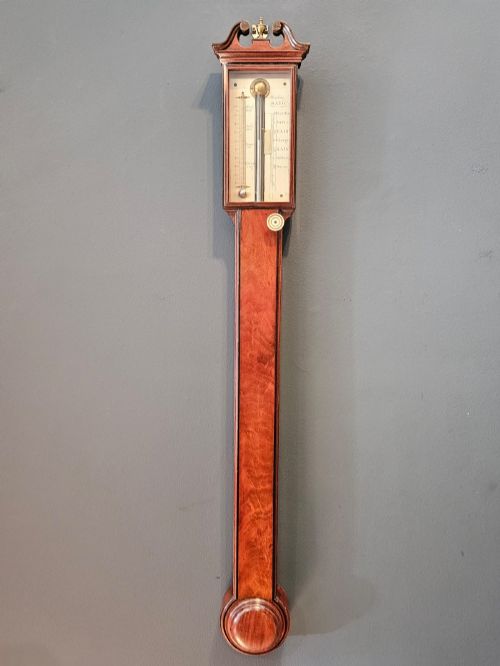


Edwardian Stick Barometer
An edwardian stick barometer measures atmospheric pressure with a mercury or aneroid column housed in a tall, slender wooden case.
Edwardian Stick Barometer
When you search for an edwardian stick barometer, you are looking at tall, narrow weather-measuring instruments designed to hang on a wall. The form houses a vertical tube of mercury or an internal metal mechanism alongside a paper or bone scale.
The versions you are most likely to meet on this page date from the Edwardian period, though the records also show examples from the Victorian era, the Georgian period, and earlier centuries.
Makers housed these instruments in timber frames such as mahogany, oak, walnut, and burr walnut, sometimes fitted with hygrometers or thermometer scales alongside the main barometer face.
How they were made
Cabinet makers constructed the tall cases using solid and veneered timbers such as mahogany, oak, and walnut, often shaping the wood with carved details or geometric inlays.
The working parts combine glass tubing filled with mercury or brass aneroid movements with engraved paper, bone, or metal scales to indicate atmospheric changes.
Edwardian Stick Barometer Retail Price Guide 2026
Typical asking prices for edwardian stick barometer among the pieces listed under this phrase on Sellingantiques today, from the lower quarter to the upper quarter. They describe what is for sale here now, not the wider market.
Certain models include specialised mining scales, ready to warn subterranean workers when barometric shifts hinted at changes in mine gas levels.
What varies in quality
Quality rests in the crispness of the timber carving, the choice of figured veneers such as burr walnut, and the precision of the engraved scale plates.
Signed instruments by recognised makers and scientific instrument firms carry greater weight than unsigned examples produced for general retail.
Hyde & Sons Sleaford·Negretti & Zambra·Alexander Wright·J Hicks of London·Thomson Skinner & Hamilton·Bassi
The Edwardian Stick Barometer Glossary
- Stick barometer
- A tall, narrow weather glass that measures atmospheric pressure using a vertical column of mercury. This form provides a direct visual reading of barometric height.
- Aneroid barometer
- A barometer that uses an expanding and contracting metal box rather than liquid mercury to measure pressure. This mechanical system allows for compact or varied case designs.
- Hygrometer
- An instrument used to measure humidity, frequently mounted alongside the barometer scale on the instrument board. It records moisture levels in the air.
- Fortin barometer
- A precision mercury barometer featuring an adjustable cistern floor to set the mercury level against an ivory index point. This design ensures accurate scientific readings.
Edwardian Stick Barometer: Frequently Asked Questions
How do I read an edwardian stick barometer?
Observe the height of the mercury column inside the glass tube against the marked scale on the paper or bone plate. Higher readings indicate settled weather while falling levels suggest approaching rain or wind.
Compare the primary reading with any secondary vernier scale or attached thermometer to note changes in pressure and temperature over the course of the day.
Where should I hang a stick barometer?
Mount the instrument securely to an interior wall away from direct sunlight, radiators, and heavy foot traffic doors. Temperature extremes can affect the mechanism and timber case.
Ensure the wall is flat and stable so the tall wooden trunk hangs plumb, which is particularly important for mercury-filled instruments that rely on a vertical drop.
Are these barometers filled with mercury?
Some stick barometers use a sealed glass tube containing liquid mercury, while others rely on an aneroid mechanical movement inside the case. The listings show both mercury-filled and aneroid designs.
Check the specific description of the piece to confirm whether it contains a fluid column or a mechanical metal capsule.
How do I tell an Edwardian barometer from a Victorian one?
Edwardian examples often display lighter timber tones, refined inlay work, and specific maker signatures associated with the early twentieth century. Victorian pieces tend to feature heavier carved oak or walnut frames.
Compare the style of the lettering on the paper or bone scales, as typography and case ornamentation evolved between the nineteenth and twentieth centuries.