

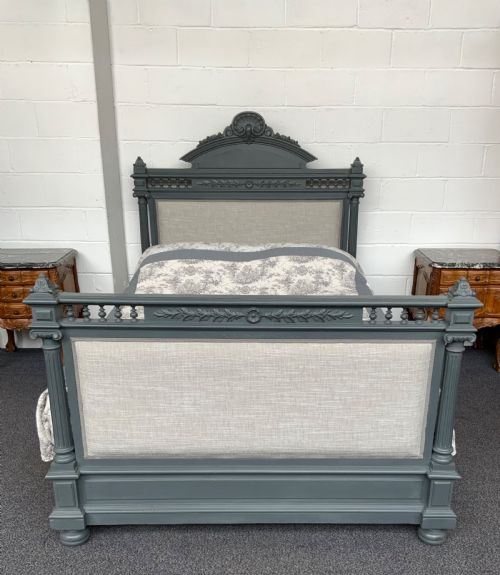
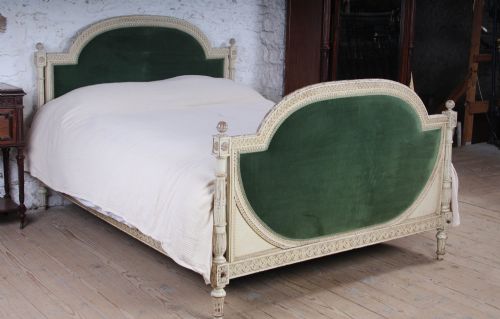
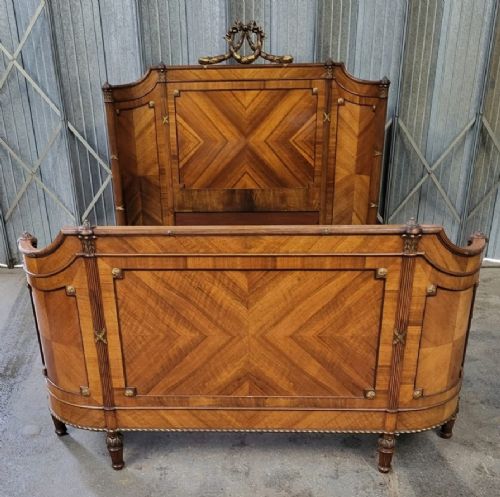
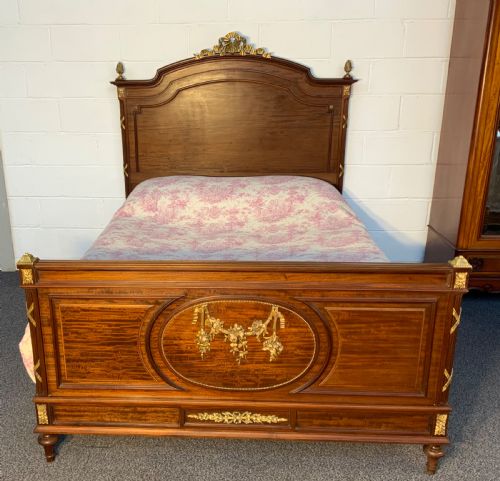


Louis XVI King Bed
A louis xvi king bed brings neoclassical restraint and generous proportions to a bedroom, pairing symmetry with classical carving.
Louis XVI King Bed
A louis xvi king bed is typically encountered as a nineteenth-century revival piece, drawing on eighteenth-century French neoclassical design principles such as straight lines, fluted columns, and balanced proportions.
The form appears across several variations in this collection, ranging from carved and gilded wooden frames to caned bergere panels and pieces fitted with upholstered headboards.
Many examples emerge within larger bedroom suites that include matching bedside cabinets and wardrobes, reflecting the domestic scale of French chateaux and grand townhouses.
Materials and construction
Cabinetmakers constructed these bedsteads using timbers like mahogany, walnut, fruitwood, and oak, frequently employing quarter-veneering and parquetry to create geometric surface patterns.
Decorative enrichment relied on cast ormolu and brass detailing applied to mounts, alongside hand-carved parcel-gilt wooden ornament following classical motifs.
Caning and woven rush appear frequently in headboards and footboards, while upholstered examples utilise traditional stuffing methods beneath contemporary fabric covers.
Several listings note original fabric coverings, preserving decades of domestic history hidden within the upholstery tacks.
Factors of distinction
The refinement of hand-carved detailing sets superior frames apart, distinguishing crisp acanthus leaves and fluting from softer, more mechanised moulding.
Quality reveals itself in the choice of timber figures and the precision of parquetry veneers, where book-matched grains align symmetrically across large panels.
Integrated metal mounts, particularly fire-gilded ormolu, demonstrate greater hand-chasing and heavier casting in finer examples compared to simpler brass fittings.
The Louis XVI King Bed Glossary
- Ormolu
- Gilt bronze mounts applied to furniture. This technique involves amalgamating gold and mercury onto a bronze base.
- Parquetry
- Geometric wood mosaic work used for floors and furniture veneers. Small pieces of timber are fitted together to form patterns.
- Bergere
- An enclosed upholstered armchair or bed panel with wooden framing. Caning is frequently integrated into the sides or headboard.
- Parcel-gilt
- Woodwork partially covered in gold leaf. The technique highlights specific carved details against a painted or polished ground.
- Neoclassical
- A style reviving classical Roman and Greek motifs. Symmetry, straight vertical lines, and restrained ornamentation define the aesthetic.
Louis XVI King Bed: Frequently Asked Questions
What size mattress fits an antique french bed?
Many nineteenth-century French frames were built to continental dimensions rather than modern standard UK sizes. Checking internal rail measurements ensures compatibility with contemporary mattresses.
Custom mattress ordering or minor rail adjustments are sometimes necessary to achieve a secure fit within antique wooden side rails.
How do I care for caned headboards?
Caned panels require gentle dusting with a soft brush and occasional light moistening to prevent the natural cane from becoming brittle. Keeping cane work away from direct heat sources preserves its flexibility.
Avoid heavy liquid cleaners on woven plant fibres, relying instead on dry maintenance to maintain the material.
Are antique beds easy to assemble?
Most antique wooden bedsteads use traditional iron bolts or wooden slot joints to secure the side rails to the headboard and footboard. Assembly typically requires basic hand tools and two people to manage heavy timber components.
Care should be taken not to over-tighten metal fixings into older threaded screw sockets within the wood.
How do I distinguish revival pieces from eighteenth-century originals?
Revival pieces from the nineteenth century often feature machine-sawn timber elements and construction methods suited to larger scale production than original eighteenth-century workshop furniture. Tool marks, timber seasoning, and secondary woods inside the frame provide clues to the exact date of manufacture.
Stylistic proportions and hardware fastenings also shift between the original neoclassical period and later nineteenth-century interpretations.