


Antique Cane Bedstead
An antique cane bedstead brings woven texture and classical proportion into a bedroom, offering lightness of frame combined with robust historic timber.
Antique Cane Bedstead
When you search for an antique cane bedstead, you encounter frames spanning from the nineteenth century into the twentieth, utilising woven plant materials set within wooden structures. These sleeping places take forms such as single beds, double frames, daybeds, and larger king sizes.
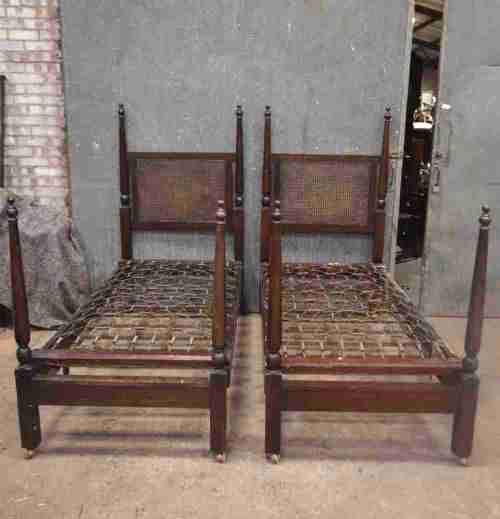
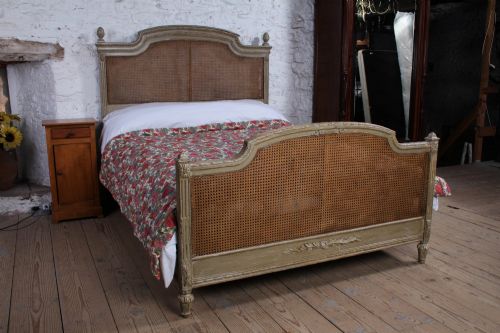
The most common versions met here belong to the Louis XVI style and its revivals, often featuring painted finishes, carved details, and French provenance. Alongside these, buyers find campaign folding formats, oak four-poster configurations, and satinwood compositions.
Makers such as Maple and Co represent the period craftsmanship found within these bedroom suites, which occasionally include matching chairs and bedside tables. The overall selection moves between understated colonial revival pieces and gilded neoclassical designs.
How they were made
The construction relies on solid timbers like oak, mahogany, beech, and satinwood, shaped into headboards, footboards, and rails. Artisans then integrated woven cane and rattan panels to form breathable, flexible mattress supports or decorative headboards.
Surface treatments involved hand painting, polychrome portrait panels, gold leaf gilding, and applied paint finishes over the wood. Carving details were executed by hand to define the classical motifs seen in the French chateau and Louis XVI styles.
The listings on this site include pieces from the Victorian era, the nineteenth century, and specific years up to 1920.
What varies in quality
The standard of the cane work dictates much of the value, with tight, uniform weaving demonstrating superior craftsmanship compared to loose or uneven strands. The integrity of the underlying wooden frame, from carved mahogany to painted beech, determines the overall durability.
Artistic execution sets apart standard production from exceptional work, particularly where hand-painted portrait panels or meticulous gilding are present. The complexity of the design, such as four-poster structures or folding campaign mechanisms, also influences the character of the piece.
Maple and Co
The Antique Cane Bedstead Glossary
- Cane
- Material woven from the outer bark of rattan palms, forming a durable and resilient mesh for furniture panels.
- Bergere
- An enclosed upholstered armchair or bed headboard design originating in France, typically featuring exposed wooden frames and cane sides.
- Campaign bed
- A portable bedstead designed for folding and transport, historically utilised by military officers on active service.
- Polychrome
- Decoration utilising multiple colours, frequently seen on painted wooden panels depicting portraits or floral motifs.
- Satinwood
- A hard, durable timber with a natural golden sheen, favoured by cabinet makers for fine nineteenth-century bedroom suites.
Antique Cane Bedstead: Frequently Asked Questions
Are these beds suitable for daily use?
Most antique bedsteads are built from robust timbers like oak or mahogany and provide sturdy support when properly assembled and maintained.
Many buyers pair the historic frames with modern custom mattresses designed to fit standard or non-standard dimensions.
How do I care for cane panels?
Keep woven cane panels clean by gently dusting them with a soft brush and maintaining moderate humidity in the room to prevent the natural fibres from drying out.
Avoid placing the bedstead in direct sunlight or close to intense heat sources that could cause the rattan to become brittle.
How do I identify a Louis XVI style bed?
Look for characteristic design elements such as straight fluted legs, symmetrical neoclassical carvings, and rectangular or oval caned headboards.
These pieces often feature painted or gilded finishes that reflect the classical restraint and elegance of eighteenth-century French design.