
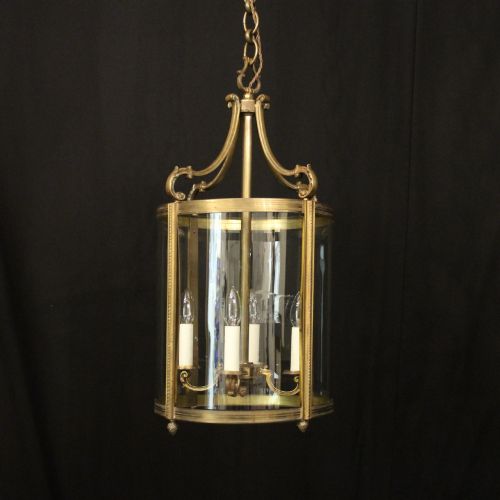
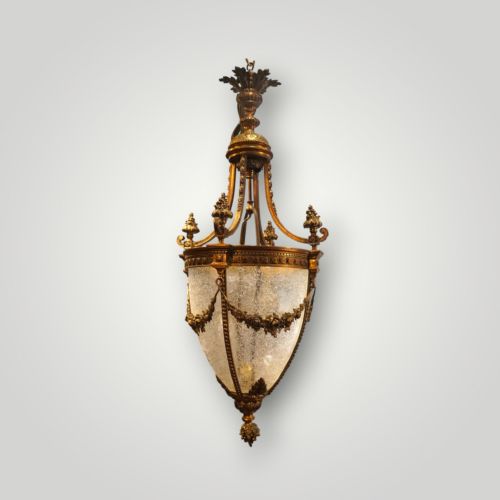
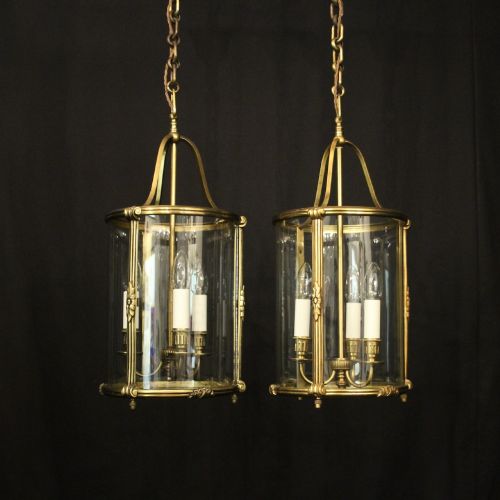
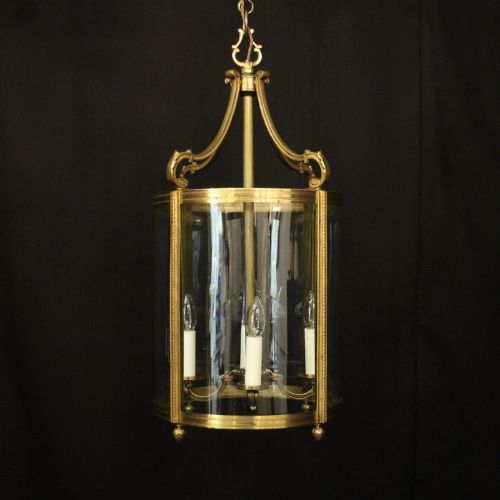


Louis XVI Hall Lantern
A louis xvi hall lantern brings neoclassical symmetry and warm hanging light to an entrance hall.
Louis XVI Hall Lantern
A louis xvi hall lantern draws on French neoclassical design to frame an interior entrance with balanced proportion and restrained ornament. These hanging ceiling lights serve as primary architectural fixtures designed to illuminate vestibules, corridors and stairwells.
The pieces appearing here span the nineteenth century, the Edwardian era and the nineteen-twenties, reflecting sustained revival periods in French chateau style. Visitors encounter single pendants, hexagonal frames and convex glazed lanterns executed in the manner of Versailles.
Most examples adopt French Louis XVI style through cast metal mounts, glazed panels and multi-light configurations suspended from chains. They combine decorative metalwork with functional glass enclosures to distribute light evenly across high-ceilinged spaces.
Materials and construction
Foundry work relies on cast bronze, brass and ormolu to form the structural frames and decorative mounts of each louis xvi hall lantern. Metal components frequently receive a gilt finish to produce a rich metallic sheen characteristic of French period lighting.
Glazing employs clear, frosted or etched glass panels held securely within the metal armature by traditional framing techniques. Panels occasionally feature convex curving to soften the internal light and amplify the visual presence of the fixture.
Listings for a louis xvi hall lantern span the nineteenth century, Edwardian period and nineteen-twenties, using gilt bronze, brass and glass.
Distinguishing quality
Superior examples of a louis xvi hall lantern display crispness in the metal castings and refinement in the decorative mounts. Finer pieces maintain substantial weight through thick bronze or brass construction rather than lighter stamped sheet metal.
The integration of glass panels and the precision of the frame joints distinguish workshop standards. Higher-grade fixtures show careful attention to internal candle clusters or lamp holders and harmonious proportions across hexagonal or convex profiles.
The Louis XVI Hall Lantern Glossary
- Ormolu
- Gilded bronze produced through mercury amalgamation or modern electroplating methods. This surface treatment gives period metalwork its characteristic warm golden lustre.
- Convex glass
- Curved glass panes that project outward from the lantern frame. This shaping widens the light spread and creates optical distortion of the interior fittings.
- Neoclassical
- An artistic movement reviving classical Greek and Roman motifs during the eighteenth century and subsequent revival periods. It prioritises straight lines, symmetry and restrained classical ornament.
- Pendant lantern
- A hanging lighting fixture suspended from the ceiling by a rod or chain. These fixtures project illumination downward into hallways and entry spaces.
Louis XVI Hall Lantern: Frequently Asked Questions
How do I hang a louis xvi hall lantern?
These fixtures suspend from ceilings using integrated chains or rods connected to a matching canopy. Installation requires secure anchorage into ceiling joists to support the weight of the metal and glass.
Positioning typically centres the lantern within an entrance hall or above a staircase landing to ensure adequate clearance and balanced illumination.
What is the difference between brass and bronze frames?
Bronze is an alloy of copper and tin offering greater density and strength, whereas brass combines copper and zinc. Both metals take gilding well, but bronze castings generally allow for sharper decorative detail in period mounts.
Visual distinction often relies on surface finishing, as both materials frequently receive a gilt layer that unifies their appearance.
Are these lanterns wired for modern electricity?
Most surviving examples have been adapted for electrical use with internal lamp holders fitted inside the glass cage. Multi-light versions accommodate several bulbs to provide sufficient brightness for modern interiors.
Rewiring can be updated by a qualified electrician to meet current safety standards while preserving the historic frame and suspension.
How do I clean the glass panels?
Maintenance involves removing dust with a soft cloth and washing glass panels with a mild detergent solution. Care must be taken around gilt bronze or brass surfaces to avoid stripping the metallic finish.
Panels that slide or unclip from the frame simplify thorough cleaning of both interior and exterior glass surfaces.