



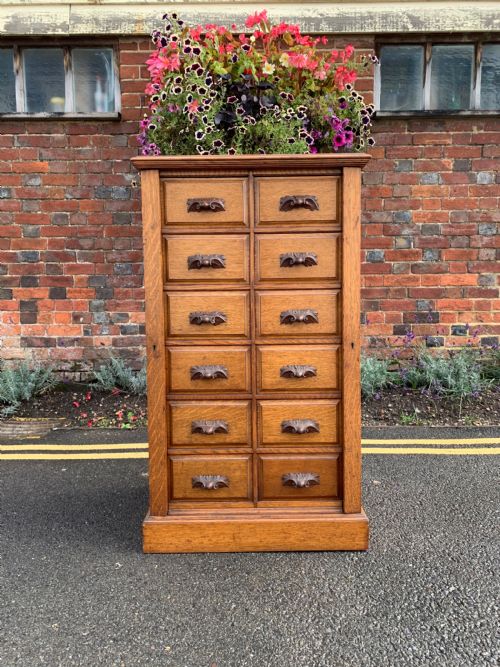

Locking Flap Chest
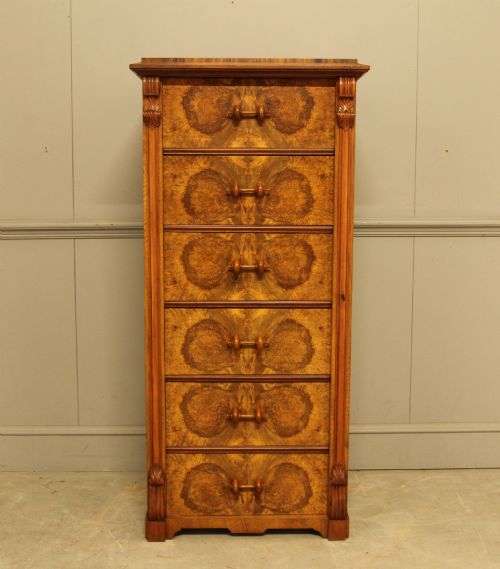
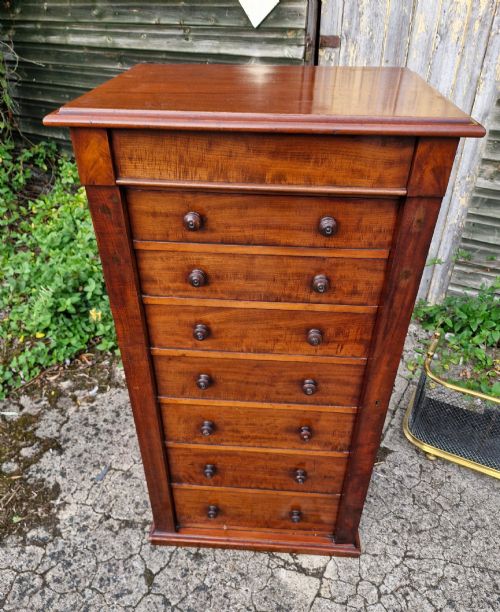
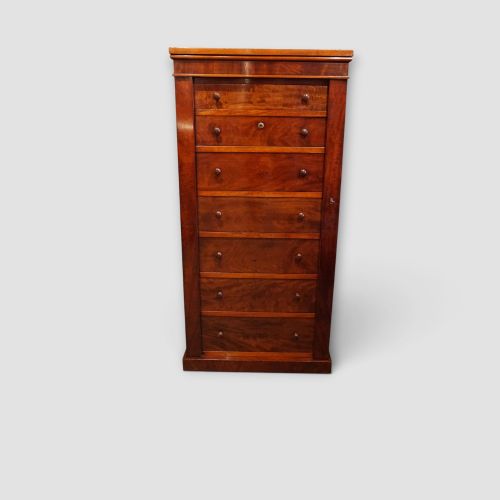
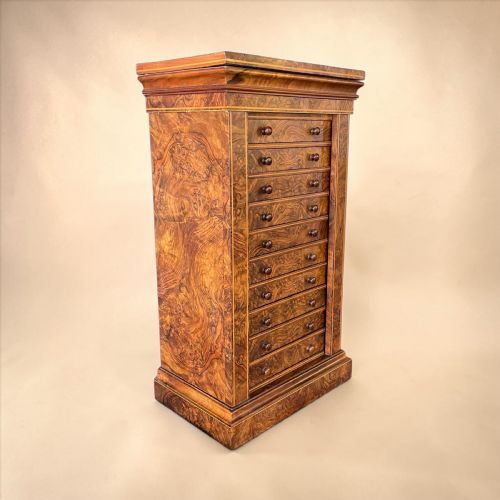
A locking flap chest is a tall, narrow set of drawers secured by a hinged side locking stile.
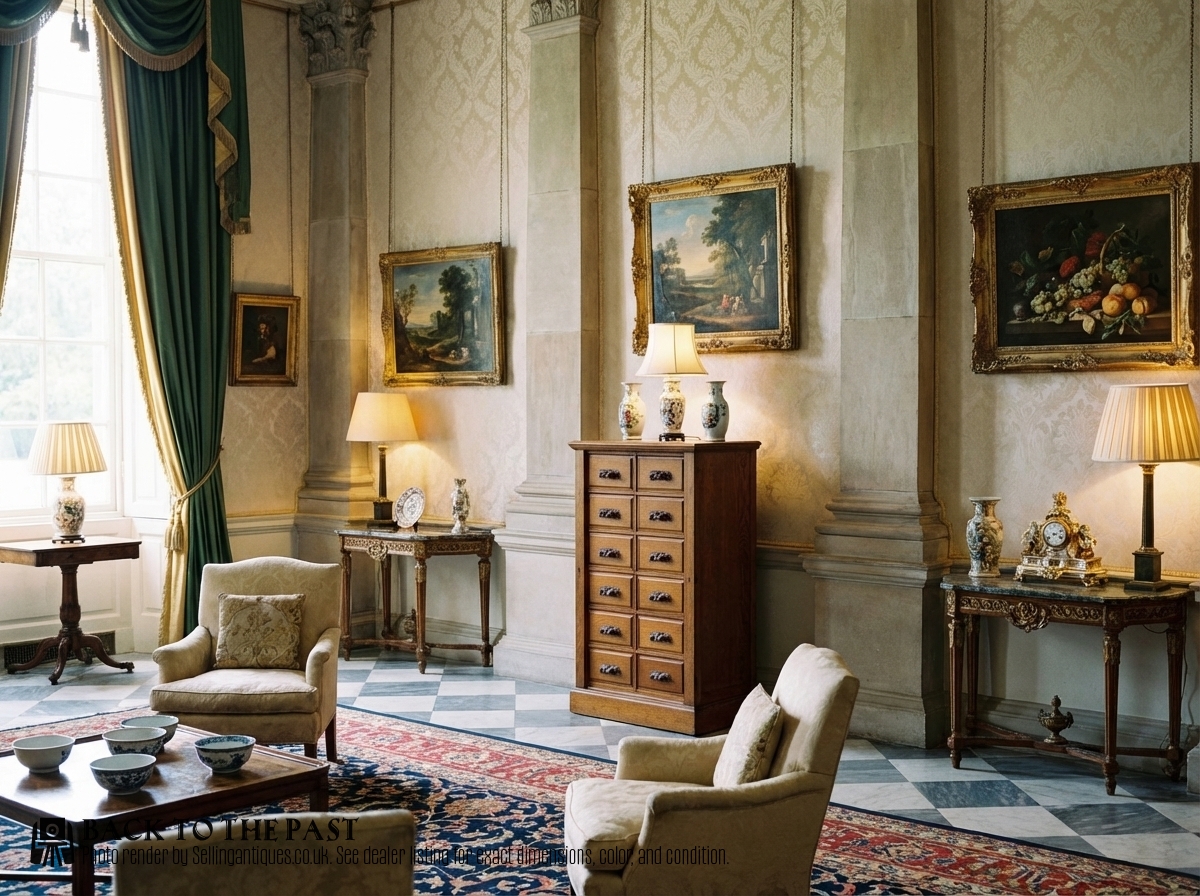
Locking Flap Chest
A locking flap chest stands as a tall, narrow case piece designed primarily for domestic use. The version most commonly met on this page is the Victorian mahogany or walnut Wellington chest, often featuring a vertical locking flap that secures all drawers simultaneously. These items provide compact vertical storage without taking up significant floor space in a room.
The periods represented stretch from the Regency era through the nineteenth century into the early twentieth century. Forms range from standard multi-drawer chests of drawers to secretaire variations incorporating a hinged fall front. Oak also appears occasionally alongside the more prevalent mahogany and walnut timbers.
How they were made
Makers utilised dense timbers such as mahogany, walnut, and rosewood for the primary carcases and drawer fronts. Flame mahogany veneer and burr walnut veneer frequently appear on the exterior surfaces to provide striking grain patterns.
Brass fittings such as escutcheons, handles, and the internal locking mechanisms provide the functional metalwork. The hinged flap relies on robust hinges fixed to the side stile to engage with the drawer edges when locked.
Locking Flap Chest Retail Price Guide 2026
Typical asking prices for locking flap chest among the pieces listed under this phrase on Sellingantiques today, from the lower quarter to the upper quarter. They describe what is for sale here now, not the wider market.
Listings span the Regency, Victorian, and early twentieth-century periods, utilising mahogany, walnut, rosewood, oak, and brass.
What varies in quality
The choice of surface veneer determines much of the visual appeal, with richly figured flame mahogany and burr walnut sitting at the upper end of the scale. Plain timber finishes and simpler secondary woods represent the more utilitarian examples.
The precision of the locking mechanism and the integrity of the hinged flap separate standard pieces from finer examples. Smooth operation of the side stile and the accompanying key-operated lock indicates superior cabinet work.
Druce & Co.
The Locking Flap Chest Glossary
- Wellington chest
- A tall, narrow chest of drawers secured by a hinged vertical locking bar on one side. This bar is typically held in place by a working lock.
- Secretaire
- A desk disguised as a chest of drawers, featuring a hinged fall front that pulls down to reveal a writing surface and small compartments. It combines storage with a compact workspace.
- Veneer
- A thin layer of figured wood applied over a secondary timber base to create a decorative surface. Flame mahogany and burr walnut are common examples.
- Escutcheon
- A protective metal plate surrounding a keyhole. It is usually made of brass on these pieces.
Locking Flap Chest: Frequently Asked Questions
What is a locking flap chest?
A locking flap chest is a tall, narrow chest of drawers featuring a hinged vertical locking stile on one side. Turning the key secures the bar over the drawer edges, locking all drawers at once.
These pieces were originally designed for compact spaces and secure storage of private papers or valuables in nineteenth-century bedrooms and studies.
How do you use a Wellington chest?
To open the chest, you unlock and swing the vertical side flap outward or remove it entirely depending on the design. This action releases the drawers so they can be pulled open normally.
When closed, the flap covers the drawer edges and locks back into the carcase frame to keep the contents secure.
How do I date a locking flap chest?
Dating relies on observing the timber choices, construction methods, and overall stylistic details. Mahogany and rosewood frequently point to earlier nineteenth-century periods, while walnut and oak variations span across the Victorian era.
Secondary woods inside the drawer construction and the style of the brass hardware also provide clues to the decade of manufacture.
Are these chests suitable for small rooms?
Their tall and narrow proportions make these chests exceptionally practical for rooms with limited floor space. They offer substantial drawer storage vertically rather than horizontally.
Placing one in a hallway, bedroom, or study provides useful surface area on top and deep drawers below without crowding the interior.