

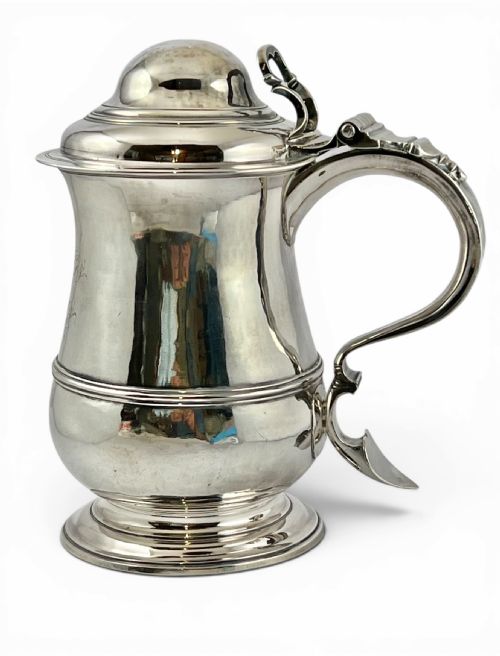


Lidded Silver Beer Mug
A lidded silver beer mug brings seventeenth-century weight and Georgian proportion straight to the modern sideboard.
Lidded Silver Beer Mug
A lidded silver beer mug takes the form of a sturdy drinking vessel fitted with a hinged lid to keep the ale clean and cool. When you search for a lidded silver beer mug, you encounter solid sterling items alongside silver-plated and Old Sheffield plate examples.
The pieces appearing on this page span several centuries, reaching from the reign of Charles II through the Georgian era and into the Victorian period and later twentieth-century work. Tankards and drinkware dominate these listings, offering both pint and quart capacities for daily use or display.
Sterling silver versions sit alongside glass-bottom vessels and silver-mounted glass bodies, reflecting shifts in tavern and household habits. You will find plain cylindrical forms and revival styles such as Queen Anne, each showing the characteristic scroll handle and thumbpiece.
Judging quality and character
Quality rests in the crispness of the maker marks, the weight of the metal, and the smooth action of the hinged lid. A well-balanced piece maintains its proportion from the stepped base to the flat or domed top without leaning or rocking.
The handling of the scroll handle and the tightness of the lid closure separate standard production from superior silversmithing. Wear on Old Sheffield plate reveals the underlying copper in varying degrees, which alters the visual harmony of the surface.
A glass bottom let eighteenth-century drinkers keep an eye on incoming press gangs while finishing their ale.
John Payne·Watts & Harton
The Lidded Silver Beer Mug Glossary
- Tankard
- A tall, cylindrical drinking vessel with a single handle and a hinged lid. These pieces formed the backbone of domestic and tavern drinkware from the seventeenth century onward.
- Old Sheffield Plate
- A material created by fusing a sheet of silver to a copper ingot and rolling them together. This technique preceded electroplating and produced durable wares with a warm tone.
- Thumbpiece
- The small lever attached to the lid near the handle, pressed by the thumb to open the vessel. It serves both a mechanical function and a decorative purpose.
- Sterling Silver
- An alloy consisting of pure silver and other metals, usually copper, to increase durability. British standards require a specific purity denoted by traditional hallmarks.
- Electroplated Nickel Silver
- A base metal alloy coated with a thin layer of pure silver using an electrical current. This method became common in the nineteenth century for producing affordable tableware.
Lidded Silver Beer Mug: Frequently Asked Questions
How do I clean a silver tankard?
Use a soft cloth and a gentle silver polish designed for antique metals, avoiding harsh dips that strip the patina. Rinse thoroughly in warm water and dry immediately with a lint-free cloth.
Take care around engraved crests and maker marks to prevent wearing away the details. Regular dusting keeps tarnishing at bay without needing frequent heavy cleaning.
Are these tankards safe for drinking beer?
Solid sterling silver and glass-bottom pieces remain suitable for holding cold beverages. Ensure the interior is clean and free from old residues before use.
Silver-plated items require caution if the base metal shows through the plating. Modern users generally reserve these historic vessels for occasional toasts rather than daily pints.
How can I date an antique silver tankard?
Examine the stamped hallmarks on the body and lid, which record the assay office, the maker, and the exact year of production. British silver used standard date letters that change annually.
Stylistic clues such as flat-topped Charles II lids versus domed George III profiles also help narrow down the period of manufacture when marks are rubbed.