




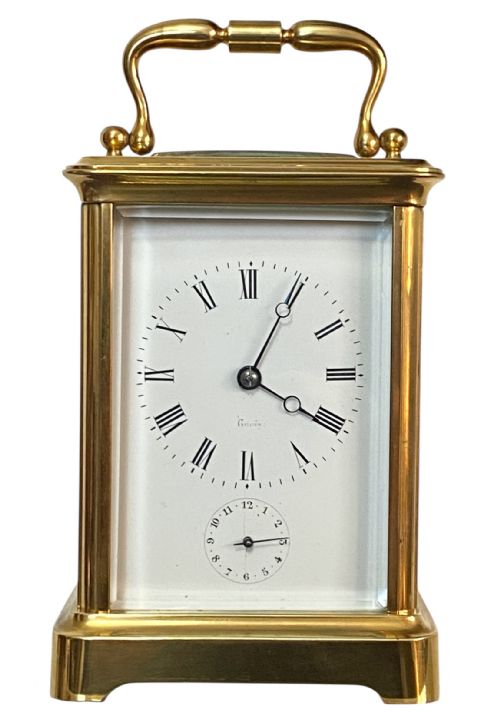

Leather Case Carriage Clock
These leather case carriage clock examples are portable timepieces housed in protective outer boxes, prized for their mechanical ingenuity and travel readiness.
Leather Case Carriage Clock
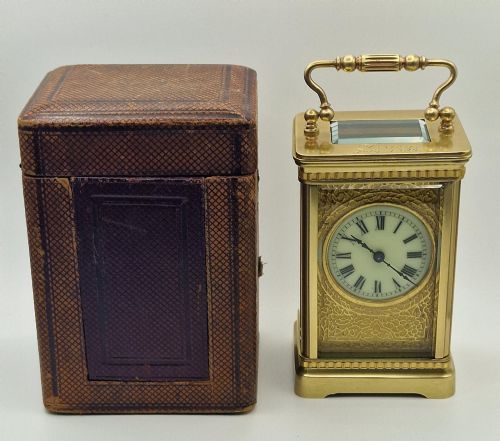
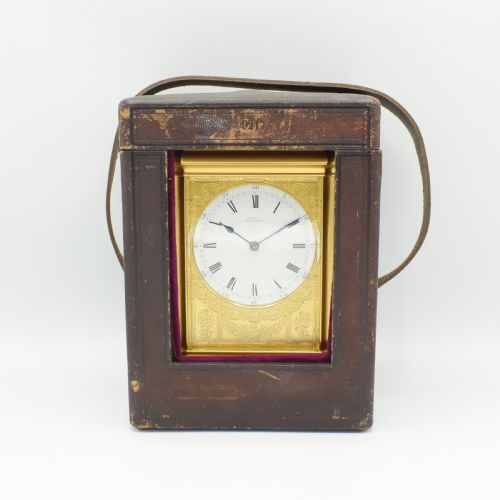
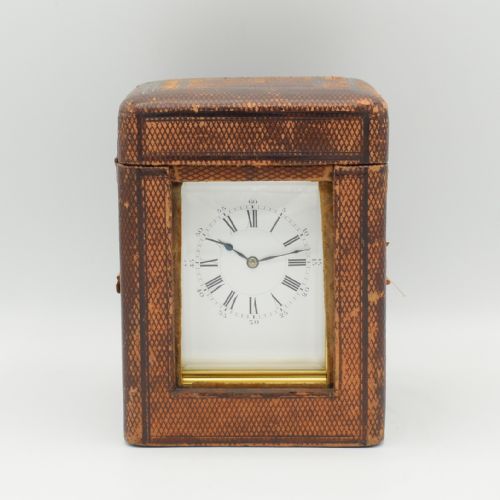
A leather case carriage clock is a portable timepiece designed for travel, typically featuring a sturdy metal housing protected by an outer leather box or travelling case. These objects date across the nineteenth and early twentieth centuries, spanning Victorian, Edwardian, and French nineteenth-century periods.
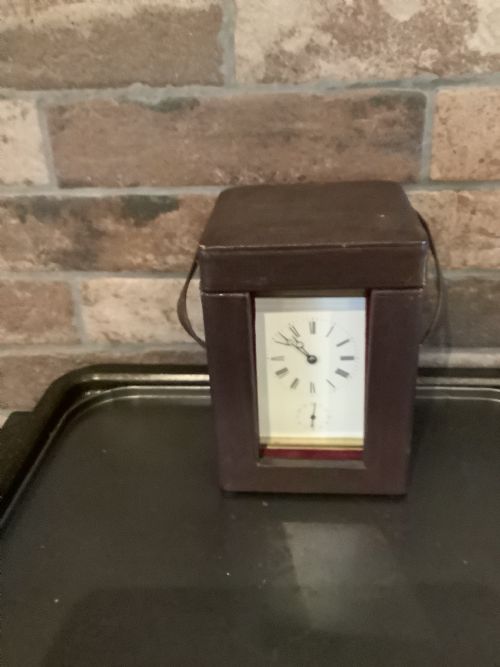
The versions most commonly met on this page include brass or gilt brass frameworks set with glass panels, frequently accompanied by original fitted leather travel cases. Forms range from standard desk clocks to miniature boudoir timepieces and repeating alarm variations.
Materials and construction
The physical build relies heavily on brass, gilt brass, and glass, combined with leather for the protective travel cases and sometimes sterling silver or guilloche enamel for decorative elements. Enamel is utilised for dials, often paired with engraved brass masks.
Movements span eight-day durations, with some examples incorporating striking mechanisms, alarms, or grand sonnerie complications. Cases are constructed to enclose these complex gear trains securely while permitting visibility of the escapement through glass panels.
Listings feature 19th-century, Victorian, Edwardian, and 1910 periods, utilising brass, glass, leather, and enamel materials.
Distinctions in quality
Quality rests in the precision of the movement, the complexity of complications such as repeating mechanisms or alarms, and the degree of hand-engraving on the brass case and dial mask. The presence of an original matching leather travel case or box elevates the completeness of the piece.
Henri Jacot·Hunt & Roskell·Alfred Hollinge·Dent
The Leather Case Carriage Clock Glossary
- Carriage clock
- A portable spring-driven timepiece originally designed for travellers during the nineteenth century. They usually feature a rectangular brass case with glass panels to view the movement.
- Gorge case
- A specific nineteenth-century brass case style characterised by a stepped cornice and base with a distinct reeded handle. It provides a robust architectural housing for the clock movement.
- Grand sonnerie
- A striking mechanism that sounds both the hours and the quarters automatically on every quarter hour. It represents a higher tier of horological complexity in portable clocks.
- Guilloche enamel
- Decorative metalwork covered in translucent enamel over an engine-turned geometric pattern. It appears on select dials and boudoir timepieces from the Edwardian era.
- Repeating alarm
- A complication that repeats the last hour struck or sounds an alarm at a set time when activated by a button. This function required intricate additional wheel trains within the case.
Leather Case Carriage Clock: Frequently Asked Questions
What is a carriage clock?
A carriage clock is a small, spring-driven mechanical clock built for portability during travel. They typically feature a glass-panelled metal case and a folding handle on top.
Originally developed in the nineteenth century, these timepieces allowed travellers to keep accurate time away from home before the widespread use of pocket watches.
How do you wind a carriage clock?
Winding requires a dedicated key inserted into the winding arbors located on the backplate of the movement. Care must be taken not to overwind the mainspring.
Most surviving examples run for eight days on a full wind, requiring attention roughly once a week to maintain accurate timekeeping.
Why did they have leather cases?
Leather travel cases and outer boxes protected the delicate brass frames and glass panels from knocks and dust during transit. These fitted containers were essential for nineteenth-century journeys.
Finding a clock with its original leather case significantly adds to the historical completeness and original condition of the object.
How can you tell the period?
Dating relies on stylistic clues, case design evolution, dial ornamentation, and maker signatures recorded on the movement backplate. Victorian and Edwardian examples often display distinct aesthetic preferences.
Engraving styles and the presence of specific complications like alarms or grand sonnerie movements also help narrow down the decade of manufacture.