


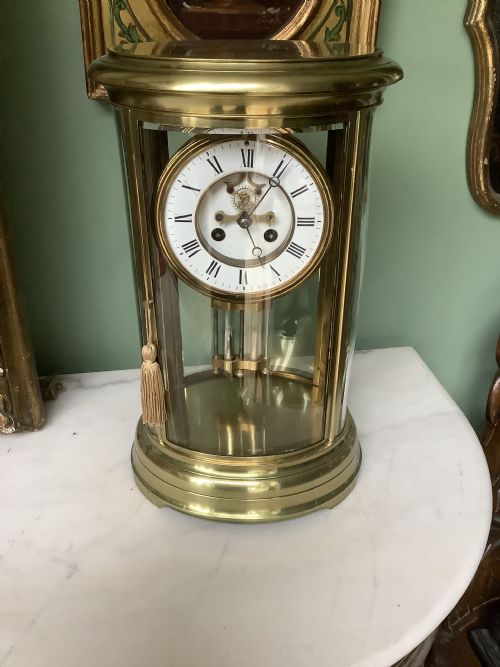


French Oval Carriage Clock
A french oval carriage clock is a portable timepiece housed in a curved brass case designed for travel during the nineteenth and early twentieth centuries.
French Oval Carriage Clock
A french oval carriage clock brings together polished brass framing and bevelled glass panels to reveal the movement within. These items span periods from the nineteenth century through the Edwardian era, encompassing styles such as Victorian and the French Belle Epoque.
Collectors frequently encounter striking and repeating mechanisms alongside simpler timepieces. The forms range from miniature examples to large four glass mantel clocks and elliptical dial designs.
Makers such as Drocourt, AD Mougin and Richard & Co Paris appear in the records, marking pieces produced during the height of French horological craftsmanship. The curved cases distinguish these items from standard rectangular carriage clocks.
Materials and Construction
Makers utilised heavy brass for the structural frames, often applying gilt finishes to enhance the exterior appearance. Enamel dials provide the face for numerals, while leather outer cases frequently accompanied these portable items to protect them during transit.
Bevelled glass panels fit tightly into the curved brass apertures, allowing light to pass through the movement. Precision gear trains and escapements were housed within these compact dimensions, requiring skilled metalwork and assembly.
Some miniature models were made small enough to slip into a pocket for a bumpy carriage ride.
Quality and Craftsmanship
The sophistication of the movement dictates the standing of an example, with striking, repeating and alarm complications sitting above basic timepieces. Engraved detail upon the brass case and superior enamel work on the dial elevate an item.
Proportion and weight also matter, as sturdier brass castings and thick bevelled glass indicate higher manufacturing standards. Pieces bearing the marks of known makers demonstrate documented skill that separates standard production from finer output.
Drocourt·AD Mougin·Richard & Co Paris
The French Oval Carriage Clock Glossary
- Carriage clock
- A portable spring-driven timepiece originally designed for travellers in the nineteenth century. These clocks usually feature a handle on top and glass panels on all sides.
- Repeater
- A mechanism that chimes the hours and quarters upon demand when a lever or button is pressed. This complication required intricate additional gear work within the movement.
- Striking clock
- A timepiece that sounds the hours and sometimes halves automatically on a bell or gong. The countwheel or rack system governs the number of strikes delivered.
- Four glass clock
- A style featuring glass panels on the front, back and both sides to showcase the entire movement. These are often slightly larger in scale than standard travelling designs.
- Enamel dial
- A metal face coated with fused glass powder and fired to create a smooth white surface. Numerals are painted onto this durable ground.
French Oval Carriage Clock: Frequently Asked Questions
How do I wind a carriage clock?
Wind the mainspring using a matching key inserted into the arbours on the back plate. Turn the key gently until resistance indicates the spring is fully tensioned.
Avoid over-winding, as this strains the internal components and can prevent proper operation.
Where should I place a carriage clock?
Position the clock on a stable, level surface away from direct sunlight, draughts and moisture. Mantelpieces and side tables allow the movement to beat evenly without disturbance.
Ensure the location is secure so the heavy brass case is not accidentally knocked.
What is the difference between a timepiece and a striker?
A timepiece simply tells the time without sounding any chimes or hours. A striking clock includes an extra train of gears to sound the hours automatically.
Some models also incorporate alarm functions for waking travellers on journeys.
How are different periods identified?
Nineteenth-century examples often feature heavier cast brass frames and hand-painted enamel dials. Edwardian and later pieces may show refinements in miniature sizing and cleaner dial layouts.
Maker signatures and style descriptors in the metalwork provide further clues to dating.