


Large Oushak Floor Rug
A large oushak floor rug anchors a room with muted palette and generous scale, bringing historic Turkish artistry directly beneath your feet.
Large Oushak Floor Rug
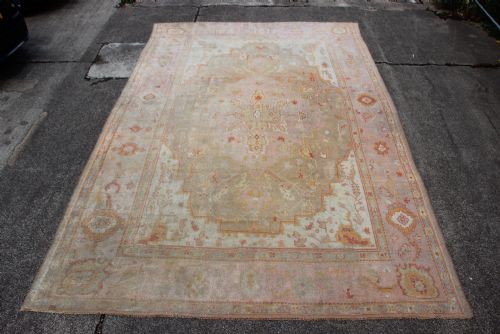
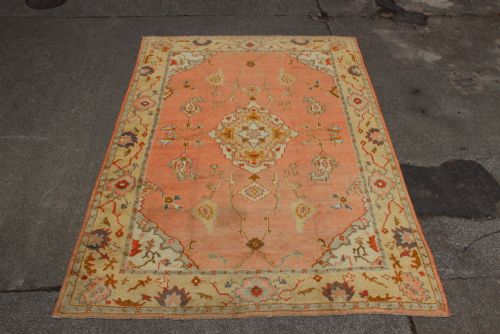
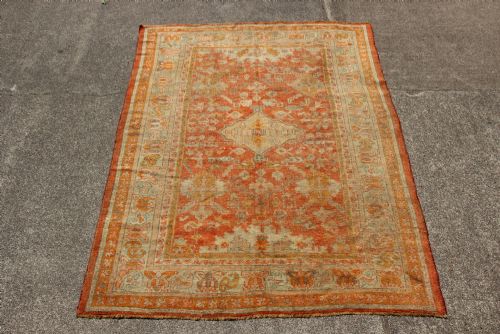
A large oushak floor rug is a substantial woven carpet originating from Western Turkey, often spanning room-sized proportions with grand decorative presence. When exploring this selection, buyers encounter pieces primarily dating from the late nineteenth century up to the early twentieth century.
These carpets typically display expansive fields with medallion patterns, pale grounds, or botanical motifs such as willow trees. The aesthetic leans toward soft, faded tones rather than rigid geometric symmetry, making them enduringly popular for historic and contemporary interiors alike.
How they were made
These floor coverings rely on natural wool woven onto cotton foundations, utilising hand-spun materials that absorb vegetable dyes with subtle variation. Certain examples incorporate angora wool, which imparts a distinct lustre and softer pile to the finished surface.
Weavers in Western Turkey knotted these large formats by hand, following traditional Ottoman and Anatolian designs that evolved over generations. The density of the weave and the quality of the wool determine how gracefully the pile wears over decades of use.
Listings feature pieces dated across the nineteenth century and early twentieth century, predominantly utilising wool and cotton materials.
What varies in quality
The distinction between tiers rests upon the fineness of the knotting and the complexity of the surviving pile across extensive room-sized formats. Pieces retaining their original wool structure without heavy restoration command greater attention from discerning collectors.
Coloration and ground rarity also dictate desirability, particularly when specific examples display uncommon pink or green fields rather than standard ivory or pale tones. The integrity of the foundational cotton warp andweft further determines the structural longevity of each carpet.
Maples
The Large Oushak Floor Rug Glossary
- Oushak
- A traditional carpet type originating from the town of Ushak in Western Turkey, known for large-scale floral motifs and soft, muted palettes.
- Angora wool
- A fine, silky yarn derived from angora goats, utilised in select antique rugs to impart a distinctive sheen and softer texture.
- Medallion
- A central ornamental design motif placed in the field of a carpet, drawing the eye toward the geometric centre of the weave.
- Ground
- The main background area of a carpet surrounding the central medallion and border decorations.
- Anatolian
- Pertaining to the historic region of Anatolia, encompassing the Asian portion of Turkey where traditional rug weaving flourished.
Large Oushak Floor Rug: Frequently Asked Questions
How do I style a large oushak floor rug?
These generous carpets work effectively when placed centrally in a reception room or beneath a dining table, allowing the muted field and borders to remain visible.
Their subdued palette complements both traditional period furniture and clean modern interiors without overwhelming the surrounding floor space.
What periods do these rugs come from?
The available examples span the late nineteenth century and the early twentieth century, specifically covering periods from eighteen-seventy to nineteen-twenty.
This era represents a prolific time for traditional Turkish weaving before industrial methods altered standard production techniques.
Are these rugs made from pure wool?
Most pieces combine a wool pile with a cotton foundation, ensuring both surface softness and structural stability across large dimensions.
Certain specialised examples incorporate angora wool, which introduces an increased softness and visual depth to the pile.
How do I identify a genuine Oushak carpet?
Genuine examples typically display characteristic Ottoman or Anatolian floral motifs executed in softer, faded vegetable dye tones rather than stark synthetic colours.
Examining the hand-knotted wool pile and the construction of the cotton backing reveals the traditional origins associated with Western Turkey.