
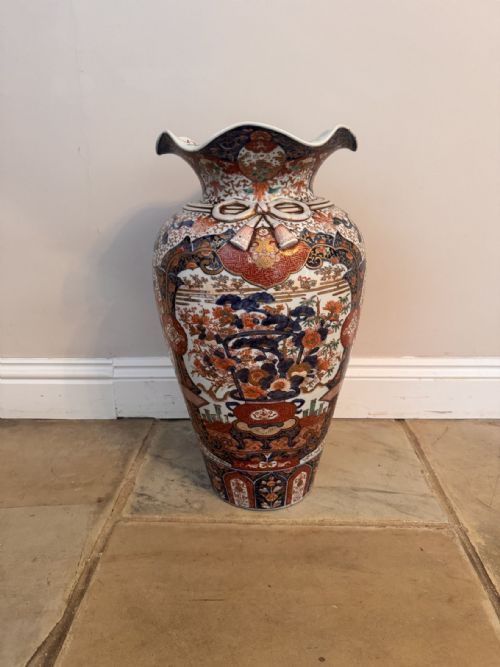
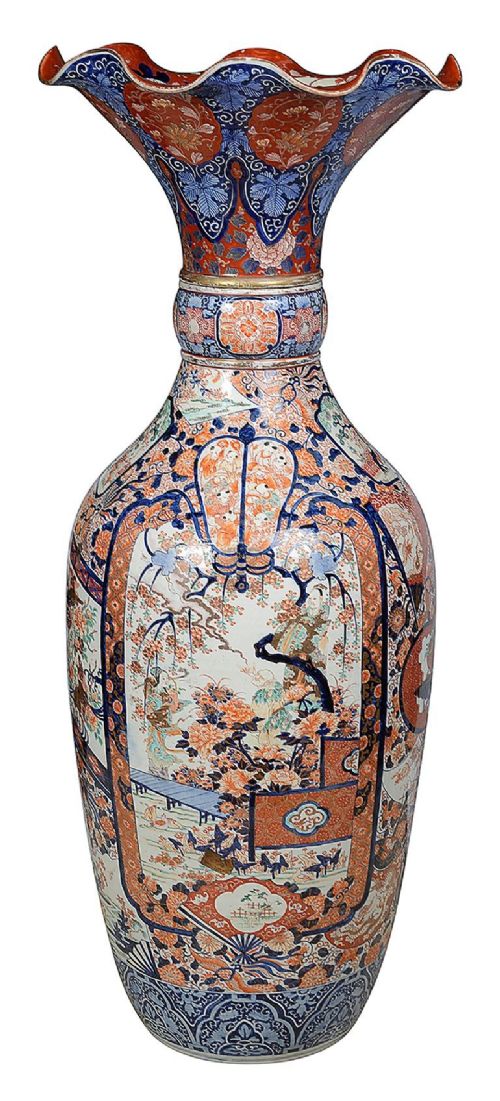


Large Imari Jar
A large imari jar brings bold palettes and commanding scale to a room, drawing the eye with rich hand-painted iron-red and cobalt details.
Large Imari Jar
A large imari jar encompasses substantial ceramic vessels created in Japanese traditions, often recorded across the Edo and Meiji periods alongside later nineteenth-century interpretations. These forms include lidded ginger jars, floor-standing vases, and substantial jardinières designed to serve as dominant decorative focal points.
The pieces appearing on this page span several centuries, with nineteenth-century production heavily represented alongside eighteenth-century works and European revival pieces made in the Japanese style. Buyers frequently encounter robust lidded vases and covered vessels displaying classic panelled decoration and symmetrical floral motifs.
Origins vary from traditional kilns in Japan to European houses producing sympathetic interpretations during the nineteenth century. Forms range from utilitarian storage shapes adapted for display to monumental floor vases standing well over a metre in height.
Materials and construction methods
These vessels utilise hard-paste porcelain and ceramic bodies formed by throwing or moulding before high-temperature firing. Artisans then applied underglaze cobalt blue pigments alongside overglaze enamels in iron red, often supplemented with gold leaf, gilt, or fine gilding.
Mountings and additions occasionally incorporate brass or ormolu fittings, particularly on pieces adapted in Europe during the nineteenth century. The integration of metallic mounts transforms standard display jars into elaborate garniture pieces or structural lamp bases.
Object types span lidded vases, floor vases, ginger jars, jardinières, and table lamps.
Quality variations across the range
Quality rests upon the crispness of the underglaze cobalt painting and the precision of the overglaze enamelling. Superior examples display dense, meticulously rendered floral and geometric panels where iron red and gilt accents remain crisp and unrubbed.
The structural integrity of the ceramic body and the presence of original matching covers elevate a piece considerably. Finer jars exhibit balanced proportions and clean potting, whereas lesser examples show heavier, coarser forms with less refined enamel work.
Arita potteries·Samson
The Large Imari Jar Glossary
- Imari
- A style of Japanese porcelain decorated in underglaze blue, iron red, and gilt. This palette originated in Arita and became widely exported through the port of Imari during the Edo period.
- Meiji Period
- The era in Japanese history spanning from 1868 to 1912. Pieces from this time often display ambitious scale and intricate decorative programmes intended for Western export markets.
- Ginger Jar
- A broad-shouldered ceramic storage vessel featuring a removable lid. Originally used for spices and preserves, these forms became prized purely for decorative display in European interiors.
- Koro
- A traditional Japanese incense burner supported on legs and fitted with a pierced cover. These vessels appear frequently among larger lidded jar forms.
- Gilding
- The application of gold leaf or powdered gold to ceramic surfaces. This technique highlights specific patterns within the wider enamel design.
Large Imari Jar: Frequently Asked Questions
What is an imari jar?
An imari jar is a ceramic vessel decorated in a distinctive palette combining underglaze cobalt blue with iron red and gilt highlights.
These pieces were produced primarily in Japan for both domestic use and export, featuring prominently in European interiors since the seventeenth century.
How do I date a large imari jar?
Dating relies upon examining the clay body, the tone of the underglaze blue, and the style of the overglaze enamels. Eighteenth-century pieces typically show softer potting and deeper cobalt tones.
Nineteenth-century Meiji period examples often display brighter gilding, denser patterns, and occasionally greater physical scale.
Were these jars made with lids?
Many large jars and ginger jars were originally manufactured with matching fitted lids to preserve contents or complete the symmetrical silhouette. Lids often suffered damage over time, making surviving original covers particularly desirable.
Some surviving vessels were produced without lids as open vases, jardinières, or spill vases.
How do I display a large jar at home?
Large jars command attention when placed on heavy wooden furniture, low tables, or directly on the floor as architectural accents. Their strong colour palette pairs well with neutral backgrounds that allow the red and blue pigments to stand out.
Care should be taken to place them on stable, level surfaces away from heavy foot traffic due to their substantial weight and ceramic composition.