
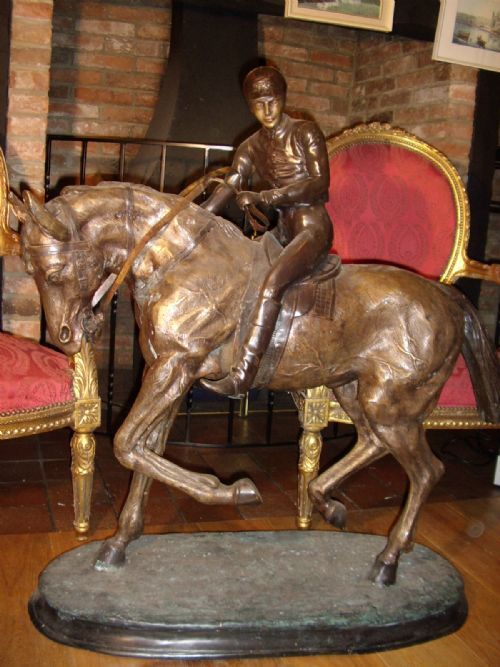


Large Equestrian Statues
Large equestrian statues capture the power and majesty of horses and riders, offering an impressive centrepiece for any serious collector of antique sculpture.
Large Equestrian Statues
Large equestrian statues represent horse and rider combinations or standalone horses rendered in substantial dimensions, spanning subjects from racehorses and jockeys to cowboys, historical figures, and mythical beasts. When searching for large equestrian statues, buyers encounter forms rooted in traditions such as French Animalier, Western American, and Chinese Asian Art, alongside academic realism.
The pieces available on this page originate from periods ranging across the nineteenth and twentieth centuries, including works dated to the 1870s, 1880s, 1900, 1920, 1930, 1940, and 1950. Object descriptions commonly classify these works as sculptures, statues, or decorative sculptures.
Makers and inspirations recorded in the evidence include Pierre Jules Mene, Franz Bergman, Liberty & Co, Bugatti style, and Coustou, reflecting diverse international origins from France, Austria, Britain, China, Japan, and Africa.
Materials and construction methods
Metal is the predominant medium for these works, with bronze forming the vast majority of the pieces alongside brass and general metal work. Many of these bronze sculptures incorporate bases made of marble, providing a heavy foundation that anchors the composition.
Alternative materials appear in the form of leather and wood, utilised in specialised models such as stamped Liberty & Co creations and arts and crafts figures. Construction techniques range from traditional lost-wax casting for bronzes to layered leather over supportive internal structures for taxidermy-style or sculpted animal models.
Listings feature periods spanning from the 1870s through the 1950s, utilising materials such as bronze, marble, brass, leather, and wood.
Assessing quality in equestrian sculpture
Quality in large equestrian statues rests upon the fidelity of the casting and the precision of the anatomical detail in both the horse and the rider. Finer pieces demonstrate careful attention to muscular tension, movement, and facial expression, whether depicting a bucking bronco, a racehorse, or a historical commander.
The integration of the sculpture with its base represents another indicator of distinction, particularly where substantial marble bases are employed to support heavy metal figures. Furthermore, the presence of clear maker stamps, signatures, or historical attributions elevates the standing of an individual piece.
Pierre Jules Mene·Franz Bergman·Liberty and Co
The Large Equestrian Statues Glossary
- Animalier
- A nineteenth-century art movement focused on the realistic depiction of animals, often dynamic scenes of horses in motion or interacting with handlers.
- Lost-wax casting
- A metalworking method in which a molten metal is poured into a mould that has been created by means of a wax model, allowing for intricate surface detail.
- Vienna bronze
- Small or medium-sized cold-painted bronze sculptures produced in Austrian workshops during the late nineteenth and early twentieth centuries, known for vibrant polychrome finishes.
- Marly horses
- Iconic monumental marble or bronze sculptural groups depicting restrained horses and their handlers, originating from the works of Guillaume Coustou for the Château de Marly.
- Patina
- The chemical or natural surface coloration that develops on bronze and other metals over time, influencing the visual depth and perceived age of the sculpture.
Large Equestrian Statues: Frequently Asked Questions
Where should I display a large equestrian statue?
These substantial works demand a prominent location where their scale and weight can be safely accommodated, such as a sturdy entryway table, a dedicated pedestal, or a spacious study. Because materials like bronze and marble add significant heft, ensure the supporting furniture is structurally sound.
Positioning the piece away from direct sunlight and high-moisture areas helps protect both metallic patinas and combined elements like leather or wooden components.
How do I identify the period of a bronze horse?
Dating relies on examining the casting technique, the style of the base, and any visible signatures or stamps associated with known foundries and makers from the nineteenth and twentieth centuries. Stylistic indicators, such as Art Deco streamlining or nineteenth-century academic realism, provide further chronological clues.
Comparing the finishing work and the nature of the patina against documented examples from specific decades helps narrow down the probable era of creation.
What is the difference between western and animalier bronzes?
Western American pieces typically focus on frontier subjects like cowboys on bucking horses, reflecting a specific regional narrative and costume. French Animalier works concentrate more broadly on the naturalistic study of animals, capturing horses in action, racing, or alongside jockeys.
Both styles utilise bronze casting techniques, but their cultural contexts and sculptural compositions diverge significantly.
How do I care for antique bronze and leather models?
Bronze sculptures generally require only gentle dusting with a soft, dry cloth to prevent the accumulation of grit in intricate crevices. Avoid harsh chemical cleaners that can strip or alter the historical patina.
Leather models benefit from occasional specialised conditioning to keep the material supple, while keeping them away from extreme temperature fluctuations.