


Large Ceramic Display Bowl
A large ceramic display bowl brings scale and history to a room, offering a commanding focal point crafted centuries ago for display or dining.
Large Ceramic Display Bowl
When searching for a large ceramic display bowl, buyers encounter substantial vessels created for presentation, celebration, or household service across multiple centuries. These pieces span Chinese export wares, Japanese Imari, Dutch Delft, and English creamware, reflecting global exchange and domestic production.
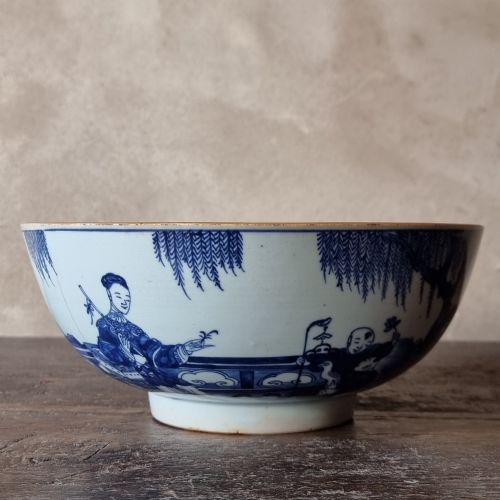
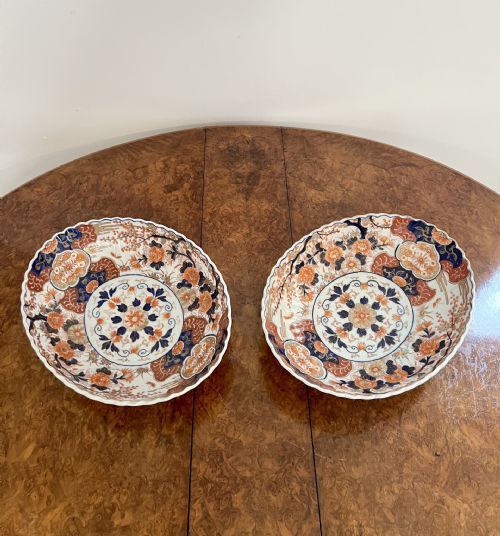
The selection on this page most frequently presents Chinese porcelain punch bowls from the eighteenth century alongside Japanese Imari wares from the Meiji period and early twentieth century. Bowls with scalloped edges, conical forms, and shallow profiles appear alongside deep centre vessels and chargers.
Origins range from the seventeenth century through to the Edwardian era and the nineteen-thirties, showing how potters across Asia and Europe handled heavy clay bodies and wide diameters. Each large ceramic display bowl serves as a record of its period, whether finished with cobalt glaze or painted with enamels.
How they were made
Potters built these wide vessels using earthenware, creamware, and hard-paste porcelain, shaping heavy clay bodies on large wheels or pressing them into moulds. Achieving stability across a broad diameter required careful control during drying to prevent warping in the kiln.
Decoration relied on cobalt underglazes, hand-painted polychrome enamels, and applied gold leaf or gilding to accentuate rims and motifs. Artisans incised patterns directly into the clay, as seen in Qingbai-glazed conical pieces, or applied opaque tin glazes typical of Delft production.
Listings feature pieces spanning from the seventeenth century to the nineteen-thirties, utilising porcelain, earthenware, and cobalt glaze.
What varies in quality
The standard of a large ceramic display bowl rests upon the crispness of the hand-painted brushwork and the control shown during high-temperature firing. Superior pieces exhibit confident, fluid motifs without kiln distortion across their wide rims.
The purity of the porcelain body or the evenness of the glaze dictates the visual weight of the vessel. Finer examples maintain structural balance despite their large diameters, integrating painted detail harmoniously with the form.
Royal Worcester·Richard Sebright·Shozo
The Large Ceramic Display Bowl Glossary
- Imari
- A style of Japanese porcelain featuring a distinct palette of underglaze blue, iron red, and gold leaf. These pieces were exported in large quantities to Europe from the Edo period onwards.
- Creamware
- A refined earthenware developed in England during the eighteenth century, known for its pale yellowish glaze and smooth surface. It provided a durable alternative to porcelain for large domestic bowls.
- Famille rose
- A palette of opaque enamel colours dominated by pink or rose tones, introduced to Chinese porcelain production in the eighteenth century. Artisans used these enamels to render complex floral and figurative scenes.
- Delft
- Tin-glazed earthenware produced in the Netherlands, typically decorated in blue and white to imitate imported Chinese porcelain. The opaque glaze covers a buff-coloured clay body.
- Qingbai glaze
- A pale bluish-green porcelain glaze developed during the Song dynasty, translucent in nature and prized for pooling in the incised lines of carved designs.
Large Ceramic Display Bowl: Frequently Asked Questions
How were large ceramic display bowls used historically?
These large vessels served varied functions ranging from communal punch service in eighteenth-century dining rooms to ornamental display on sideboards and tables. Punch bowls held mixed drinks for gatherings, while shallow chargers and centre bowls showcased imported porcelain or earthenware.
Over time, many of these utilitarian and decorative objects transitioned purely into display pieces, valued for their painted surfaces and impressive scale within domestic interiors.
How do I style a large bowl in a modern room?
A wide bowl sits comfortably on a low table, sideboard, or deep shelf where its diameter can be appreciated without crowding the space. Placing the vessel on its own allows the painted interior motifs and glaze variations to remain the visual focus.
While some owners keep the bowl empty to display the artistry of the maker, others use them to hold natural items like dried botanicals or fruit, matching traditional domestic uses.
How can I tell Japanese Imari from Chinese porcelain?
Japanese Imari pieces from the Meiji period typically feature dense patterns combining iron red, cobalt blue, and gold leaf, often rendered on a slightly greyish or textured porcelain body. The forms frequently include scalloped edges and asymmetrical compositions.
Chinese export porcelain from the eighteenth century relies on different palettes, such as famille rose enamels, and tends to feature more balanced, narrative compositions with finer paste and smoother foot rims.
What is the difference between earthenware and porcelain?
Earthenware, such as creamware or Delft, uses softer clay fired at lower temperatures, resulting in a porous body that requires an opaque glaze to remain watertight. These pieces feel heavier and thicker in the hand.
Porcelain utilises hard-paste clay fired at extreme temperatures until the material vitrifies into a dense, non-porous white surface that rings when struck and can be made much thinner while retaining strength.