


Khorjin Saddlebag Face
These khorjin saddlebag face fragments and complete tribal bags bring the bold geometry and practical nomadic artistry of Persian weaving directly into interior spaces.
Khorjin Saddlebag Face
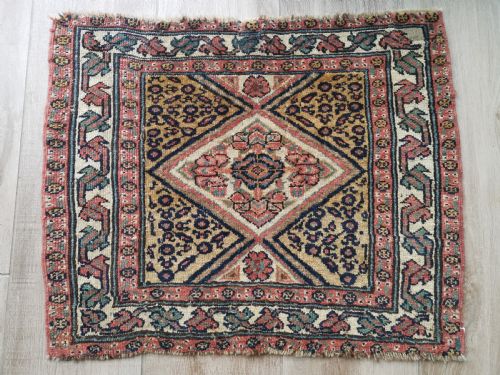
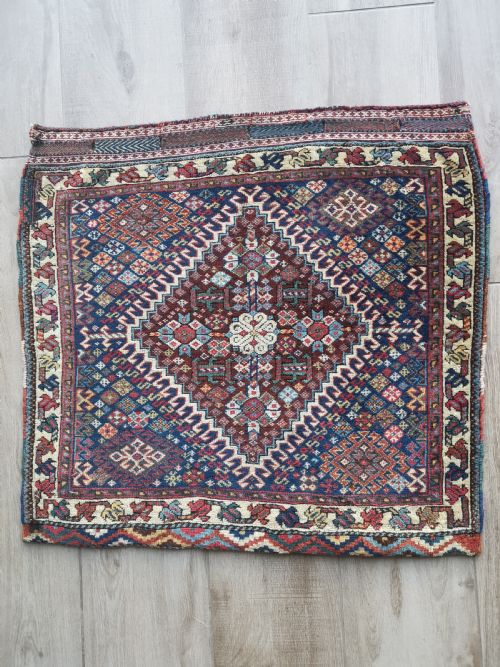
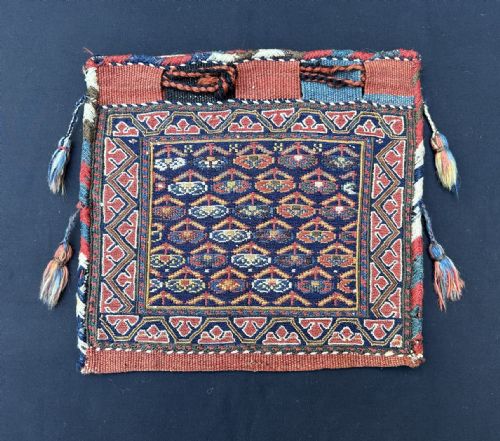
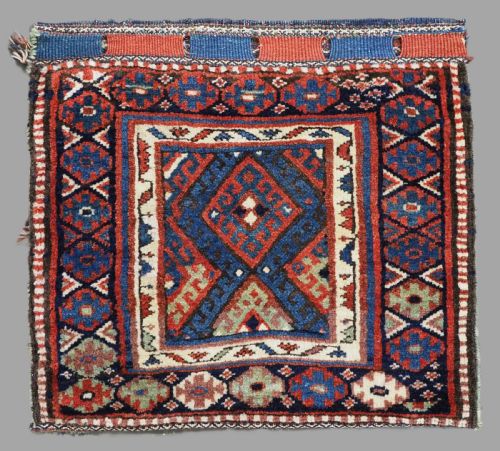
A khorjin saddlebag face represents the front panel of a larger double-sided pack used by nomadic and tribal confederations across Persia for transport and storage. When the original carrying structures wore out or were divided, the decorative faces were preserved as independent panels or small rugs.
The examples gathered here span from the mid-nineteenth century to the early twentieth century, originating from groups such as the Qashqai, Afshar, Shahsavan, Jaf Kurd, and Lori-Bakhtiari tribes. Buyers encounter both complete pouches retaining their plain weave backs and individual fragments adapted into compact wall hangings or floor coverings.
Tribal Persian weaving dominates the selection, reflecting distinct regional patterns from Fars, Kerman, Azerbaijan, and Luristan. These textiles showcase traditional iconography, including central medallions, geometric boteh motifs, and intricate border systems executed by village and nomadic weavers.
Materials and construction methods
Weavers relied principally on hand-spun wool for both the foundation warps and the plush pile, yielding a dense, tactile surface that endured rigorous daily handling. Natural dyes provided the deep indigo blues, madder reds, and earthy yellows that mellow gracefully over decades of exposure.
Production techniques varied between pile knotting and flatwoven soumak work, particularly among Shahsavan and Kurdish makers who utilised intricate wrapping methods for structural strength and sharp pattern definition. Plain weave backs, where present, were constructed from sturdy wool or cotton to support the weight of the contents during transport.
Nomadic weavers frequently incorporated tiny protective amulets and stray misplaced knots into their patterns to ward off the evil eye.
Distinctions in craftsmanship and materials
The standard of wool quality dictates much of the tactile appeal, ranging from ordinary commercial yarns to highly lustrous, lanolin-rich fleece that catches ambient light. Superior pieces demonstrate exceptional handling of natural dye palettes, where colour variations show depth and subtle tonal shifts.
Knot density and structural crispness separate standard utilitarian items from finer tribal weaving. Precision in drawing out geometric medallions and maintaining symmetry across a small format distinguishes the most accomplished nomadic work.
Qashqai Tribes·Afshar Nomads·Shahsavan Nomads·Jaf Kurd·Luri Tribes
The Khorjin Saddlebag Face Glossary
- Khorjin
- The Persian term for a traditional double saddlebag used by nomadic tribes for pack animals. These bags were often separated over time, leaving only the decorative face.
- Soumak
- A flatweave technique where supplementary decorative threads are wrapped over and around the warp threads in a herringbone pattern. This method creates a sturdy textile without a raised pile.
- Boteh
- An ancient motif resembling a stylized almond, pear, or bent cypress tree. It appears frequently in Persian tribal weaving as a symbol of life and eternity.
- Medallion
- A central ornamental design element placed in the middle of the field. In tribal rugs, these are often geometric or hooked in outline.
- Warp
- The stationary vertical threads stretched onto a loom before weaving begins. The pile knots are tied around these foundational elements.
Khorjin Saddlebag Face: Frequently Asked Questions
What is a khorjin saddlebag face?
It is the decorated front panel of a traditional animal transport bag made by Persian nomads. These panels were woven to be both durable and visually striking.
Over time, many bags were cut apart when the reverse sides wore out, leaving the decorative faces to survive as collectible tribal textiles.
How were these bags used?
Nomadic families slung these paired bags across pack animals to transport belongings during seasonal migrations. They served practical storage functions inside tribal tents as well.
Contents typically included household goods, grain, clothing, and personal possessions needed on the move.
How do I display a saddlebag face?
Many collectors mount these square or rectangular panels on walls as textile art. Their compact dimensions make them suitable for hanging in narrow spaces or hallways.
Alternatively, smaller examples can be placed on tables or used as small floor accents in low-traffic areas of a home.
How can I tell tribal groups apart?
Tribal attribution relies on specific structural characteristics, colour choices, and drawing styles. For instance, Shahsavan pieces frequently feature soumak wrapping and sharp geometric lines.
Afshar and Qashqai weavers often employed distinct medallion layouts and specific shades of madder red and indigo that reflect their geographic origins.