

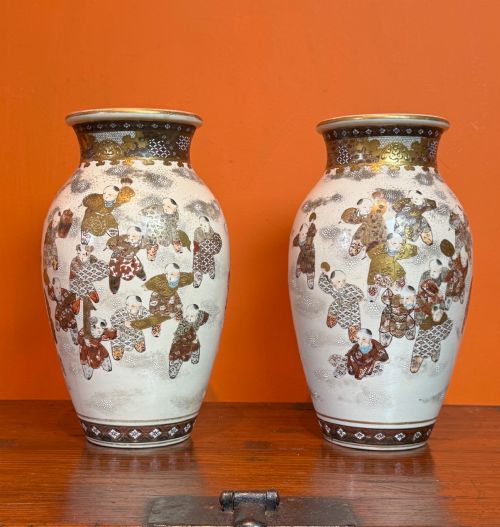


Japanese Earthenware Display Urns
These japanese earthenware display urns bring intricate hand-painted detail and dense gilding into a room.
Japanese Earthenware Display Urns
When searching for japanese earthenware display urns, you encounter decorative vases and vessels created primarily during the Meiji period and the late nineteenth century. These objects include hexagonal vases, miniature vessels, bamboo-handle forms and monumental display pieces.
The aesthetic is defined by Satsuma ware, originating from Kyoto and other centres, featuring elaborate figural processions, court figures, Rakan, dragons and landscape panels. Many examples pair cobalt grounds or dense thousand-flowerhead patterns with heavy gold gilt.
Makers such as Chosei, Seiko-en Chokei, Hododa and Kinkozan produced these works, often incorporating signed marks and the Shimazu mon. The selection ranges from cabinet miniatures to large exhibition-quality pairs.
How they were made
The physical basis of these vessels is earthenware, formed into traditional shapes and finished with characteristic crackle-glaze surfaces. Potters shaped these bodies by hand or on the wheel before applying the base layers.
Decoration relies on hand-painted enamel colours combined with extensive gold leaf and gold gilt highlights. Raised moriage work adds tactile relief to figures, garments and architectural details across the panels.
Japanese Earthenware Display Urns Retail Price Guide 2026
Typical asking prices for japanese earthenware display urns among the pieces listed under this phrase on Sellingantiques today, from the lower quarter to the upper quarter. They describe what is for sale here now, not the wider market.
Materials recorded across the inventory include earthenware, enamel, gold leaf, glaze and wood.
What varies in quality
Quality rests in the precision and density of the hand-painted brushwork across the panels. Superior pieces display crisp definition in facial expressions, garments and architectural motifs without crowding or smudging.
The application of gold leaf, heavy gilt and raised moriage relief distinguishes standard production from exhibition-quality works. Intricate signatures from known makers such as Kinkozan or Seiko-en Chokei further elevate a piece.
Chosei·Seiko-en Chokei·Hododa·Kinkozan
The Japanese Earthenware Display Urns Glossary
- Satsuma
- A type of earthenware originating from Satsuma province in Japan, characterised by an ivory-coloured, crackled glaze and elaborate overglaze enamel and gilt decoration.
- Moriage
- A decorative technique using clay applied in dots or lines to create raised patterns and textured surfaces before painting and gilding.
- Meiji Period
- The era in Japanese history spanning from 1868 to 1912, noted for a surge in decorative arts produced for international export.
- Mon
- A Japanese emblem or crest used to identify families, clans or prominent institutions, often seen on Satsuma ceramics associated with the Shimazu clan.
- Rakan
- Representations of enlightened Buddhist saints or holy figures, frequently depicted in groups on traditional Japanese art objects.
Japanese Earthenware Display Urns: Frequently Asked Questions
What is Satsuma ware?
Satsuma ware is a distinct category of Japanese pottery featuring a pale, finely crackled earthenware body. Artisans decorated these surfaces with detailed polychrome enamels and rich gold leaf.
Most surviving examples date from the late nineteenth century during the Meiji period. They were produced primarily for export markets in Europe and America.
How do I display these vases?
These vessels suit prominent positions on sideboards, mantelpieces or dedicated display stands where their detailed panels are visible. Keep them away from direct sunlight to protect the enamel colours and gold gilt.
Because many are earthenware rather than vitrified porcelain, handle them with care when dusting or repositioning. Pair smaller miniature pieces together or let a monumental vase stand alone.
Are these pieces signed?
Many Japanese earthenware display urns feature painted or impressed signatures on the base or within the panels. These marks may name individual artists, specific workshops such as Kinkozan, or particular studio locations.
Signatures help attribute pieces to known makers of the period. However, unsigned examples of equal artistic quality also exist from the same era.
What is moriage decoration?
Moriage is a ceramic technique where slip is piped onto the earthenware body to create raised, three-dimensional patterns. Artisans then paint and gild over these textured areas to highlight robes, foliage and architectural borders.
This method gives the surface a tactile quality that catches the light. It is particularly prevalent on high-quality Meiji period display pieces.