



Late Meiji Decorative Vases
Late Meiji decorative vases bring intricate ceramic, bronze, and cloisonné artistry into the home, prized for their rich palettes and detailed panels.
Late Meiji Decorative Vases
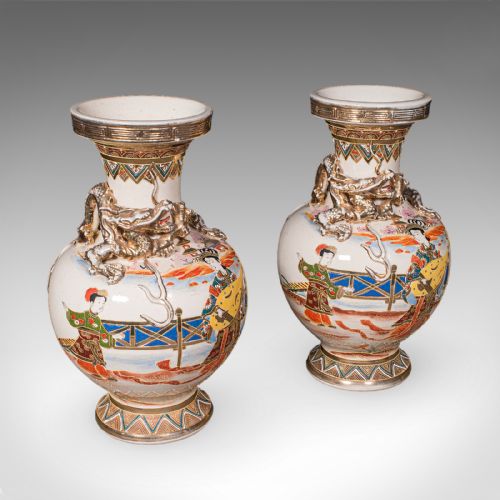
Late Meiji decorative vases encompass a variety of forms including baluster vessels, ginger jars, and large floor-standing pieces originating from Japan during the late nineteenth and early twentieth centuries. These objects are most frequently encountered as pairs of Satsuma earthenware vases decorated with extensive gilding, figures, and landscapes.
The selections span different regional production centres such as Kyoto and Arita, reflecting both traditional motifs and the international exhibition standards of the period. Buyers find examples decorated in the Imari palette alongside blue and white porcelain and bronze creations with lacquer panels.
The objects date from the 1890s through to the Edwardian transition around 1915, sitting squarely within the late Meiji aesthetic. They range from domestic mantelpiece items to large exhibition-scale works standing over fifty inches high.
How they were made
Potters and artisans utilised ceramic, earthenware, and porcelain bodies as the foundation for these vessels, often shaping them into substantial baluster or ginger jar forms. Bronze was also employed for metalwork alternatives.
Decoration relied heavily on intricate hand-applied enamel, cobalt, and heavy gold leaf or gilt. Techniques such as moriage created raised, textured relief patterns, while specialist workshops integrated lacquer panels or distinct maker and family marks onto the surfaces.
Late Meiji Decorative Vases Retail Price Guide 2026
Typical asking prices for late meiji decorative vases among the pieces listed under this phrase on Sellingantiques today, from the lower quarter to the upper quarter. They describe what is for sale here now, not the wider market.
One towering pair stands fifty-eight inches high, proving that Victorian mantelpieces were not the only things straining under the weight of Japanese art.
What varies in quality
The standard of a piece depends on the fineness of the brushwork and the complexity of the narrative or landscape panels. Workshop attribution, such as signed pieces by known makers like Kinkozan or Nanzan, elevates the standing of an object.
The density and preservation of the gilt, enamel, and raised moriage work dictate the visual impact. Large scale and exhibition quality output distinguish superior works from standard domestic wares.
Kinkozan·Nanzan·Hododa·Fukagawa
The Late Meiji Decorative Vases Glossary
- Satsuma
- A type of Japanese earthenware featuring a characteristic ivory-coloured, crackled glaze that serves as a canvas for detailed enamel and gilt decoration.
- Moriage
- A ceramic technique where slip is piped onto the surface to create raised, three-dimensional decorative patterns before firing and gilding.
- Imari
- A traditional Japanese porcelain style defined by a distinct palette of underglaze blue, iron red, and added gold.
- Baluster
- A vertical vase form characterised by a rounded body that tapers towards a narrow neck and flared rim.
- Mon
- A Japanese emblem or crest used to indicate family lineage, clan association, or imperial patronage.
Late Meiji Decorative Vases: Frequently Asked Questions
How do I identify Satsuma ware?
Satsuma pieces are recognised by their warm, ivory-coloured earthenware body covered in a fine network of crackled glaze. They typically feature densely painted figures and landscapes enhanced with heavy gold leaf.
This distinct surface provides the ideal background for the intricate enamel work and raised moriage details characteristic of the Kyoto workshops.
What is an Imari palette?
The Imari palette relies on a striking combination of deep underglaze blue and rich iron red, frequently accented with gold highlights. This traditional colour scheme creates a high-contrast visual effect.
Porcelain vases decorated in this manner were produced for both domestic use and export during the late nineteenth century.
Where should I display large floor vases?
Large exhibition-scale pieces require stable placement in hallways, entranceways, or spacious reception rooms where their height and weight can be safely accommodated. Their scale makes them natural focal points in a room.
Keep them away from direct foot traffic and heavy vibrations to protect the delicate enamel and gilt surfaces.
What does a Shimazu Mon signify?
The Shimazu mon is a crest featuring a cross within a circle, representing the powerful Shimazu clan of Satsuma province. Its presence on a piece denotes a connection to this specific regional patronage.
Such marks often appear on higher-quality export wares produced during the Meiji period.