


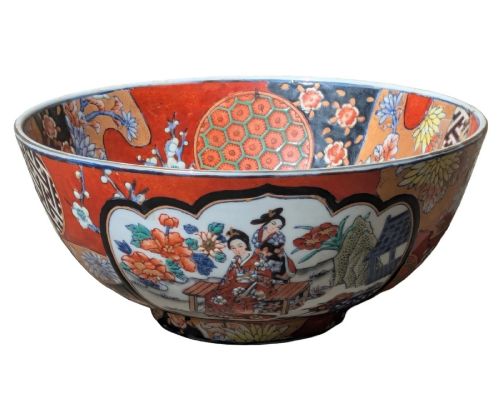


Japanese Decorative Porcelain Basin
A japanese decorative porcelain basin brings rich hand-painted palettes and centuries of kiln tradition straight onto a side table.
Japanese Decorative Porcelain Basin
A japanese decorative porcelain basin covers large bowls, chargers, and tripod vessels shaped for display rather than utility. These items span periods from the eighteenth century through the Meiji era and Edwardian years, reflecting deep roots in Asian ceramic history.
Imari porcelain forms a large share of what appears here, alongside Satsuma earthenware and various ceramic bowls. Buyers encounter scalloped edges, shallow profiles, and wide diameters designed to showcase intricate painting.
Origins stretch from early Arita kilns to later export workshops, capturing both traditional aesthetics and pieces tailored for Western tastes. Each vessel preserves the scale and decorative ambition of its original period.
How they were made
Potters shaped porcelain and earthenware bodies on the wheel or by hand before applying mineral pigments. Cobalt blue pigment beneath the glaze and overglaze enamels dominate the decorative surface.
Artisans layered gold leaf and gilt accents over fired glazes to catch the light on Satsuma and Imari wares. Celadon glaze offered an alternative monochrome finish relying on iron oxide reduction within the kiln.
Japanese Decorative Porcelain Basin Retail Price Guide 2026
Typical asking prices for japanese decorative porcelain basin among the pieces listed under this phrase on Sellingantiques today, from the lower quarter to the upper quarter. They describe what is for sale here now, not the wider market.
Listings span multiple centuries, uniting eighteenth-century Arita porcelain with Meiji period Satsuma earthenware and Edwardian exports.
What varies in quality
The precision of the brushwork dictates the tier of the piece, separating rapid commercial output from meticulous studio painting. Crisp lines in cobalt blue and finely applied millefleur patterns elevate the visual depth of the vessel.
The clarity of the porcelain body and the evenness of the glaze application distinguish superior bowls. Maker signatures, such as those by Ryuzan or Nikko, often accompany higher standards of potting and decoration.
Ryuzan·Nikko
The Japanese Decorative Porcelain Basin Glossary
- Imari
- A style of Japanese porcelain featuring a distinct palette of cobalt blue, iron red, and gold. It originates from the town of Arita and became immensely popular for export.
- Satsuma
- A type of Japanese earthenware featuring a crackled ivory glaze decorated with polychrome enamels and gilt. Many examples date from the Meiji period.
- Meiji Period
- The era in Japanese history spanning from 1868 to 1912, marked by widespread artistic production for international markets. Pieces from this time often display complex floral and pictorial motifs.
- Celadon Glaze
- A transparent jade-green glaze derived from iron oxide in a reduction kiln atmosphere. It creates a subtle, tactile surface across traditional ceramic forms.
- Millefleur
- A decorative pattern meaning a thousand flowers, covering the entire surface of a vessel in dense floral detail. This technique requires exceptional patience from the artist.
Japanese Decorative Porcelain Basin: Frequently Asked Questions
How old are these bowls?
These pieces range from eighteenth-century Arita tripod bowls to nineteenth-century Meiji period examples and Edwardian imports. Dates depend on the specific ceramic tradition and kiln mark.
Most items seen on this page cluster around the Meiji period and the turn of the twentieth century, reflecting the peak of Japanese export ceramics.
What is the difference between Imari and Satsuma?
Imari is a hard porcelain typically decorated in cobalt blue, iron red, and gold, known for its crisp ring and vibrant palette. Satsuma uses a softer earthenware body covered in a fine crackle-glaze.
Satsuma pieces frequently display elaborate figural or dense floral scenes enhanced with heavy gilt, whereas Imari relies on geometric and natural motifs under and over the glaze.
How were these basins used?
These large bowls and chargers served primarily as decorative showpieces in interiors rather than functional kitchenware. Their wide diameters and stable tripod bases made them ideal for display on tables or sideboards.
Export pieces were specifically created to satisfy Western demand for ornate decorative objects during the late nineteenth and early twentieth centuries.
How do I care for antique porcelain?
Dust these bowls gently with a dry, soft cloth to protect the overglaze enamels and gold leaf from abrasion. Avoid using water or chemical cleaners, especially on earthenware bodies with crackle glazes.
Display the vessels away from direct sunlight and areas subject to sudden temperature shifts to preserve the integrity of the glaze and pigments.