



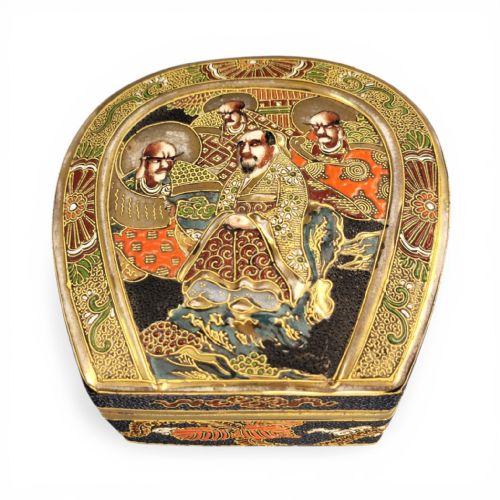


Japanese Arhat Pottery
These Japanese arhat pottery pieces combine intricate earthenware forms with rich gilt decoration, offering collectors detailed depictions of traditional religious figures.
Japanese Arhat Pottery
When searching for japanese arhat pottery, buyers encounter items centred around traditional Buddhist figures known as arhats or rakan, often alongside dragons and figurative processions. The objects appearing on this page take forms such as vases, trinket boxes, and incense burners.
The majority of these pieces originate from the Meiji period, alongside examples spanning the Victorian era through to the Showa period. Satsuma ware dominates the selection, appearing in monumental sizes, hexagonal shapes, and delicate miniature formats.
Quality Variations
Quality rests upon the precision of the hand-painted figural work and the density of the gilt decoration across the surface. Pieces bearing named signatures from notable workshops or makers demonstrate superior brushwork and compositional control.
The complexity of the form itself dictates distinction, with hexagonal geometry, lidded structures, and heavy relief detailing requiring greater technical mastery from the potter.
Japanese Arhat Pottery Retail Price Guide 2026
Typical asking prices for japanese arhat pottery among the pieces listed under this phrase on Sellingantiques today, from the lower quarter to the upper quarter. They describe what is for sale here now, not the wider market.
Certain arhat vessels feature dragons winding around the ceramic neck, keeping a watchful eye over the sages below.
Hotoda·Toshozan·Seiko-en Chokei·Hattori
The Japanese Arhat Pottery Glossary
- Arhat
- A perfected person in Buddhism who has gained insight into the true nature of existence and achieved Nirvana. These figures frequently appear in traditional Japanese ceramic decoration.
- Satsuma
- A type of Japanese earthenware originating from Satsuma Province, traditionally characterised by an ivory-coloured, crackled glaze and elaborate polychrome and gilt enamel work.
- Moriage
- A ceramic technique where slip is piped onto the surface of a vessel to create raised decorative patterns and textures before firing.
- Meiji Period
- The era in Japanese history spanning from 1868 to 1912, marked by the opening of trade with the West and a flourishing of decorative arts for export.
Japanese Arhat Pottery: Frequently Asked Questions
What are arhats on these ceramics?
Arhats are enlightened Buddhist sages and disciples who appear in detailed figural processions on Satsuma ware.
Artists rendered these religious figures with individual expressions and robes, often surrounded by dragons or landscapes.
How do I identify Meiji period pieces?
Meiji period items date between 1868 and 1912, aligning with an era of significant export production for Western markets.
Look for fine crackle glazes combined with dense gold gilt and hand-painted enamel narratives.
Where were Satsuma vessels made?
Satsuma pottery originated in the Satsuma Province of Kyushu, though production later expanded to major urban centres like Kyoto.
Kyoto workshops produced many of the large, heavily decorated exhibition pieces seen today.
How should I care for gilt earthenware?
Keep these fragile earthenware pieces away from direct sunlight and excessive moisture to protect the enamel and gold leaf.
Dust them gently with a dry, soft cloth rather than using liquid cleaners.