
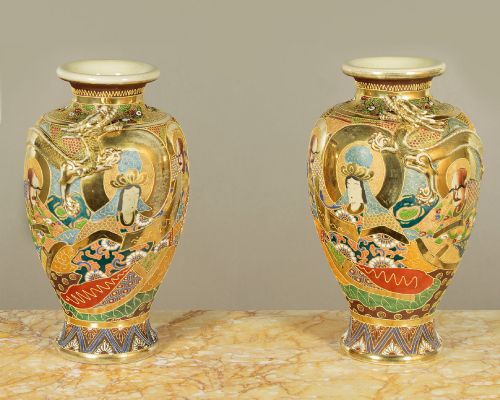


Japanese Arhat Ceramic Vase
A japanese arhat ceramic vase brings intense figural storytelling into a room through meticulous hand-painted detail and heavy gilding.
Japanese Arhat Ceramic Vase
A Japanese arhat ceramic vase presents intricate depictions of spiritual figures, often accompanied by dragons, emerging from the Meiji, Taisho, and Showa periods. Buyers searching this phrase encounter earthenware and porcelain vessels ranging from miniature cabinet pieces to monumental palace displays.
The dominant form on this page is the Satsuma ware vessel, typically characterised by intricate figural processions of arhats or rakan alongside detailed landscape panels. These pieces span hexagonal, cylindrical, and lidded forms, frequently bearing rich gilt decoration and maker signatures from studios such as Hotoda or Seiko-en Chokei.
Alongside Satsuma production, the listings include Kutani cylindrical vases representing nineteenth-century craftsmanship. These ceramic objects combine religious iconography with ornamental elements like elephant handles and the Shimazu crest.
Materials and construction
These vessels are constructed from earthenware and porcelain bodies, shaped into symmetrical forms including polygons, cylinders, and large lidded urns. Artisans then applied detailed enamel palettes directly onto the ceramic surface to build up complex narrative scenes.
Gilding plays a primary role in the surface finish, utilising gold leaf and gold gilt to highlight robes, haloes, and dragon scales. Techniques such as moriage build raised enamel dots and lines that give the figures and decorative borders a distinct tactile relief.
Listings feature earthenware and porcelain bodies decorated with enamel, gold leaf, and raised moriage across the 19th and 20th centuries.
Assessing craftsmanship
Quality rests in the precision of the brushwork across hundreds of tiny arhat faces and the depth of the gilding. Finer pieces demonstrate controlled layering of enamel and gold leaf that remains crisp across crowded figural processions.
The ambition of the form also dictates the tier of the piece, separating standard decorative vessels from monumental works with complex handles, signed panels, and heavy relief detailing. Studio attribution to recognised makers often aligns with superior execution in both ceramic throwing and surface painting.
Hotoda·Seiko-en Chokei·Hattori
The Japanese Arhat Ceramic Vase Glossary
- Arhat
- An enlightened Buddhist sage or holy person. These figures appear in large groups on Japanese ceramics, often shown with expressive faces and flowing robes.
- Satsuma
- A type of Japanese earthenware originating from Satsuma Province, known for a crackle glaze and elaborate polychrome and gilt enamel decoration. It serves as the primary ceramic body for figural vases on this page.
- Moriage
- A decorative ceramic technique using piped clay or thick enamel to create raised, three-dimensional patterns. This method adds heavy texture to borders, dragon scales, and garments.
- Meiji Period
- The era of Japanese history lasting from 1868 to 1912, marked by the opening of trade with the West and a surge in highly detailed decorative arts. Many pieces bearing arhat imagery date from this period.
- Gilt
- A thin layer of gold or gold paint applied to the surface of ceramics to accentuate details. On these vases, it defines religious iconography and framing panels.
Japanese Arhat Ceramic Vase: Frequently Asked Questions
How do I distinguish Meiji period Satsuma?
Meiji period Satsuma vessels typically feature a finely crackled cream-coloured earthenware glaze beneath dense enamel and gold work. The painting on these pieces displays high precision in the faces of arhats and decorative borders.
Signatures of specific makers or studios frequently appear on the base, pointing to dedicated workshops active during the late nineteenth and early twentieth centuries.
Where were large Satsuma vases displayed?
Monumental Satsuma vases were created largely for export markets and international exhibitions during the late nineteenth century. Wealthy households placed them in reception rooms and hallways to showcase Japanese craftsmanship.
Their substantial height and heavy gilding allowed them to function as architectural focal points within Victorian interiors.
What is the difference between Satsuma and Kutani?
Satsuma ware is characterised by an earthenware body with a fine crackle glaze, heavily embellished with polychrome enamels and gold leaf. Kutani ware typically uses a different ceramic base with distinct colour palettes focused on greens, blues, and reds.
While Satsuma frequently incorporates raised moriage and religious figural scenes like arhats, Kutani pieces on this page lean towards cylindrical forms with alternate decorative traditions.