







Jacobean Revival Stool
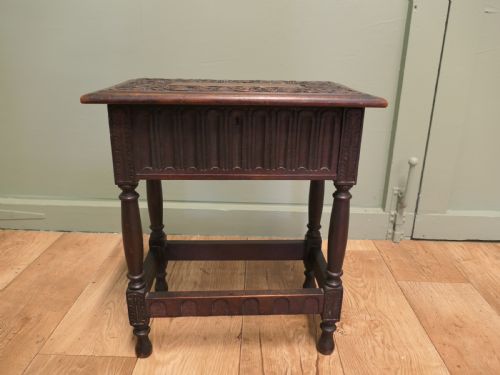
These jacobean revival stool examples offer sturdy craftsmanship and historic form, built to anchor an interior with period character.

Jacobean Revival Stool
A jacobean revival stool brings seventeenth-century architectural severity into later Victorian, Edwardian and twentieth-century domestic spaces. Buyers searching this phrase look for solid timber seating that mimics earlier joint construction and heavy rectilinear frames.
Alongside standard stools, the inventory includes related forms such as small box stools, benches, and footstools framed in matching timbers. These variations share the same stylistic vocabulary of turned supports and planked tops.
Materials and construction
Solid oak provides the structural foundation for almost every piece, chosen for its durability and traditional association with the style. Makers frequently employed traditional joint techniques to assemble the rigid frames without relying on modern fasteners.
Surface details often include carved ornamentation, brass or iron hardware, and metal studs securing leather or fabric elements. Selected examples incorporate cane panels or upholstered tops to soften the otherwise austere wooden framework.
Jacobean Revival Stool Retail Price Guide 2026
Typical asking prices for jacobean revival stool among the pieces listed under this phrase on Sellingantiques today, from the lower quarter to the upper quarter. They describe what is for sale here now, not the wider market.
Listings span the nineteenth century, Victorian, Edwardian, and 1920s periods, predominantly utilising solid oak alongside cane, leather, and metal studwork.
Judging the work
Superior pieces display crisp, purposeful carving and tight, stable joinery that withstands daily use without shifting. The best examples maintain the proportion and heft of genuine early furniture rather than appearing thin or overly light.
The choice of secondary materials, from high-grade upholstery fabrics to hand-forged studs and sturdy cane work, separates standard production from finer interpretations. Execution of the turned legs and stretcher bases reveals the maker's dedication to period accuracy.
The Jacobean Revival Stool Glossary
- Joint stool
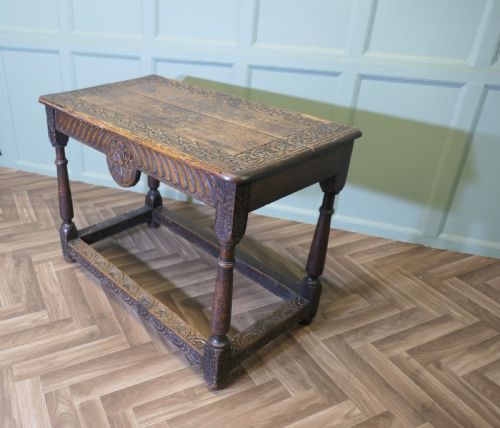
- A sturdy wooden seat constructed with mortise and tenon joints rather than turned or glued spindles. These items were originally used as primary seating or small side tables in early homes.
- Jacobean Revival
- A nineteenth and twentieth-century design movement that reinterprets the heavy, straight-lined furniture styles of the early seventeenth century. It relies heavily on oak, geometric moulding, and turned supports.
- Bobbin turned
- A style of leg or stretcher lathe-cut to resemble a series of bobbins or spools strung together. This decorative turning technique appears frequently on nineteenth-century and Edwardian tables and seating.
- Box stool
- A low seat featuring a hinged lid that opens to reveal a concealed storage compartment underneath. These multifunctional items served domestic spaces where floor space was at a premium.
- Demi-lune
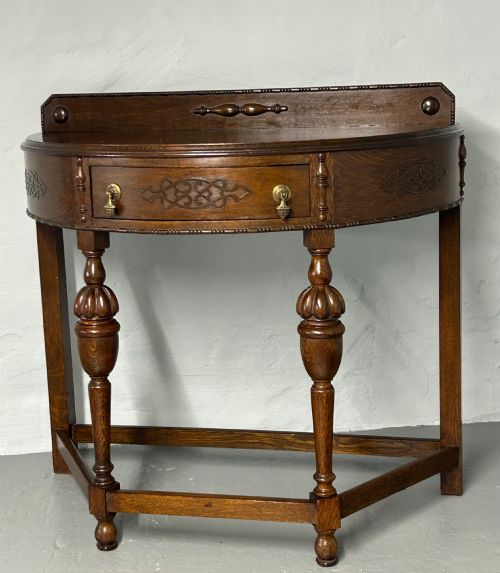
- A half-moon shape used for small tables and furniture designed to sit flush against a wall. The term describes the curved top and flat rear edge typical of these console and side pieces.
Jacobean Revival Stool: Frequently Asked Questions
How are these stools dated?
Dating relies on timber characteristics, tool marks left during manufacture, and the style of the turned legs or stretchers. Revival pieces often combine older forms with nineteenth or twentieth-century construction methods.
Examining the underside and joint construction reveals whether an item dates to the Victorian or Edwardian revival eras rather than the seventeenth century.
Can I use a joint stool as a side table?
Their flat planked tops and rigid, level frames make these stools well-suited for use as compact side tables or plant stands. Historic domestic use was similarly versatile.
Placing one beside a chair provides a stable surface for books or lamps without overwhelming a small room.
What is the difference between an Elizabethan and Jacobean style?
Elizabethan design draws from late sixteenth-century aesthetics, often featuring strapwork carving and massive, bulbous table supports. Jacobean style reflects the early seventeenth century with simpler geometric mouldings and turned legs.
Many revival pieces blend these vocabulary elements interchangeably under a broader historicist banner.
How do I care for antique oak furniture?
Regular dusting with a dry, soft cloth prevents particulate buildup on carved surfaces and joints. Avoiding direct sunlight and extreme humidity fluctuations preserves the stability of the timber.
Applying a traditional beeswax polish occasionally helps nourish the grain without leaving a heavy synthetic buildup.