





Jacobean Revival Settle Bench
These jacobean revival settle bench examples bring heavy timber presence to a hallway, offering high-backed seating with hidden storage beneath the lid.
Jacobean Revival Settle Bench
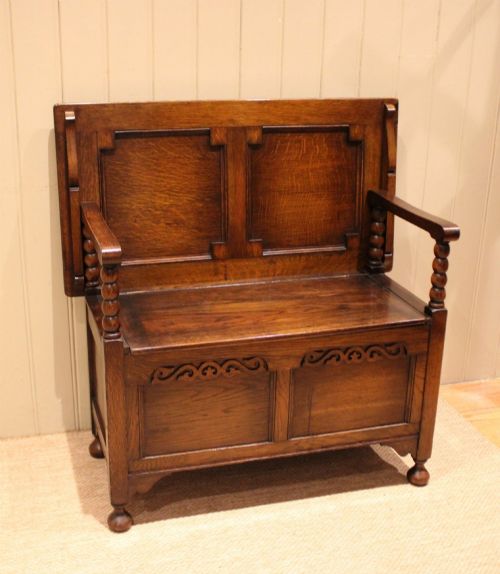
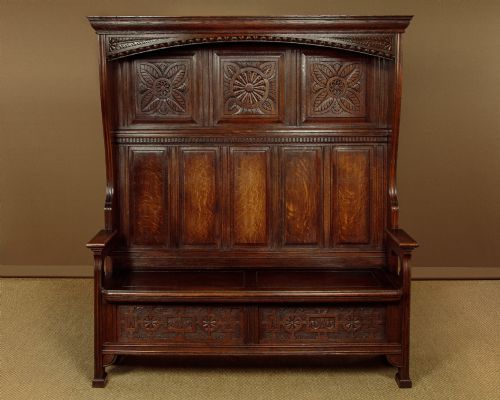
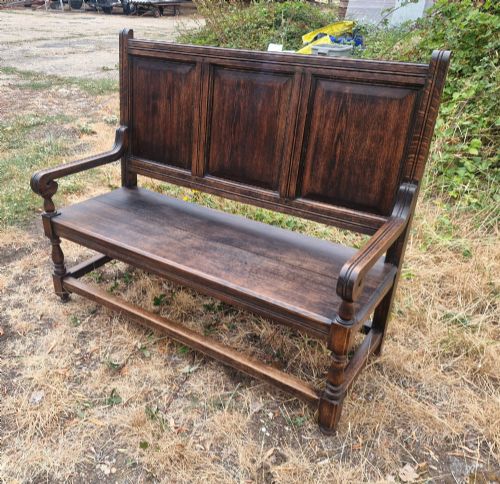
A jacobean revival settle bench is a substantial wooden seating form built primarily for hallways and reception spaces, drawing on earlier seventeenth-century design motifs. These pieces frequently incorporate high panelled backs, box bases with lift-up lids, and occasionally folding tops that convert the seat into a table.
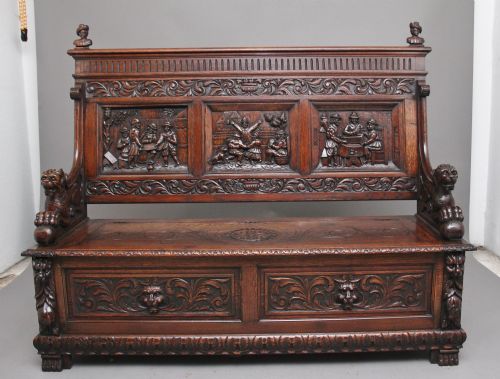
The selection here spans from the late nineteenth century through to the Edwardian period and the 1920s and 1930s. Buyers frequently encounter oak hall seats and monks benches alongside more elaborate baronial and gothic revival forms.
Most examples function as dual-purpose furniture, offering a place to sit while concealing boots, textiles, or household items inside the box base. The proportions tend to be deep and upright, designed to stand against a hallway wall rather than float in the middle of a room.
How They Were Made
Construction relies heavily on solid oak, chosen for its strength and ability to take deep hand-carved ornamentation. Makers utilised traditional mortise and tenon joinery to build rigid frames capable of withstanding heavy daily use in entrance halls.
Surface decoration typically involves relief carving, featuring strapwork, floral motifs, panelled linenfold patterns, and occasionally figural elements like the Green Man. Iron hinges, brackets, and catches provide the functional mechanical support for lift-up seats and folding tabletops.
Jacobean Revival Settle Bench Retail Price Guide 2026
Typical asking prices for jacobean revival settle bench among the pieces listed under this phrase on Sellingantiques today, from the lower quarter to the upper quarter. They describe what is for sale here now, not the wider market.
Current listings span the nineteenth century through the 1930s, constructed almost entirely in solid oak with occasional iron hardware.
What Varies in Quality
Quality rests significantly on the depth and execution of the timber carving, moving from simple flat panels to crisply chiselled relief work. The weight and selection of the oak itself also dictate the character, with denser grain and older timber offering a more convincing revival presence.
The integrity of the internal box construction and the smoothness of the operating mechanism for folding tops or lift-up lids separate standard utilitarian seating from finer reception furniture. Pieces retaining their original hardware and sound structural framing hold greater architectural coherence.
The Jacobean Revival Settle Bench Glossary
- Settle bench
- A high-backed wooden seat with solid arms and a closed base designed to keep out drafts in entrance halls.
- Monks bench
- A convertible form featuring a folding back that lowers onto the arms to transform the seat into a table.
- Box settle
- A seating unit incorporating a large enclosed storage compartment accessed by lifting the hinged seat lid.
- Canopy top
- An architectural projection or roof-like structure built over the upper back of a settle to retain heat and frame the seat.
- Green Man
- A sculptural motif depicting a human face emerging from or entwined with foliage, frequently found on carved revival oak furniture.
Jacobean Revival Settle Bench: Frequently Asked Questions
Where should I place a settle bench?
These pieces suit entrance halls, boot rooms, and wide corridors where their high panelled backs can anchor a wall space.
The enclosed box base provides practical storage for bulky items while keeping hallways clear of clutter.
How do I use a monks bench?
The hinged upper back pivots forward to rest upon the sturdy wooden arms, converting the high-backed seat into a functional table.
Lifting the seat reveals a deep storage compartment underneath the top surface.
How do I date an oak settle?
Dating relies on examining the construction marks, timber patina, and the specific revival style influences present in the carved ornamentation.
Pieces seen here range from late nineteenth-century baronial interpretations to Edwardian and 1920s versions.
Does the wood need special care?
Solid oak benefits from occasional treatment with appropriate beeswax or natural oils to nourish the grain and maintain the surface sheen.
Keep wooden furniture away from direct heat sources and sudden humidity shifts to prevent timber movement.