

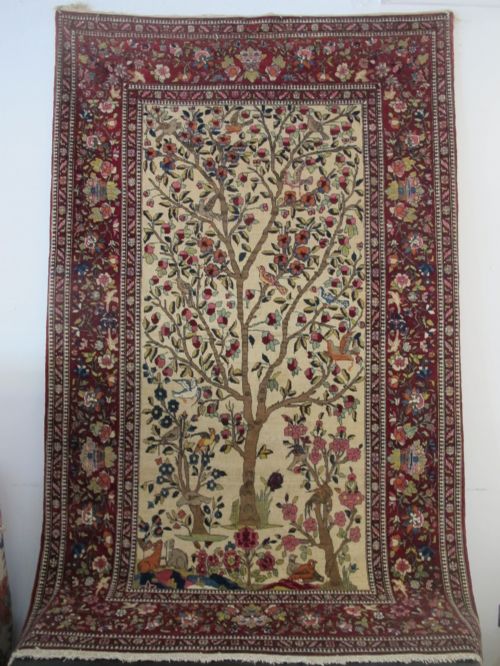


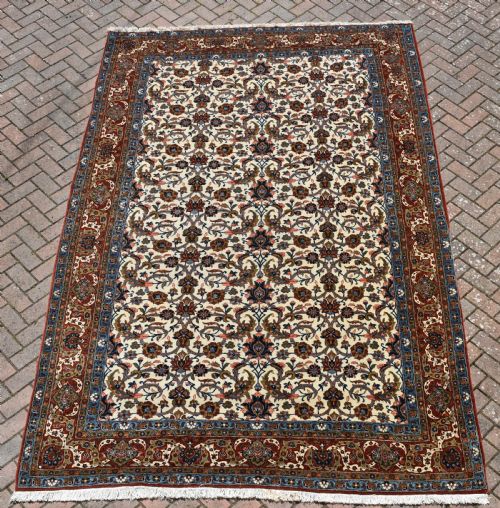


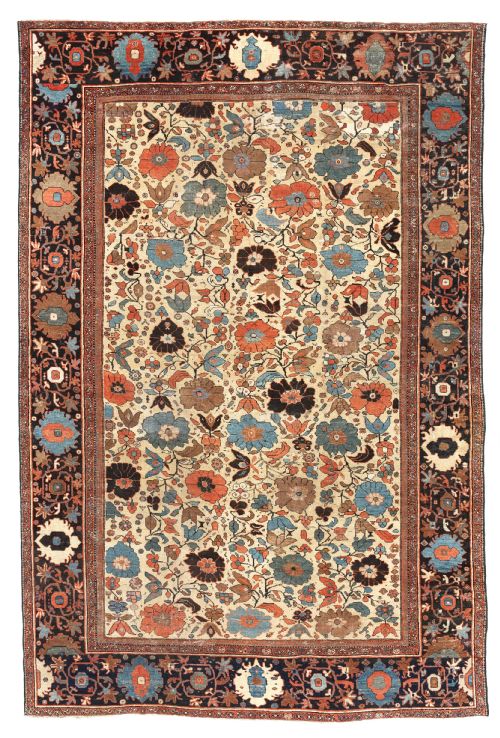


Ivory Border Rug
An ivory border rug anchors a room with its pale framing edge, drawing the eye across Persian and Turkish weaves.
Ivory Border Rug
When you search for an ivory border rug, you are looking at hand-knotted and flatwoven floor coverings defined by a pale neutral outer band framing the field. These pieces cross various Persian and Turkish origins, spanning village productions and city workshops from the late nineteenth century through to the early twentieth century.
The version you are most likely to meet on this page is a roomsize or area carpet carrying traditional Persian motifs, often featuring an ivory ground border paired with denser colours through the centre. Village pieces such as Baluch and Timuri examples sit alongside formal city weaves from Tabriz, Isfahan, Qum, and Agra.
Mughal style and Sarkoy kilim formats also appear, showing how diverse the tradition of framing a design with a light border truly is. Each piece demonstrates how weavers used pale neutral wool or cotton frames to set off deeper reds, blues, and browns within the main field.
How they were made
The materials recorded in these pieces rely upon natural animal and plant fibres, principally wool, hand-spun wool, cotton, and silk. Weavers utilised wool for its durability and soft pile, while cotton served primarily for the foundational warps and wefts that held the structure firm.
Silk appears in finer city workshops to render intricate floral details with a distinct sheen. Hand-spun wool gives village and tribal pieces a textured, irregular warmth that machine-made alternatives cannot replicate.
Ivory Border Rug Retail Price Guide 2026
Typical asking prices for ivory border rug among the pieces listed under this phrase on Sellingantiques today, from the lower quarter to the upper quarter. They describe what is for sale here now, not the wider market.
Some Baluch weavers tucked tiny boat motifs into their ivory borders, quietly steering a little journey right across your floorboards.
What varies in quality
Quality in these woven works rests upon the density of the knotting and the precision of the design execution. City carpets from centres like Tabriz or Qum show rigorous symmetry and finer materials, whereas tribal rugs exhibit a charming irregularity in their lattice and boat border patterns.
The handling of the wool itself dictates the tactile success of the piece, with hand-spun yarns yielding a richer handle. The clarity of the dye work within both the ivory border and the central field determines how well the composition holds its visual balance.
The Ivory Border Rug Glossary
- Ivory border
- A pale neutral outer framing band that contrasts with the darker or more colourful central field of a rug.
- Warps and wefts
- The foundational vertical and horizontal threads that form the structural grid of a hand-knotted carpet.
- Kilim
- A flatwoven rug produced without a pile, common in Turkish and regional traditions.
- Lattice design
- A repeating network pattern forming geometric or floral compartments across the rug field.
- Hand-spun wool
- Yarn spun by hand rather than machine, retaining natural variations in thickness and texture.
Ivory Border Rug: Frequently Asked Questions
What is an ivory border rug?
An ivory border rug is a hand-knotted or flatwoven carpet defined by a pale neutral outer framing band. These pieces originate from various Persian and Turkish weaving traditions.
They range from formal city carpets to village and tribal formats, all sharing the characteristic light-coloured frame that sets off the central design.
How do I date these rugs?
Dating these rugs relies on stylistic analysis, material assessment, and structural evidence recorded across nineteenth and early twentieth-century examples. Indicators include regional weaving techniques and specific design motifs.
Comparing known workshop pieces with tribal village work helps narrow down the decade of production.
Where were these rugs made?
These rugs were produced across distinct regions, including central and regional Persia alongside Turkish weaving centres. City workshops in places like Tabriz, Isfahan, and Qum operated alongside nomadic tribal groups.
Village weavers in areas associated with Baluch and Timuri production also contributed significantly to this group.
How do I care for a wool rug?
Caring for a wool rug involves regular gentle vacuuming without a rotating brush to protect the delicate pile and foundational structure. Keeping the piece out of direct sunlight prevents natural dyes from fading unevenly.
Professional cleaning tailored for antique textiles ensures the hand-spun wool and cotton remain stable over time.