



Italian Renaissance Revival Desk
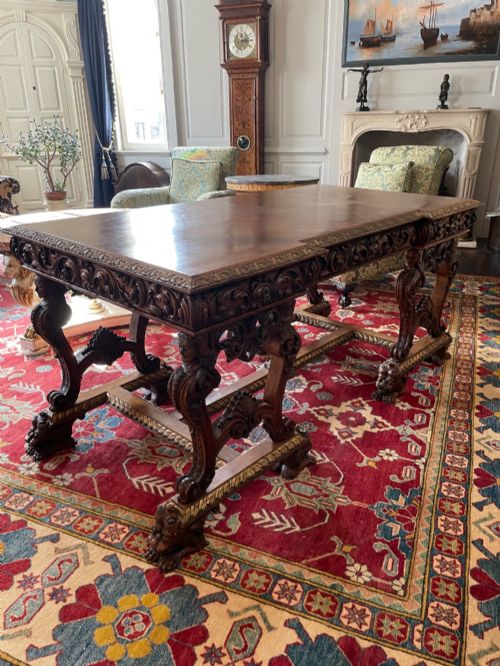
An italian renaissance revival desk brings heavy architectural carving and rich walnut timber into a room, offering a commanding workspace rooted in nineteenth-century historicism.
Italian Renaissance Revival Desk
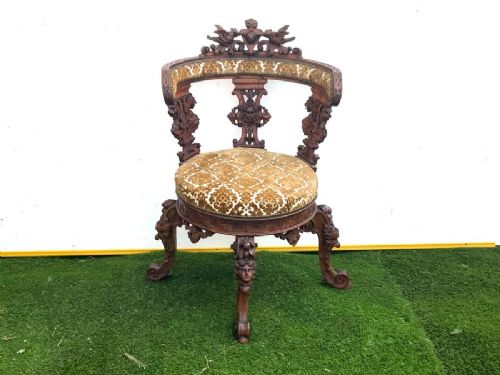
An italian renaissance revival desk draws upon sixteenth-century architectural forms, executed predominantly in solid walnut during the nineteenth century. These pieces often incorporate elaborate carving, ranging from figural supports to winged griffins and cherubs, reflecting a Victorian appetite for grand historical revivals.
Buyers encountering this furniture will find writing desks, Davenport desks, and library tables alongside related seating and centre tables. The forms mirror historical prototypes from Florence and Rome, reinterpreted by nineteenth-century workshops to suit contemporary Victorian libraries and reception rooms.
How they were made
Cabinetmakers utilised dense walnut timber, selected for its deep grain and ability to hold crisp, deep relief carving. Master carvers worked the wood by hand to produce sculptural figures, winged griffins, and intricate mouldings that define the structural profile of the desk.
Construction relied on traditional joinery methods suited to heavy hardwoods, complemented occasionally by patinated bronze mounts or brass hardware. Secondary materials such as leather or velvet frequently lined the writing surfaces, providing a textural contrast to the carved wooden frames.
Italian Renaissance Revival Desk Retail Price Guide 2026
Typical asking prices for italian renaissance revival desk among the pieces listed under this phrase on Sellingantiques today, from the lower quarter to the upper quarter. They describe what is for sale here now, not the wider market.
Carved winged griffins peer out from beneath nineteenth-century walnut writing desks, keeping a silent, watchful eye over the correspondence.
What varies in quality
The distinction between standard nineteenth-century production and exceptional exhibition-standard pieces lies entirely in the depth and ambition of the hand carving. Master carvers brought an anatomical precision and sculptural fluency to walnut figures that routine workshop output simply cannot match.
Proportion and structural integrity also separate the finer examples, where architectural elements balance harmoniously without feeling crowded. The selection of the walnut timber itself, coupled with the crispness of the raised mouldings, dictates the enduring visual authority of the desk.
Angiolo Barbetti Firenze·Luigi Frullini
The Italian Renaissance Revival Desk Glossary
- Renaissance Revival
- A nineteenth-century architectural and decorative style that drew inspiration from fifteenth and sixteenth-century Italian design. It manifested in heavy walnut furniture adorned with classical motifs and figural carving.
- Davenport desk
- A compact Victorian writing desk featuring a sloping, leather-lined lid above a pedestal of drawers. The form prioritised enclosed storage while maintaining a formal presence in a study or boudoir.
- Library table
- A large freestanding centre table utilised for reading and writing rather than dining. These tables typically featured frieze drawers and heavy, carved supports.
- Patinated bronze
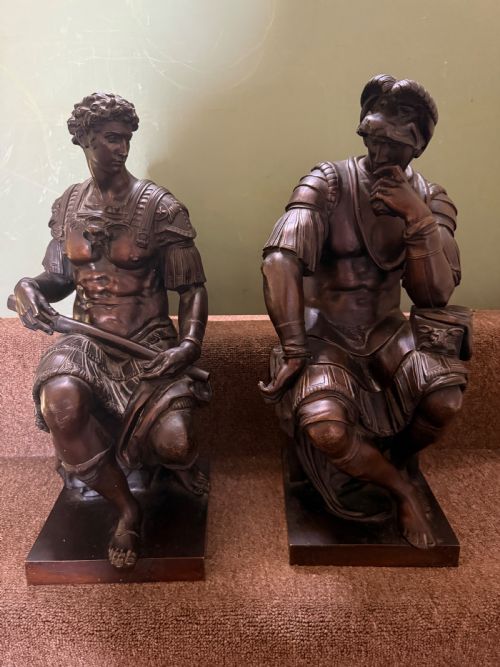
- A copper alloy treated chemically to produce a controlled surface colour or sheen. It frequently appeared as decorative mounts or companion sculptures on nineteenth-century desks.
- Writing bureau
- A cabinet form incorporating a fall-front flap that opens to reveal a fitted interior of small drawers and pigeonholes. It combined upright storage with a concealed writing surface.
Italian Renaissance Revival Desk: Frequently Asked Questions
What is an italian renaissance revival desk?
An italian renaissance revival desk is a nineteenth-century piece of furniture inspired by historical Italian design. It is typically built from solid walnut and heavily decorated with hand-carved figures, scrolls, and architectural motifs.
These desks were produced for Victorian libraries and grand reception rooms where historicism and heavy ornamentation were prized. They offer a commanding focal point for a study today.
How do I date these desks?
Dating relies on examining the timber construction, joinery methods, and the style of the carving. Most examples date from the nineteenth century, reflecting the Victorian revival of earlier Renaissance forms.
Makers working in Florence during this era often adopted sixteenth-century motifs with a high degree of technical skill. Comparing the carving depth to documented workshop pieces helps narrow the period.
Where were these desks placed?
These desks were designed for principal reception rooms, studies, and private libraries in large nineteenth-century homes. Their freestanding forms meant they could sit centrally in a room rather than pushed against a wall.
Because they were finished on all sides to display the carved walnut and sculptural details, they commanded authority within the floor plan.
How do I care for walnut furniture?
Walnut furniture requires a stable indoor environment away from direct sunlight and sudden temperature changes. Regular dusting with a soft, dry cloth preserves the finish without stripping the natural oils in the timber.
Avoiding excessive moisture and using gentle beeswax sparingly will maintain the historic patina of the carved surfaces over time.