
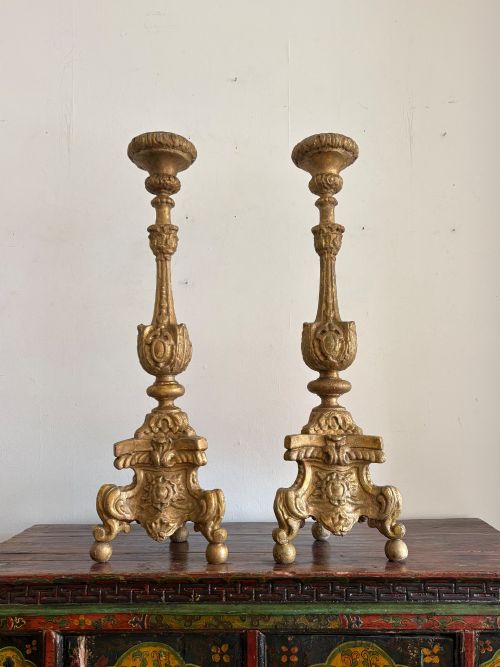


Italian Church Candlesticks
These Italian church candlesticks bring devotional theatre into a room, carved in wood and finished in gold leaf.
Italian Church Candlesticks
Italian church candlesticks are ritual objects originating from ecclesiastical settings, created to hold candles on altars or stand as floor torcheres. When searching for italian church candlesticks, buyers encounter items ranging from monumental altar pieces to smaller table lamps adapted from older bases.
The selections span several centuries, with the eighteenth century represented by elaborate baroque items and later decades showing revival movements and provincial interpretations. Most examples take the form of pricket sticks with a sharp spike to secure the candle, or candle holders designed for sockets.
Origins trace across stylistic regions, including Venetian workshops known for silvered finishes and provincial makers working in simpler carved pinewood. Forms vary from compact table versions to tall torcheres reaching significant heights for floor placement.
Materials and construction
Wood serves as the primary structural material, utilising carved pinewood and general timber shaped by hand. Craftsmen applied layers of gesso to the carved wooden surfaces to create a smooth ground for subsequent gilding.
Decoration relies heavily on gold leaf and silver leaf applications, alongside silvered mecca finishes that imitate precious metals. Polychrome highlights occasionally appear alongside the giltwood surfaces to add depth to the carved details.
Object forms range from standard table candlesticks and altar-style pricket sticks to tall floor torcheres and converted lamp bases.
Quality and craftsmanship
The distinction between tiers rests upon the depth and vigour of the carving, where confident baroque scrolls outshine mechanical or shallow execution. The handling of the gesso and the warmth of the underlying gold leaf determine the visual richness of the surface.
Proportion and scale dictate the presence of a piece, with larger altar types and tall torcheres demanding precise balance in their turned shafts and triangular bases. The integrity of the original wood structure beneath centuries of surface finish remains central to the standing of any piece.
The Italian Church Candlesticks Glossary
- Giltwood
- Wood that has been coated with gold leaf or gold paint. This finish creates a luminous surface that catches candlelight.
- Pricket
- A sharp metal spike on a candlestick designed to hold a candle in place. Older altar sticks commonly utilise this method rather than a socket.
- Torchere
- A tall ornamental stand or candlestick meant to hold a light source off the floor. These pieces often feature substantial carved wooden shafts.
- Mecca
- A transparent golden varnish applied over silver leaf to simulate the rich tone of gold at a lower cost. This technique appears frequently on Venetian-style pieces.
- Gesso
- A plaster mixture applied to wood surfaces to prepare them for painting or gilding. It allows for crisp carved details to be built up before metal leaf is laid down.
Italian Church Candlesticks: Frequently Asked Questions
What is a pricket stick?
A pricket stick is a candle holder featuring an upright metal spike instead of a traditional cup or socket. The base of the candle is pressed directly onto this spike to secure it.
This form is common in ecclesiastical contexts and older lighting pieces, requiring candles with a hollow base or deliberate placement.
How do I use them safely today?
Many surviving examples function well with modern taper candles or have been wired carefully as lamp bases. Ensure any electrical adaptation respects the historic wood structure without causing damage.
When burning real wax candles, place a protective disc beneath the flame to catch drips and protect the antique giltwood or gesso surface.
How can I tell baroque from neoclassical styles?
Baroque pieces display exuberant curves, heavy acanthus carving, and dynamic movement intended to draw the eye upwards. The overall forms feel theatrical and robust.
Neoclassical pieces favor restraint, straight lines, symmetry, and classical motifs derived from ancient architecture. The silhouettes become more architectural and orderly.
What does mecca finish mean?
Mecca is a warm, translucent varnish brushed over silver leaf to give the appearance of rich gold without the expense. It creates a distinctive, aged metallic sheen.
This technique is particularly associated with Venetian workshops producing decorative church furnishings during the eighteenth century.