
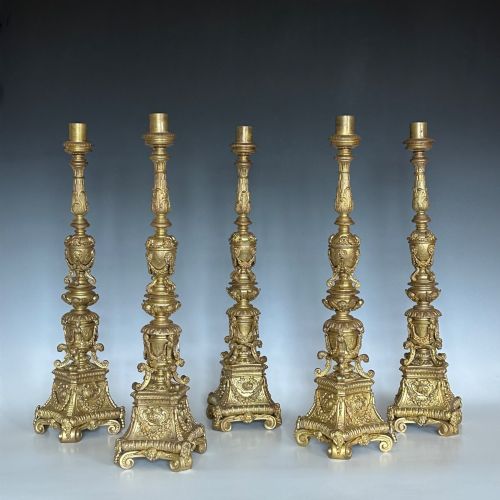


Antique Italian Candleholders
Antique italian candleholders bring sculptural warmth to a room, ranging from gilded altar pieces to brass wall sconces.
Antique Italian Candleholders
You are most likely to meet pairs of carved and gilded wooden candlesticks reflecting baroque or rococo design. These items originate from Italian workshops and churches, often displaying remnants of polychrome paint and silvered mecca finishes.
The inventory extends across candlesticks, candle holders, wall sconces, and candelabras. Pieces range from modest nineteenth-century domestic items to imposing eighteenth-century altar pieces of impressive proportions.
How they were made
Wood forms the primary structural material, heavily shaped through hand carving before receiving decorative treatments. Artisans applied layers of gesso to wooden cores to create smooth surfaces for subsequent gilding or painting.
Giltwood, silver leaf, and polychrome paint create the rich decorative skins characteristic of these objects. Metal pieces utilise cast brass, gilt bronze, and ormolu, particularly in figures and sconces produced for the grand tour market.
Several pieces feature carved Blackamoor figures holding candles, a striking motif found within nineteenth-century decorative arts.
What varies in quality
The crispness of the hand carving dictates much of the visual success in wooden examples. Deeply undercut foliage and expressive figures demonstrate superior craftsmanship compared to softer, more mechanical execution.
The integrity of the original surface finish separates standard items from finer survivals. Retained layers of genuine gold leaf, silvered mecca, and early polychrome pigment command greater appreciation than later overpainting.
The Antique Italian Candleholders Glossary
- Giltwood
- Wood that has been coated with a thin layer of gold leaf or gold paint. This technique provides a luminous surface that catches candlelight effectively.
- Mecca
- A transparent golden varnish applied over silver leaf or tin to imitate gold. It creates a warm, aged metallic tone frequently found on altar-type candlesticks.
- Gesso
- A plaster-like mixture applied to wood to prepare the surface for gilding or painting. It allows for crisp carved details before the metal leaf is laid down.
- Candelabra
- A branched candlestick holding multiple lights. These larger pieces often incorporate figural elements or elaborate scrolling arms.
- Polychrome
- Decorated in multiple colours. This paintwork often appears alongside gilding on devotional and decorative Italian objects.
Antique Italian Candleholders: Frequently Asked Questions
What is an altar-style candlestick?
Altar-style candle-sticks are tall, substantial pieces originally designed for church use. They feature sturdy bases and elevated proportions to stand securely upon church altars.
These pieces often display baroque or rococo ornamentation, reflecting their ecclesiastical origins and intended visual impact.
How do I clean antique wooden candleholders?
Cleaning requires a soft, dry brush to remove dust from intricate carved details. Moisture and commercial cleaners damage fragile historic surfaces like gesso and gold leaf.
Keeping them away from direct heat sources prevents the wood from drying and cracking over time.
Are brass sconces from the grand tour period?
Grand tour brass wall lights and sconces date from the Victorian era when travellers collected souvenirs across Italy. These items catered to foreign visitors seeking decorative pieces for domestic interiors.
They combine traditional Italian motifs with portable lighting formats suited to nineteenth-century homes.
How can I tell eighteenth-century pieces apart?
Eighteenth-century examples typically show deeper hand carving, heavier proportions, and authentic wear to the underlying gesso and wood. Baroque and rococo forms from this era prioritize organic asymmetry and dramatic scrolling.
Later copies or nineteenth-century interpretations often exhibit more uniform tool marks and different ageing patterns in the gilt surfaces.