




Italian Bronze Urn
An italian bronze urn brings the classical weight of antiquity into a room, serving as a sculptural souvenir from the Grand Tour.
Italian Bronze Urn
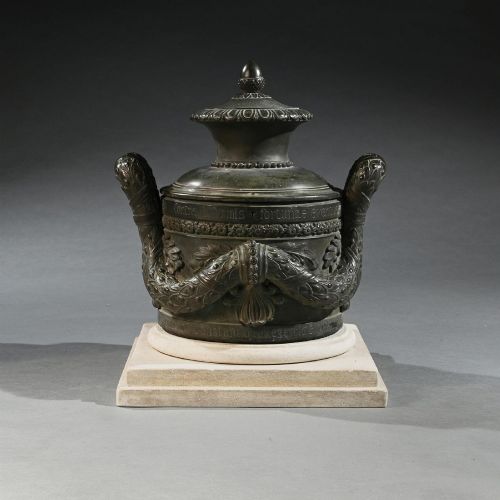
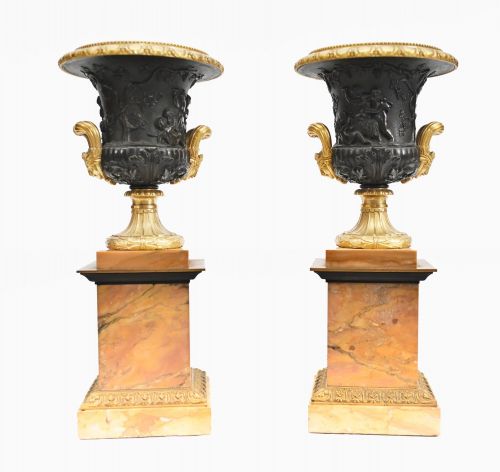
The search for an italian bronze urn reveals vessels shaped as Campana and Warwick vases, tazzas, and tripod Atheniennes. These pieces draw directly on classical antiquity, created as souvenirs for travellers on the Grand Tour.
Most examples date from the nineteenth century, spanning the Victorian era, alongside pieces originating in the eighteenth century. They appear singly or in pairs, functioning as decorative vessels, planters, and ornamental ewers.
Materials and construction
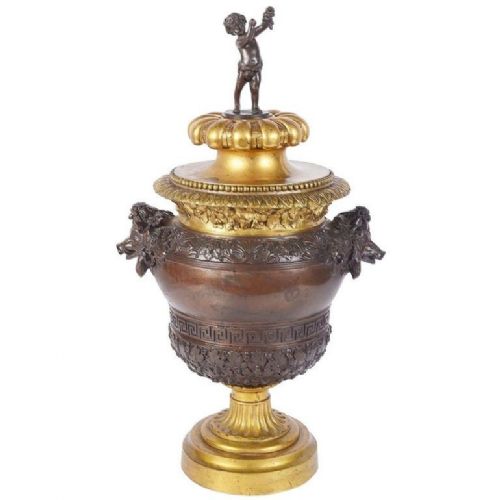
Foundry work combines cast bronze with patinated or gilt finishes, often mounted on marble or stone bases. Some iterations incorporate ormolu, brass, and glass elements to highlight classical ornamentation.
Casting techniques capture intricate relief details, such as cherubs and Bacchus motifs, replicating celebrated antiquities for nineteenth-century collectors.
A bronze vessel might double as a drinking cup or a maritime locking device, proving that Grand Tour souvenirs had a playful side.
Craftsmanship and presence
Finer examples display crisper chasing in the metalwork and deeper relief in sculptural figures like cherubs and Bacchus. The integration of high-grade marble bases and controlled patination elevates the decorative impact.
Superior weight and balance distinguish better casts, while inscriptions or specific classical forms like the Warwick vase add historical resonance to individual vessels.
The Italian Bronze Urn Glossary
- Grand Tour
- A traditional trip through Europe undertaken by upper-class young European men of means, resulting in the collection of antiquities and souvenir bronzes.
- Campana
- A bell-shaped vase form popular in classical antiquity and revived during the nineteenth century for decorative urns.
- Warwick Vase
- A large Roman marble vase discovered in Hadrian's Villa, frequently reduced in bronze for Grand Tour collectors.
- Tazza
- A shallow saucer-like vessel or cup on a stem and foot, often utilised as a decorative centrepiece.
- Athenienne
- A tripod stand supporting a bowl or vase, modelled on ancient furniture forms found in Pompeii and Herculaneum.
- Ormolu
- Gilded bronze, applied to decorative metalwork to create a rich gold-coloured finish.
Italian Bronze Urn: Frequently Asked Questions
What is an italian bronze urn?
An italian bronze urn is a decorative vessel cast in bronze, frequently produced during the nineteenth century as a souvenir for travellers on the Grand Tour.
These pieces copy ancient Roman and Greek models, taking shapes such as Campana vases, tazzas, and tripod vessels.
How were these urns used originally?
Travellers collected them in Italy to display their classical education, refined taste, and wealth upon returning home.
In domestic interiors, they functioned purely as ornamental displays, table centrepieces, or occasionally as small planters and posy vases.
Where should I place an urn in my home?
Their sculptural silhouette suits heavy wooden mantelpieces, sideboards, or console tables where their patinated surfaces catch the light.
Pairs look striking balanced at either end of a long surface, while single vessels anchor a bookshelf or small display table.
How do I distinguish nineteenth century pieces?
Examine the quality of the bronze cast, the depth of the patination, and the character of any associated marble bases.
Nineteenth-century Grand Tour items typically show specific classical revivals, referencing famous excavations and museum pieces of that era.