


Irish Desk
An irish antique desk brings substantial mahogany and walnut character to a room, offering practical workspace rooted in eighteenth and nineteenth century cabinet-making traditions.
Irish Desk
When you search for an irish antique desk, you encounter pieces spanning the Georgian, Regency, and Victorian periods, with mahogany and walnut serving as the primary timbers. The selection includes kneehole desks, bureau cabinets, and writing slopes, often reflecting Dublin craftsmanship.
The nineteenth century examples frequently take the form of library tables and writing boxes, whilst eighteenth century pieces lean towards solid walnut desks and bureau cabinets on stands. Regional variations also appear through inlaid Killarney work and carved oak details.
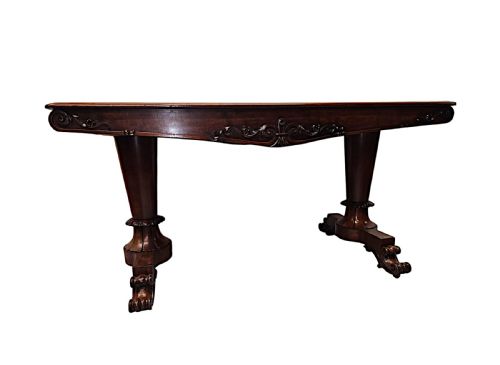
Buyers are most likely to meet mahogany library tables and walnut writing slopes on this page, alongside occasional side tables adapted for writing. These forms illustrate the functional requirements of domestic and library spaces across successive reigns.
How they were made
Cabinet-makers utilised dense timbers such as mahogany, red walnut, pollard oak, and ash, selecting figured grain for prominent surfaces and secondary woods for drawer linings. Construction relied on traditional dovetailing and mortise and tenon joints to ensure structural stability.
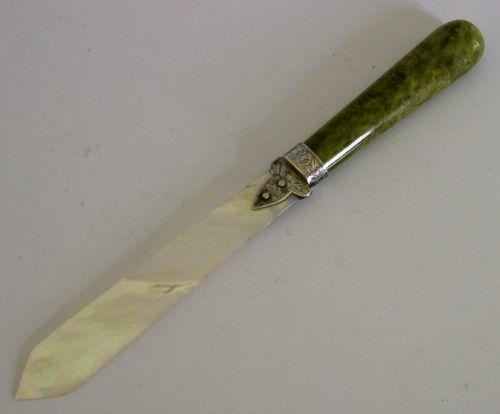
Secondary materials included brass handles, tooled leather writing inserts, mother-of-pearl inlay, and occasionally Connemara marble, applied to enhance both utility and visual contrast. Hand carving shaped the legs, edges, and structural ornaments of the finer pieces.
Surface finishing involved hand-applied polishes that highlighted the natural chatoyancy and depth of the timber, particularly on walnut and mahogany items produced in Dublin workshops.
The site listings feature Irish antique desks and writing furniture spanning from the mid-eighteenth century George II period through to the Edwardian era.
What varies in quality
The standard of carving and timber selection dictates the distinction between standard utilitarian furniture and high-workshop output. Pieces attributed to recorded makers display crisper mouldings, more balanced proportions, and superior grain matching across drawer fronts and tops.
The integrity of secondary construction, such as untouched drawer bottoms and original brass hardware, separates unaltered survivals from heavily restored examples. Superior execution shows in the precision of inlaid details, particularly in Killarney work and cabinet interiors.
Williams and Gibton·Gillingtons of Dublin·George Austin·Rodman and co
The Irish Desk Glossary
- Bureau cabinet
- A desk form featuring a sloping fall-front that opens to reveal internal pigeonholes and small drawers, frequently raised upon a chest of drawers or a stand.
- Killarney work
- An inlaid decorative technique utilising native timbers like arbutus and yew to create intricate geometric or floral motifs on nineteenth century boxes and slopes.
- Library table
- A freestanding centre table designed for domestic or institutional study, often fitted with frieze drawers and finished on all sides.
- Writing slope
- A portable box with an inclined writing surface that opens to store stationery, inkwells, and writing implements.
- Secretaire
- A cabinet or desk incorporating a concealed writing drawer or fold-down writing flap within its upper structure.
Irish Desk: Frequently Asked Questions
How do I identify an irish antique desk?
Look for distinct regional cabinet-making traits, characteristic native timbers such as red walnut or pollard oak, and specific structural proportions typical of Dublin workshops.
Attribution often relies on maker stamps, historical provenance, or documented construction methods linked to known Irish firms.
Where were these desks used originally?
These pieces served primarily in the libraries, studies, and private drawing rooms of country houses and urban townhouses.
They accommodated correspondence, estate management, and scholarly study, reflecting the administrative needs of their period.
Can I use an antique desk daily?
Most sturdy mahogany and walnut examples function well for modern writing and laptop use, provided the writing surface is treated with care.
Writing slopes and smaller portable desks require attention to hinges and internal compartments during regular handling.
What is the difference between a slope and a bureau?
A writing slope is a portable box placed on a table for use, whereas a bureau is a larger freestanding desk with a built-in writing flap.
Both types contain internal compartments for stationery, but bureaus generally provide greater storage capacity underneath the writing surface.