


Inlaid Mahogany Washstand
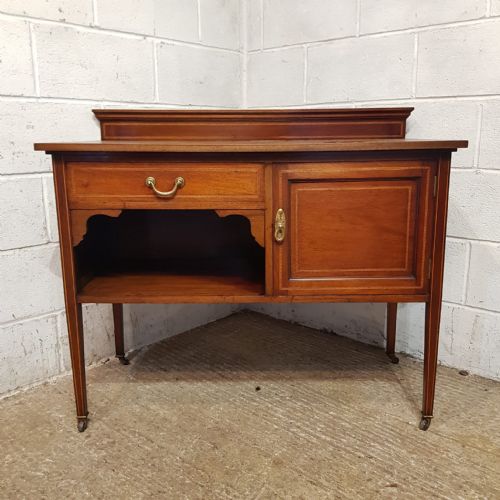
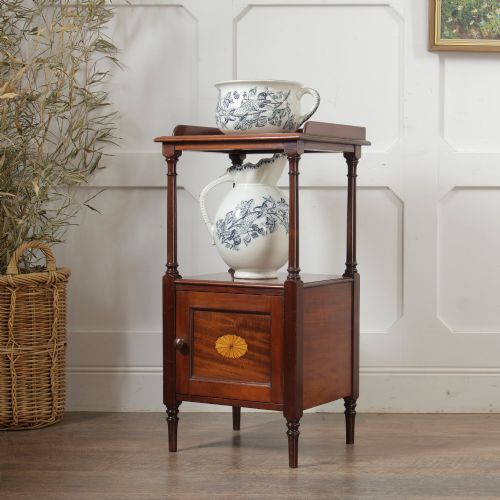
An inlaid mahogany washstand brings practical Georgian and Edwardian craftsmanship into a bedroom with distinct timber grain and crisp boxwood lines.
Inlaid Mahogany Washstand
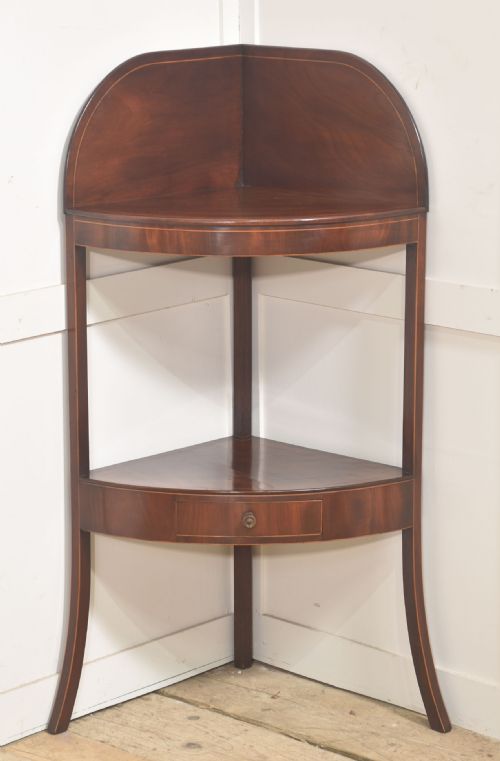
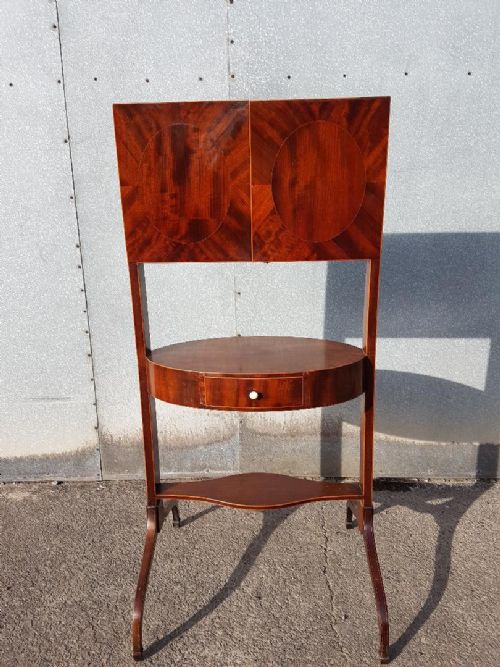
The version most commonly met on this page is the Edwardian or Georgian corner washstand, frequently featuring mahogany timber enhanced with boxwood or satinwood inlay. Makers also produced variations containing marble tops, tile backs, or folding tops that concealed basins and mirrors.
How they were made
Cabinet makers utilised solid mahogany and timber veneers, shaping curved bow fronts and constructing sturdy carcasses designed to support heavy marble slabs. Boxwood and satinwood inlay formed delicate stringing and geometric motifs along doors and tops.
Brass hardware such as handles, hinges, and occasional castors provided functional accents. Some examples integrated tiles into splashbacks or incorporated mirrors and tambour cabinets within the timber framework.
Listings feature mahogany, marble, brass, and boxwood inlay across Georgian, Regency, and Edwardian eras.
What varies in quality
The calibre of an inlaid mahogany washstand rests upon the crispness of its boxwood and satinwood inlay and the selection of figured mahogany timber. Master craftsmen achieved precise joinery and balanced proportions, particularly on complex bow front and corner profiles.
Gillows Lancaster·Shapland and Petter
The Inlaid Mahogany Washstand Glossary
- Boxwood inlay
- A pale contrasting wood inserted into recesses within the darker mahogany surface to create decorative lines and borders. This technique highlights edges and panel shapes.
- Bow front
- A convex curved cabinet front that projects outward in a smooth arc. This shape frequently appears on corner and freestanding washstands.
- Gentleman's washstand
- A specialised cabinet version equipped with internal compartments, mirrors, and washing apparatus designed for men's grooming routines. These pieces often feature fitted interior drawers and surfaces.
- Tambour cabinet
- A small enclosed storage section constructed from narrow vertical strips of wood glued to a canvas backing, allowing the door to slide open along a track.
Inlaid Mahogany Washstand: Frequently Asked Questions
What is a corner washstand?
A corner washstand is a triangular or angled piece of furniture built to slot directly into the corner of a bedroom.
These pieces maximise bedroom space while providing a functional surface for a basin, jug, and grooming accessories.
How do I identify a Georgian washstand?
Georgian washstands typically display understated mahogany frames, delicate boxwood stringing, and precise proportions dating from the eighteenth century.
Many examples feature shaped splashbacks, undertier shelves for water jugs, and slender legs characteristic of the period.
Why do some washstands have marble tops?
Marble tops and tile backs were introduced to protect the surrounding timber from water splashes during washing.
Victorian and Edwardian makers utilised these stone surfaces for durability and hygiene in the bedroom.
How do I live with an antique washstand today?
An antique washstand functions effectively as a hallway table, a bedside cabinet, or a decorative corner display unit.
The surface and lower tiers offer practical display space for lamps, books, and ceramics without altering the historic structure.