
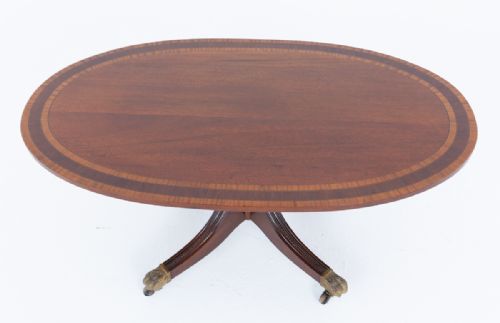


Inlaid Mahogany Centre Table
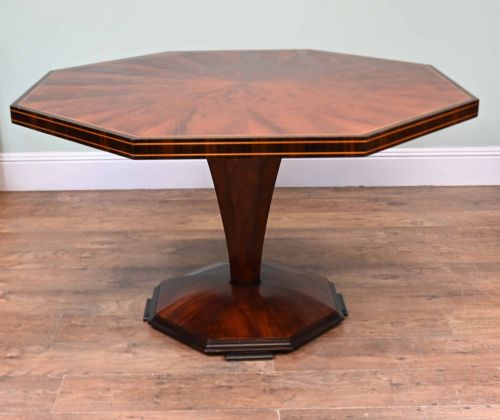
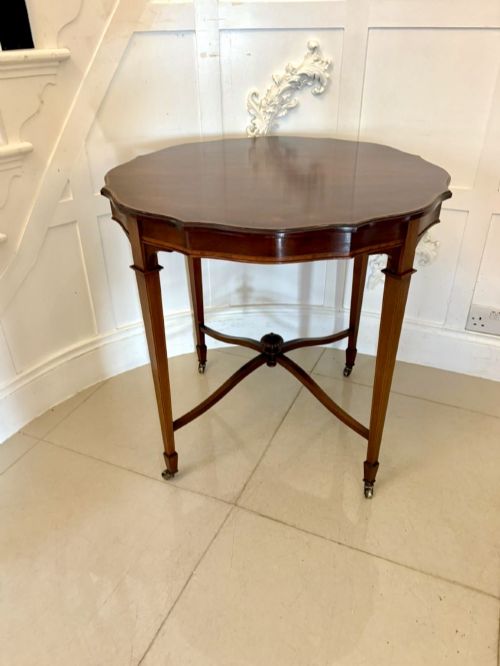
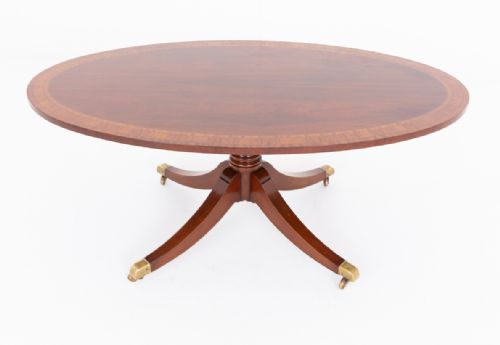
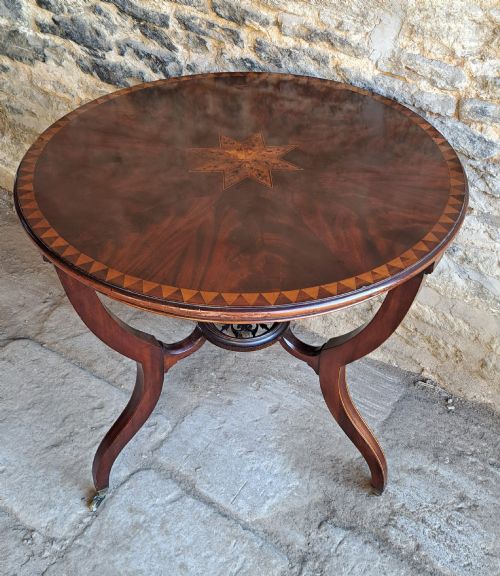
An inlaid mahogany centre table brings striking timber grain and delicate contrasting banding to the middle of a room.
Inlaid Mahogany Centre Table
An inlaid mahogany centre table stands free within a room rather than against a wall, displaying finished detail on all sides. These pieces range from Georgian and Regency forms to Victorian and Edwardian interpretations.
The Edwardian examples and nineteenth-century designs dominate the selection, appearing in circular, oval, and occasional formats.
Cabinet makers constructed these tables to serve functional roles as lamp tables, library tables, and principal room focal points.
Materials and methods
Artisans built the primary carcase using solid and veneered mahogany, often selecting figured or flame timber for the top surface. They integrated contrasting lighter woods such as satinwood and boxwood for geometric or floral stringing and marquetry.
Brass mounts, banding, and occasionally pietra dura or specimen marble inserts feature in the construction of select Regency and Victorian pieces. Cabinet makers employed precise joinery techniques to secure the timber panels against atmospheric changes.
Several tables feature detailed zodiac and avian marquetry motifs, bringing celestial charts and stone birds directly into the parlour.
Distinctions in quality
The refinement of the marquetry and the choice of timber grain determine the grade of an inlaid mahogany centre table. Superior examples exhibit tightly fitted contrasting veneers and crisp hand-cut stringing rather than printed or superficial decoration.
Proportion and structural integrity separate workshop output, where balanced pedestal supports or finely turned legs complement the composition of the top.
Francoise Linke·A. Beurdeley·Woodley family·Edwards and Roberts·Maples and Co
The Inlaid Mahogany Centre Table Glossary
- Marquetry
- Decorative patterns formed by inserting pieces of veneer into a wood foundation to create pictorial or geometric designs. This technique requires considerable skill from the cabinet maker.
- Satinwood
- A hard, yellow-toned timber utilised extensively for contrasting stringing and inlay work. It provides a bright visual accent against dark mahogany.
- Drum table
- A circular library table with a deep top resembling a drum, frequently fitted with drawers around the perimeter. These pieces date predominantly to the Regency period.
- Pietra dura
- An artistic technique using cut and fitted polished coloured stones to create images. It appears on the marble tops of select nineteenth-century tables.
Inlaid Mahogany Centre Table: Frequently Asked Questions
Where should I place a centre table?
These pieces work best positioned in the middle of a room, allowing access from all sides and showcasing the finished timber grain.
They serve effectively as lamp tables or occasional surfaces in larger living spaces and hallways.
How do I care for mahogany veneer?
Keep the timber away from direct sunlight and heat sources to prevent the mahogany and inlaid veneers from drying out.
Apply natural beeswax occasionally and polish gently with a soft cloth to maintain the surface finish.
What is the difference between Edwardian and Regency tables?
Regency tables from the early nineteenth century generally feature robust pillar supports, brass detailing, and architectural proportions.
Edwardian interpretations from around 1900 lean towards lighter slender legs, delicate satinwood banding, and Sheraton Revival influences.
Can I use a centre table for daily dining?
Most examples function as lamp, occasional, or display tables rather than heavy-use dining furniture.
Heavier Victorian and Georgian breakfast or library tables offer greater stability if required for regular seating.