
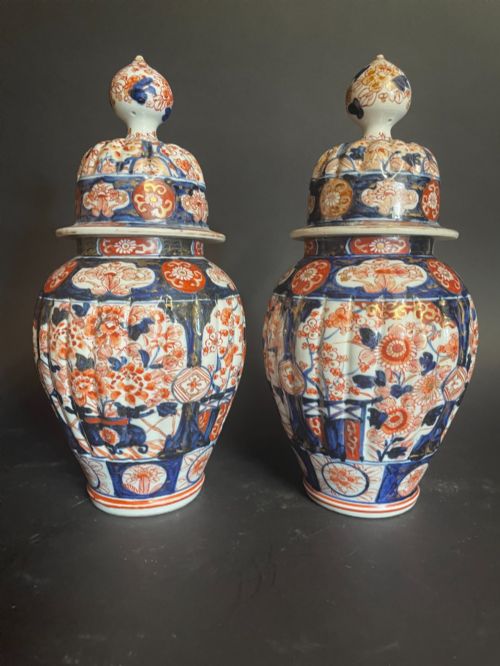
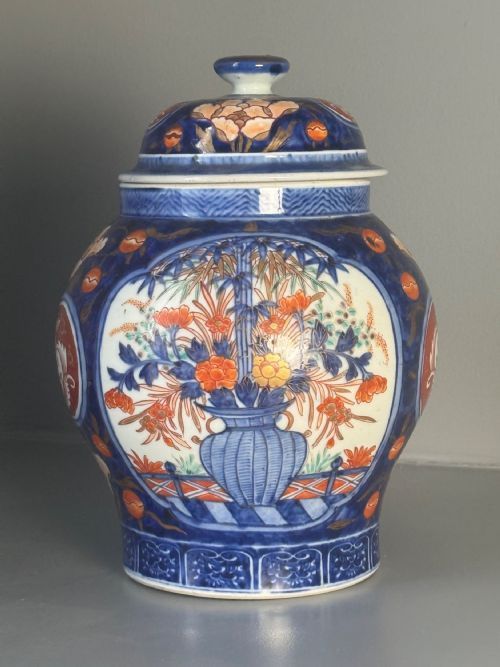


Imari Porcelain Temple Jar
An imari porcelain temple jar brings heavy palettes of cobalt blue, iron red, and gold leaf into a room, spanning periods from the Edo era to the Edwardian decades.
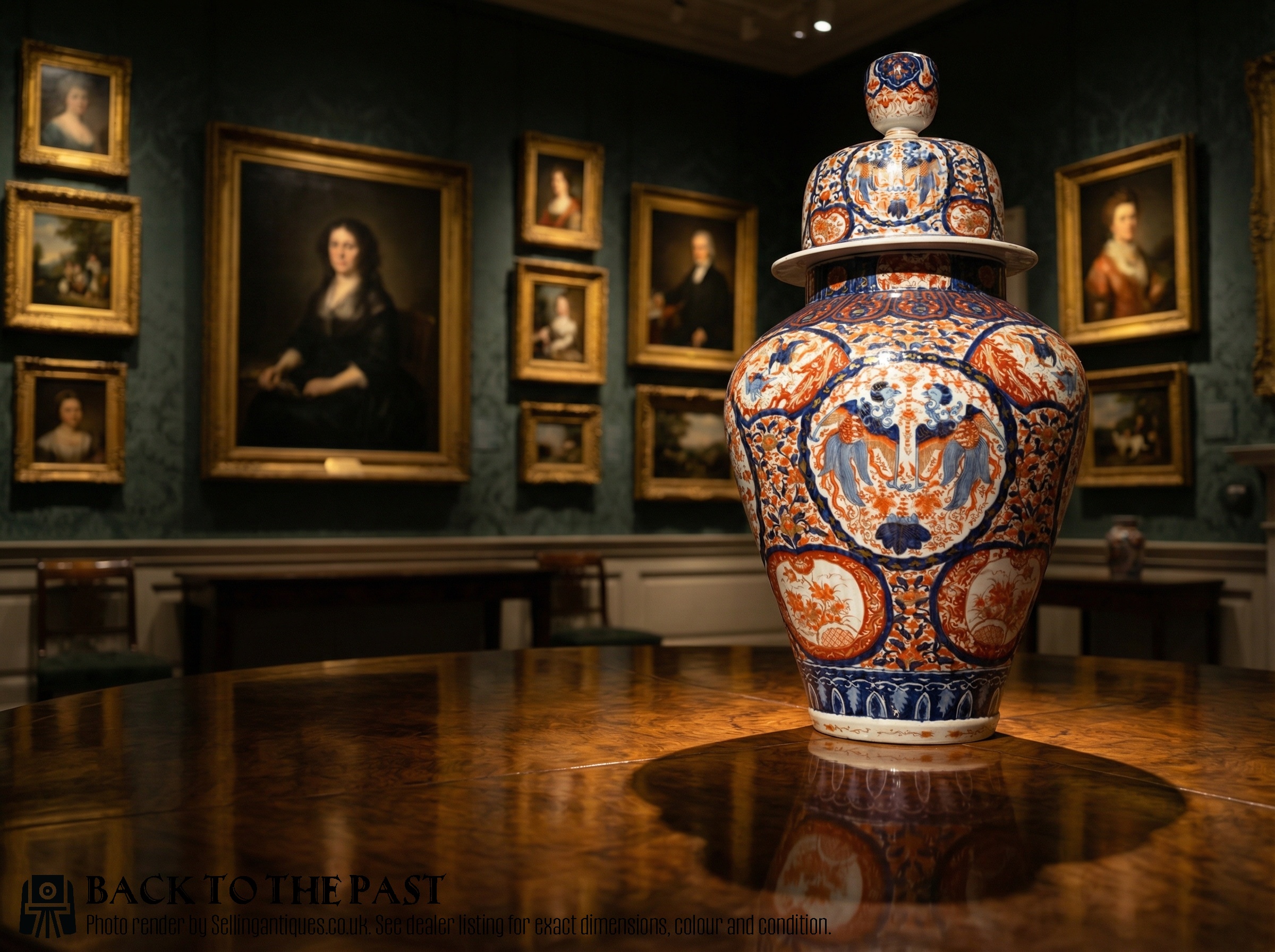
Imari Porcelain Temple Jar
When buyers search for an imari porcelain temple jar, they encounter lidded vases, ginger jars, and baluster vessels primarily from the nineteenth century alongside seventeenth and eighteenth-century origins. The form serves as a focal point for displays, often surviving in pairs or garnitures.
Japanese Arita kilns produced the majority of these pieces across the Edo and Meiji periods, though European makers also adopted the palette. Lidded jars and covered vases dominate the selections, combining utility with decorative presence.
How they were made
Potters shaped porcelain bodies on the wheel, applying cobalt enamel under the glaze before secondary firings fixed iron red enamels and gold leaf or gilding onto the surface. Some vessels incorporated ormolu mounts during later European adaptations.
The distinct Imari palette relies on high-temperature underglaze blue combined with iron red and supplementary metallic highlights, creating dense surface patterns that define the style.
Some jars are so tall they require their own dedicated stands to keep from dominating the floor entirely.
What varies in quality
Quality rests in the crispness of the cobalt painting, the purity of the white porcelain ground, and the precise application of gold leaf and enamel details. Superior examples display balanced symmetry across large baluster forms and covers.
The richness of the palette and the complexity of the diaper panels separate standard production pieces from exceptional works originating in Arita kilns or European revival workshops.
Samson
The Imari Porcelain Temple Jar Glossary
- Imari
- A style of Japanese porcelain originating from Arita, characterised by a palette of cobalt blue, iron red, and gold. The name derives from the port from which the wares were shipped.
- Baluster
- A vase form with a rounded body that tapers toward the base and swells near the lower centre. This shape provides stability and surface area for dense decoration.
- Garniture
- A set of three or more matching vases and lidded jars designed to be displayed together on a mantelpiece or cabinet top.
- Ormolu
- Gilded bronze mounts applied to the base or rim of a ceramic vessel. European makers frequently added these to Asian porcelain during the eighteenth and nineteenth centuries.
Imari Porcelain Temple Jar: Frequently Asked Questions
How were temple jars used?
These large lidded vessels held dry goods, spices, or medicinal herbs in traditional settings before transitioning into pure decorative display objects.
In Western interiors, pairs or garnitures stood upon mantelpieces, cabinets, and tables to project status and aesthetic taste.
How do I date an imari jar?
Dating relies on stylistic markers, potting techniques, and the character of the cobalt and iron red enamels. Seventeenth and eighteenth-century examples exhibit different clay bodies and brushwork compared to Meiji period or Edwardian pieces.
European revival pieces often reveal subtle differences in glaze texture and weight that separate them from Japanese originals.
Are lids usually original?
Many surviving jars retain their original matching covers, which is a key factor for completeness and visual balance. Replacement lids occur frequently due to the fragility of ceramic finials over centuries of handling.
Checking the fit and glaze continuity between the body and cover helps confirm whether they started together.
How do I display them?
Temple jars require sturdy surfaces due to their substantial porcelain weight and height, especially larger nineteenth-century examples. Placing them away from high-traffic edges prevents accidental impacts.
Grouping pairs or sets creates symmetry, while single large baluster jars anchor open spaces or corner tables.