



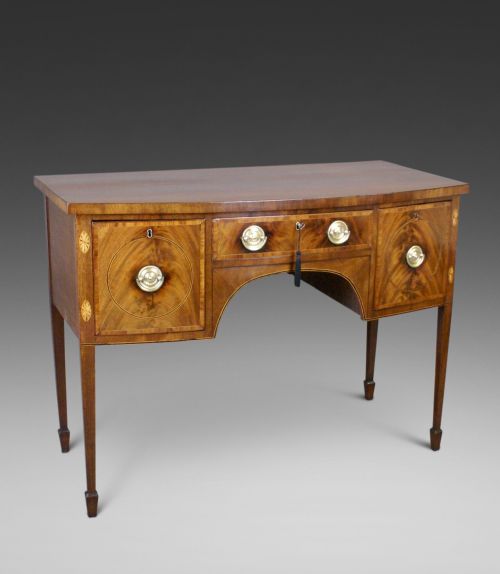
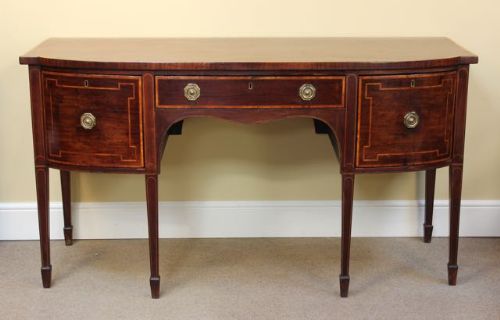
Hepplewhite Serving Table
A hepplewhite serving table brings refined eighteenth-century elegance and exceptional mahogany craftsmanship into a modern dining room.
Hepplewhite Serving Table
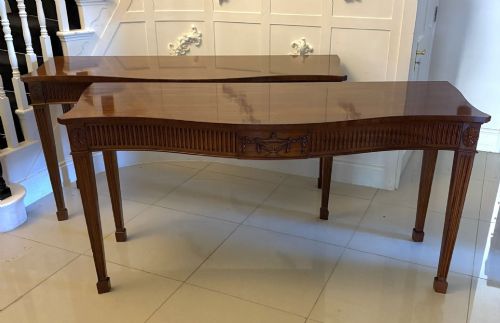
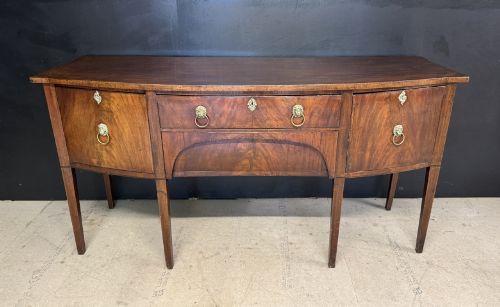
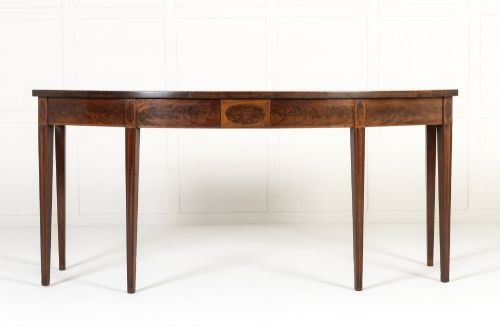
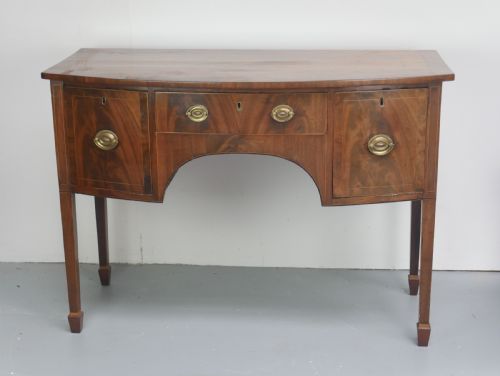
Buyers will encounter both genuine eighteenth-century pieces and later revival works from the nineteenth and twentieth centuries. Forms range from straight-fronted serving tables to serpentine and bowfront sideboards bearing delicate boxwood and satinwood inlay.
How they were made
Cabinetmakers utilised solid mahogany and flame mahogany veneers over secondary timbers, selecting stock for rich grain patterns. Drawer fronts and tabletops frequently received decorative contrast through boxwood and satinwood inlay.
Structural embellishments relied on neoclassical carving techniques applied directly to the mahogany frames. Brass hardware, including drop handles and backplates, completed the construction of these tables and sideboards.
Cabinetmakers occasionally hid secret compartments behind decorative inlay to safeguard family silver.
What varies in quality
The distinction between ordinary and superior pieces rests on the choice of timber and the crispness of the carving. Flame mahogany with deep natural figuring elevates a serving table far above plain stock.
Execution of the inlay and the balance of the serpentine or bowfront silhouette define the maker's mastery. Subtle proportions and untouched original brass fixtures distinguish the finest examples from standard production.
Gillow
The Hepplewhite Serving Table Glossary
- Serpentine
- A front contour characterised by a convex central section flanked by concave curves. This shape requires advanced cabinetmaking skill to execute cleanly in solid mahogany.
- Bowfront
- A convex, outwardly curving furniture front popular during the Georgian period. It softens the linear geometry of a dining room.
- Flame mahogany
- Timber cut from the fork of the mahogany tree where the branch meets the trunk, producing a fiery, three-dimensional grain pattern. It was favoured for high-status drawer fronts and tabletops.
- Neoclassical
- A style drawing inspiration from classical antiquity, featuring symmetrical geometry and restrained ornamentation. It dominates the decorative vocabulary of these serving tables.
- Boxwood inlay
- Contrasting light-coloured wood inserted into recesses within the darker mahogany surface. It creates delicate geometric borders and botanical motifs.
Hepplewhite Serving Table: Frequently Asked Questions
What is a hepplewhite serving table?
A hepplewhite serving table is a Georgian dining room piece known for graceful tapered legs and refined neoclassical lines. These tables function as servers, sideboards, or console tables.
Most examples feature mahogany construction, often enhanced with satinwood or boxwood inlay. They date from the eighteenth century through to later revival periods.
How do I identify a Georgian serving table?
Look for traditional eighteenth-century proportions, solid mahogany timbers, and hand-cut joinery. Neoclassical motifs and subtle stringing inlay are typical indicators of this era.
Check the drawer linings and backboards for age-appropriate wear and construction methods. Revival pieces from later centuries often display machine-made consistency in their secondary woods.
Where should I place a serving table?
A serving table belongs in a dining room or a spacious hallway where its linear silhouette can be appreciated. It provides a practical surface for serving food or displaying silver during gatherings.
Keep these mahogany pieces away from direct heat sources and strong sunlight to protect the wood and inlay. Regular polishing with traditional wax maintains the finish.
What is the difference between a sideboard and a serving table?
Serving tables are generally lighter in construction and often lack the extensive banks of drawers found on full sideboards. They emphasise open leg space and elegant console proportions.
Many pieces listed under these terms share similar Georgian aesthetics and neoclassical carving details. The primary distinction lies in the storage capacity and frame design.