




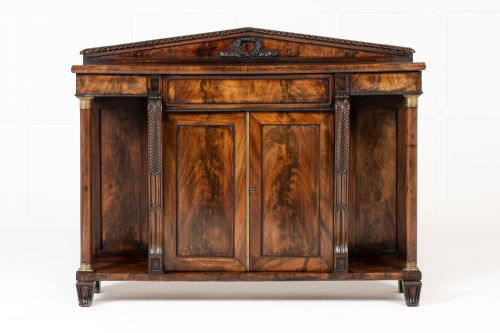


English Mahogany Sideboard
An english mahogany sideboard brings architectural presence and rich timber grain to a dining room or hall.
English Mahogany Sideboard
An english mahogany sideboard serves as a substantial dining room or hallway piece designed for storage and display. When searching for this phrase, buyers encounter forms ranging from Georgian serving tables to elaborate Victorian pedestal sideboards and chiffoniers.
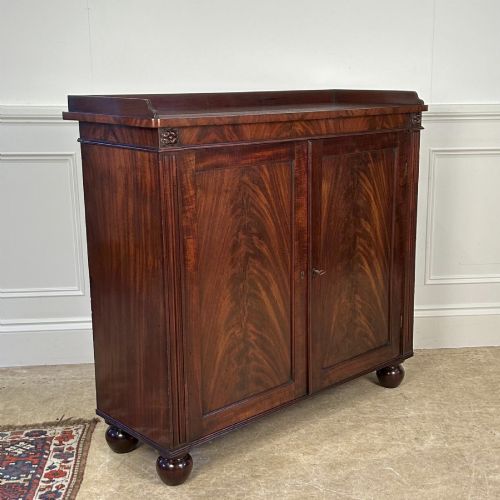
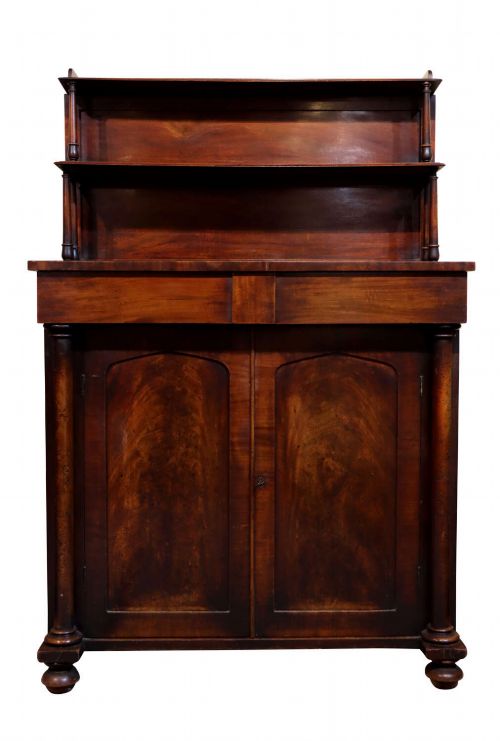
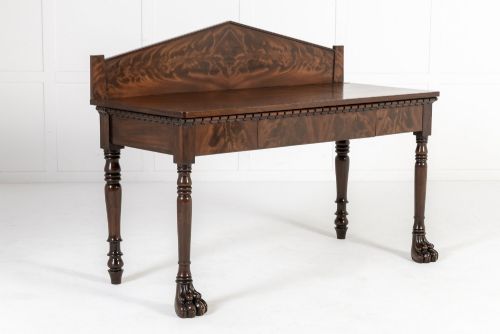
The pieces on this page span the eighteenth and nineteenth centuries, capturing the evolution from linear serving tables to deep pedestal cupboards. Regency and William IV examples frequently feature flame mahogany veneers and brass details.
Makers utilised dense timber to create functional furniture that anchored formal dining spaces. Later Victorian iterations introduced large mirrored gallery backs and four-door storage configurations.
How They Were Made
Cabinet makers built these pieces using solid mahogany frames overlaid with carefully selected flame mahogany veneer to create striking grain patterns across the doors and drawers. Workshops integrated secondary timbers internally while mounting brass handles, locks, and gallery rails to the primary surfaces.
Surface ornamentation relied on contrasting inlays of satinwood and ebony alongside hand-carved mouldings. Techniques evolved from eighteenth-century joinery to nineteenth-century pedestal construction, incorporating glass doors and marble or timber tops.
A miniature dresser base waits patiently on the floor, proving that grand country house furniture sometimes comes in remarkably small packages.
What Varies in Quality
The grade of timber selection separates standard storage furniture from exceptional examples. Fine pieces display matched flame mahogany veneers that mirror each other across cabinet doors, whereas lesser items utilise plain, unfigured boards.
Construction methods and hardware define the tier of craftsmanship. Superior sideboards incorporate finely detailed hand carvings, original brass mounts, and robust internal framing that survives centuries of daily use without sagging.
Gillows·Cowtan And Sons·Oetzmann And Co·S Jamar·John Gregory
The English Mahogany Sideboard Glossary
- Chiffonier
- A lower sideboard cabinet, often featuring enclosed shelving behind two doors and sometimes a raised superstructure or gallery back. These pieces became common during the Regency and Victorian periods.
- Flame Mahogany
- A veneer cut from the branchwood fork of the mahogany tree, producing a distinctive flickering wave pattern. Cabinet makers prized this timber for central door panels and drawer fronts.
- Pedestal Sideboard
- A heavy form featuring two large pedestals flanking a central section, popular during the Regency and William IV eras. The pedestals often contained cellarets or deep cupboards.
- Serving Table
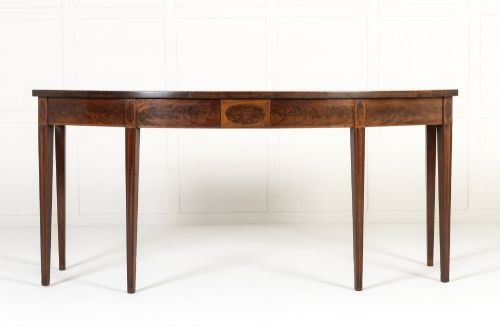
- An open-leg table precursor to the enclosed sideboard, designed for holding dishes during meals. Georgian examples frequently exhibit elegant tapered legs and inlaid borders.
- Cross-banding
- A decorative border technique where thin strips of veneer are laid perpendicular to the surrounding grain. This method frames drawer fronts and tabletops on eighteenth-century pieces.
English Mahogany Sideboard: Frequently Asked Questions
What is an english mahogany sideboard?
An english mahogany sideboard is a formal dining room or hallway storage piece constructed from tropical hardwood. These items evolved from simple serving tables into complex pedestal cupboards with extensive drawer and shelving capacity.
Craftsmen produced them across the Georgian, Regency, and Victorian eras. They remain central decorative and functional elements in traditional interiors.
How do I date a sideboard?
Dating relies on architectural style, leg forms, and handling of timber veneers. Georgian pieces tend to show linear serving table profiles or inlaid serpentine fronts, whereas Regency and William IV examples favour bold pedestal bases and flame veneers.
Victorian iterations often introduce heavier proportions, arched panel doors, and mirrored gallery backs. Comparing construction traits against known period markers clarifies the exact decade of manufacture.
Where should I place a sideboard?
These pieces suit dining rooms, large hallways, or spacious living areas where their length and depth can be appreciated. They function effectively as serving surfaces during meals or as display areas for lamps and decorative objects.
Ensure the room has sufficient clearance for cabinet doors and drawers to open fully. Placing them away from direct heat sources protects the mahogany timber and veneer.
How do I care for mahogany furniture?
Maintain mahogany surfaces by dusting with a dry, soft cloth and occasionally applying natural beeswax to nourish the timber. Avoid using modern silicone sprays, which build up residue and dull the antique finish over time.
Keep the furniture away from direct sunlight and radiators to prevent the wood from drying out and the veneer from lifting. Consistent indoor humidity levels preserve both the timber and the original brass hardware.