

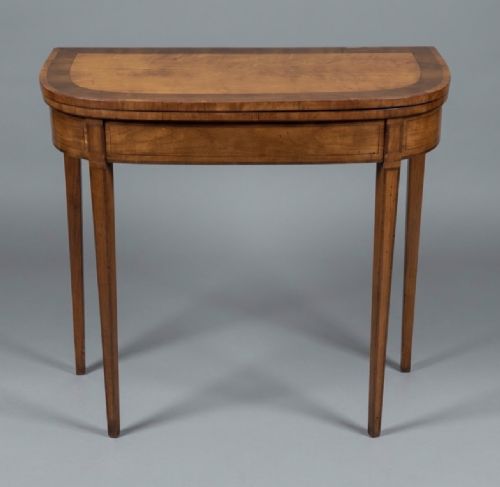
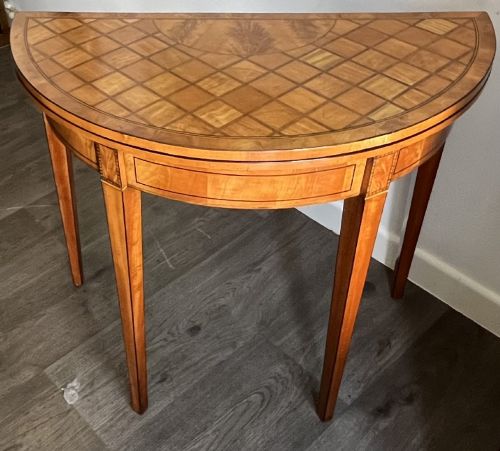
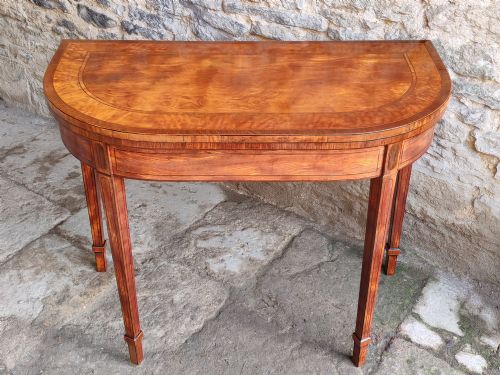
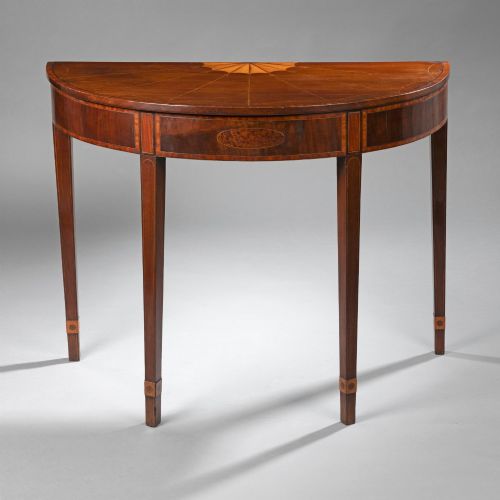
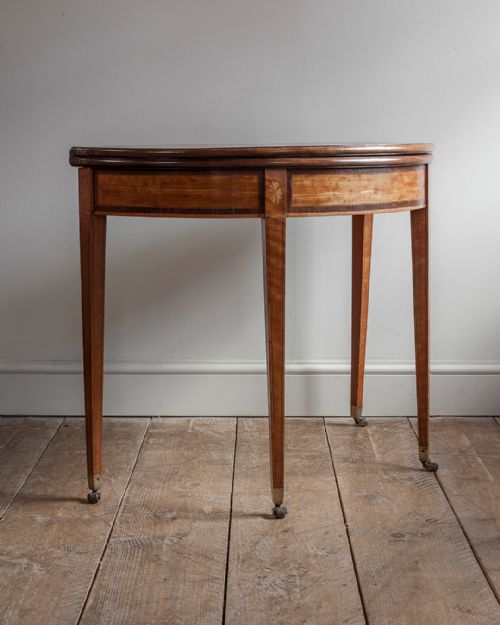


Hepplewhite Satinwood Console Table
These hepplewhite satinwood console table pieces bring refined geometry and delicate timber work to a room, offering adaptable surfaces from card playing to display.
Hepplewhite Satinwood Console Table
A hepplewhite satinwood console table or related folding form brings distinct late eighteenth-century elegance into a room. Buyers searching this phrase encounter a mix of genuine period items from the Georgian era alongside later revival pieces from the Victorian and Edwardian periods.
The material vocabulary centres strongly on satinwood, often paired with mahogany, rosewood, boxwood, and ebony. Forms span demi-lune console tables, serpentine tea tables, and fold-over card tables that double their surface area when opened.
Originating predominantly within Georgian and George III styles, these tables showcase graceful curved silhouettes and restrained classical ornament. Later iterations from nineteen-thirty or nineteen-hundred emulate these classic proportions using the same traditional timber combinations.
Materials and Craftsmanship
Cabinet makers utilised exotic timber veneers laid over sturdy secondary woods to create smooth decorative surfaces. Satinwood provides the golden yellow ground, while contrasting woods such as mahogany, rosewood, and ebony form delicate crossbanding and borders.
Inlay and painted decoration define the surface ornamentation of these tables. Craftsmen embedded fine lines of boxwood and ebony, or applied hand-painted motifs directly to the satinwood panels, achieving a light and balanced neoclassical aesthetic.
Hepplewhite Satinwood Console Table Retail Price Guide 2026
Typical asking prices for hepplewhite satinwood console table among the pieces listed under this phrase on Sellingantiques today, from the lower quarter to the upper quarter. They describe what is for sale here now, not the wider market.
Card tables often retain faint chalk marks inside their frames from eighteenth-century makers tallying up piecework wages before the varnish dried.
Assessing Quality and Execution
The finesse of the timber grain and the precision of the crossbanding separate standard workshop output from superior cabinet work. High quality surfaces display meticulously matched satinwood veneers with crisp, unbroken inlaid borders.
Structural integrity in the pivoting mechanisms and leg joints determines lasting utility. Finer examples maintain smooth movement in their fold-over leaves and tight joinery across serpentine and demi-lune frames without excessive timber shrinkage or movement.
The Hepplewhite Satinwood Console Table Glossary
- Satinwood
- A durable tropical timber known for its lustrous, golden sheen and smooth texture. It forms the primary decorative veneer on late eighteenth-century polite furniture.
- Demi-lune
- A half-moon shape characteristic of console and card tables designed to sit flush against a wall. This profile softens interior angles and saves floor space.
- Crossbanding
- A border technique where thin strips of veneer are laid with the grain running perpendicular to the main surface. This frames the top panel in a contrasting timber tone.
- Serpentine
- A curved line that undulates outward at the centre and inward at the sides or vice versa. It requires expert woodworking skill to execute accurately on a table apron or top.
Hepplewhite Satinwood Console Table: Frequently Asked Questions
How were these tables used originally?
These tables served primarily as multi-functional furniture in principal rooms, functioning as console tables against walls or opening out for card games and tea.
The fold-over mechanism allowed households to clear floor space during the day and expand surfaces for evening entertaining without cluttering the interior.
Can I use a card table as a regular console?
A card table sits comfortably against a wall in its closed position, functioning entirely as a slim console surface.
Opening the top reveals the baize-lined interior, offering versatility whenever extra tabletop space is required for guests.
How do I distinguish eighteenth-century pieces from later revivals?
Eighteenth-century examples display hand-cut joinery, period timber ageing, and natural wax patination developed over generations of use.
Revival pieces from nineteen-hundred or nineteen-thirty often show machine-tooled elements, tighter uniform finishes, and construction methods characteristic of twentieth-century workshops.
How do I care for satinwood surfaces?
Satinwood thrives in stable indoor environments away from direct sunlight and sudden radiator heat which can dry out veneers.
Applying a traditional beeswax polish occasionally maintains the natural lustre and protects the timber grain from moisture.