
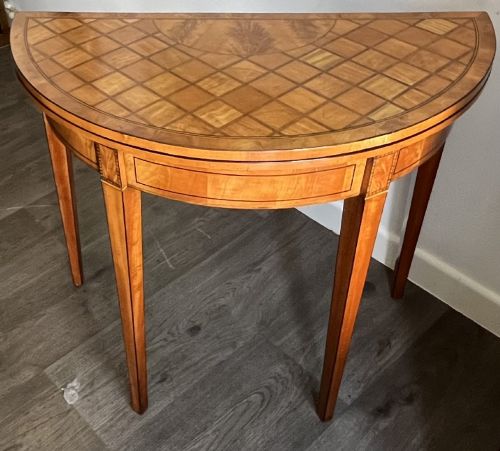
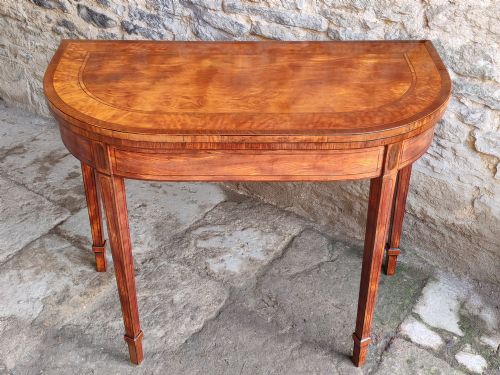
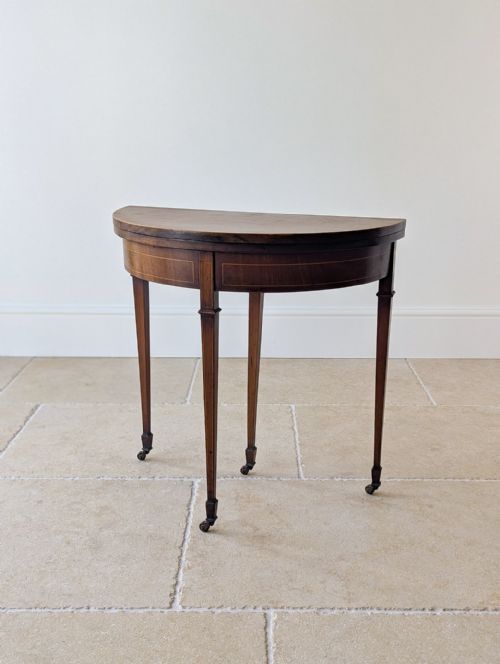
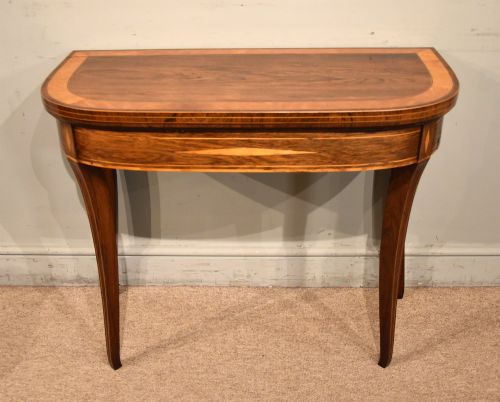
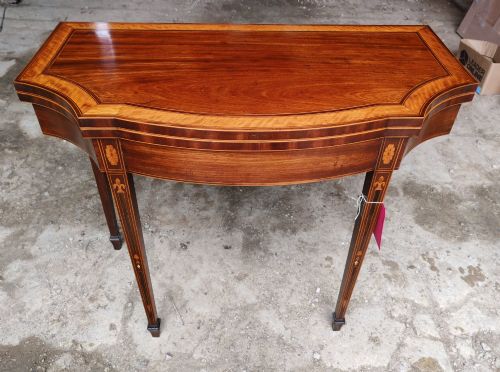
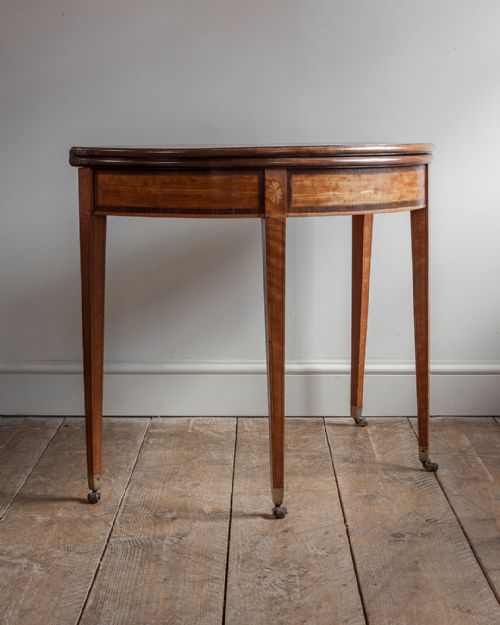


Satinwood Demilune Games Table
A satinwood demilune games table brings disciplined geometry and luminous timber to a room, functioning as a console until the leaf unfolds for play.
How they were made
Cabinetmakers constructed these tables using a sturdy carcase of mahogany or oak, upon which they laid veneers of satinwood, rosewood, and boxwood.
Surfaces frequently display marquetry, parquetry, and painted details, employing contrasting timber sections to create geometric patterns and floral motifs.
Brass hinges and swing-action pivot joints secure the folding top, allowing the upper leaf to turn over smoothly without straining the framework.
What varies in quality
The degree of refinement in the timber selection and inlay work separates ordinary examples from superior ones, with tight grain and crisp botanical or geometric borders indicating skilled workmanship.
Structural integrity depends on how accurately the hinge placement and pivot leg align when the top is folded open or closed.
The sophistication of the painted decoration or marquetry, alongside the preservation of the original polished finish, dictates the overall visual impact of the piece.
Some tables hide secret compartments beneath the folding top, originally designed to keep spare counters and stray playing cards safely out of sight.
The Satinwood Demilune Games Table Glossary
- Demilune
- Half-moon shape. This semicircular form allows the table to stand flush against a wall.
- Fold-over
- A hinged top design. The upper leaf rotates and rests upon an extended frame or leg to create a flat playing surface.
- Marquetry
- Veneer patterns. Craftsmen piece together various coloured woods to form decorative pictures and designs on the surface.
- Cross-banded
- Border decoration. A strip of veneer is applied around the edges with the grain running perpendicular to the main panel.
- Parquetry
- Geometric inlay. Wood pieces are arranged in repeating patterns such as cubes or chequers.
Satinwood Demilune Games Table: Frequently Asked Questions
How were these tables used?
These pieces functioned primarily as pier tables or console tables against a wall during daytime hours, maintaining a neat domestic footprint.
When evening arrived, the hinged top unfolded to accommodate card games, social gatherings, and parlour pastimes.
How do I spot a Georgian original?
Georgian examples display period construction methods, traditional timber ageing, and hand-cut joinery beneath the framing and underneath the top.
Stylistic cues include classical satinwood inlay, crisp proportions, and period-appropriate hardware rather than modern fixings.
What is Sheraton style?
Sheraton style draws on the neoclassical designs popular in the late eighteenth century, characterised by elegant tapering legs and restrained ornamentation.
Tables in this taste utilise contrasting veneers, boxwood stringing, and balanced proportions to achieve a refined aesthetic.
How do I care for satinwood?
Satinwood requires stable indoor humidity and protection from direct sunlight to prevent the timber from fading and the delicate veneers from lifting.
Occasional dusting with a soft, dry cloth preserves the polished surface without the need for heavy modern cleaning products.