
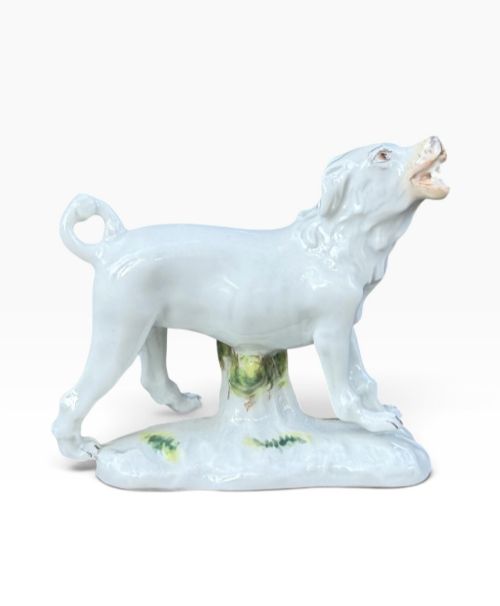


Hard Paste Porcelain Sculpture
Hard paste porcelain sculpture brings enduring 18th and 19th-century European craftsmanship into a room.
Hard Paste Porcelain Sculpture
A hard paste porcelain sculpture represents detailed figural work created across the eighteenth, nineteenth, and twentieth centuries. When searching for hard paste porcelain sculpture, collectors encounter figures and groups depicting animals, street traders, gardeners, and mythological scenes.
The pieces on this page are predominantly German and French in origin, featuring notable works from Meissen alongside productions by C. G. Schierholz in Plaue and Samson in France. Forms range from single animal figures to elaborate multi-figure groups like musicians and harvesters.
The selection spans several distinct stylistic periods, moving from Rococo and Rococo Revival designs to nineteenth-century interpretations and twentieth-century naturalist works. Buyers will find both cabinet-sized figures and larger presentation pieces measuring up to fifty centimetres.
How they were made
Makers shaped hard paste porcelain using a high-firing ceramic body composed of kaolin and petuntse, which yields a dense, vitreous substrate. Artisans applied vitreous glaze over the moulded body before subjecting the piece to high kiln temperatures.
Decoration relied on hand-applied enamel paint and enamel pigments fused to the glazed surface during subsequent lower-temperature firings. Many examples incorporate gold leaf and gilt highlights to accentuate the sculptural details and garments.
Monkeys holding fruit and leopards attacking snakes demonstrate that historical porcelain sculptors possessed a wonderfully theatrical sense of drama.
What varies in quality
Quality in these sculptures rests upon the crispness of the moulding and the nuance of the hand-painted enamel work. Superior pieces exhibit fine detail in facial expressions, textiles, and naturalistic elements without blurring or pooling in the glaze.
The sophistication of the composition distinguishes standard production from exceptional works, particularly in multi-figure groups where anatomical proportions and spatial arrangement dictate the artistic success of the piece.
Meissen·C. G. Schierholz·Samson
The Hard Paste Porcelain Sculpture Glossary
- Hard-paste porcelain
- A dense and durable ceramic material invented in Europe in the early eighteenth century, composed of kaolin and china stone. It fires at very high temperatures to create a strong, impermeable body.
- Enamel
- Opaque or translucent glassy substances fused to the surface of porcelain during firing to add colour and detail. These pigments retain their brilliance over centuries.
- Gilt
- A thin layer of gold or gold leaf applied to the surface of porcelain to highlight decorative elements. It adds a reflective quality to garments, bases, and ornamental details.
- Glaze
- A glassy coating applied to the fired ceramic body to seal the porous material and provide a smooth, glossy finish. It protects the underlying body and painted decoration.
- Rococo Revival
- A nineteenth-century design style that revives the asymmetrical curves, natural motifs, and ornate scrollwork of the mid-eighteenth century. It frequently appears in nineteenth-century figural groups.
Hard Paste Porcelain Sculpture: Frequently Asked Questions
How do I identify a Meissen figure?
Meissen pieces often feature distinct modeled forms, ranging from animals to complex groups, produced at the famous German factory. Examining the style, subject matter, and quality of the enamel painting helps establish attribution.
Many figures also carry period characteristics specific to eras such as the Marcolini period or nineteenth-century production phases.
What is hard paste porcelain?
Hard paste porcelain is a true ceramic composition fired at exceptionally high temperatures, resulting in a durable and vitreous body. It differs from soft paste by being harder and less porous.
This material allows for sharp sculptural details and a bright, glossy surface finish that accepts enamel colours readily.
How should I display these sculptures?
These sculptures suit placement in secure cabinets, on sturdy console tables, or within dedicated display shelving away from high-traffic areas. Adequate lighting helps reveal the fine enamel work and gilt details.
Ensure the display surface is stable, particularly for larger multi-figure groups and taller pieces.
Are these figures fragile?
Hard paste porcelain is physically hard, but protruding elements such as fingers, leaves, and musical instruments remain vulnerable to impact. Handle each piece with two hands, supporting both the base and the body.
Routine maintenance requires only gentle dusting with a soft, dry brush to preserve the enamel and glaze.
How do I distinguish eighteenth and nineteenth-century pieces?
Eighteenth-century examples often display the lighter, more fluid characteristics of the Rococo style and earlier modeling conventions. Nineteenth-century works frequently show the heavier forms and revivalist tendencies typical of later Victorian production.
Comparing the complexity of the modeling and the palette of the enamel paint provides further clues to the date of manufacture.