
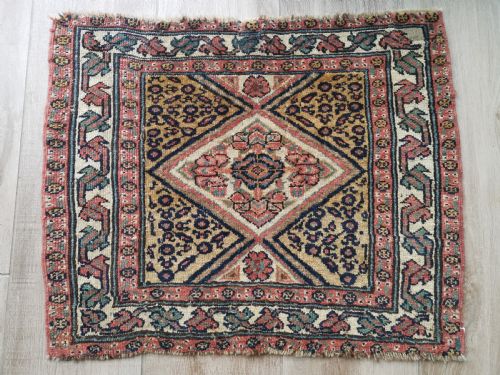
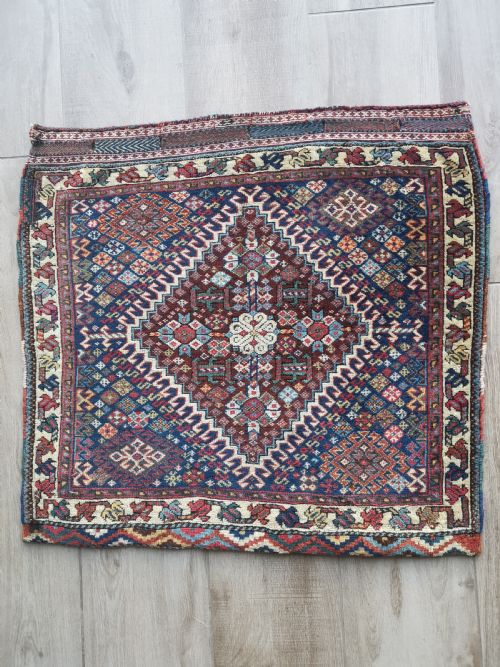


Hand Knotted Wool Saddlebag
These hand knotted wool saddlebag pieces are tribal weavings crafted for nomadic life, prized by collectors for their authentic village character and rich natural dyes.
Hand Knotted Wool Saddlebag
A hand knotted wool saddlebag is a tribal textile created by nomadic and village weavers across Persia, designed originally for practical pack animal use. When you search this phrase, you encounter bag faces and half-saddlebags produced by tribal confederations such as the Qashqai, Afshar, Luri, and Kurdish groups.
The pieces listed here date from the nineteenth century into the early twentieth century, spanning periods like eighteen eighty, eighteen ninety, nineteen hundred, and nineteen thirty. They frequently appear as individual bag faces or fragments rather than complete pairs, preserved because of their striking geometric patterns and robust construction.
Makers from tribal groups including the Khamseh and Jaf Kurd produced these textiles using local wool to withstand daily rigours. Collectors value them for their direct connection to nomadic heritage and the individuality inherent in each tribal design.
How they were made
These textiles rely on hand-spun wool for both the pile and the foundation, often paired with cotton elements in later examples. The natural dyes utilised by nomadic weavers produce deep, enduring tones derived from local plants and minerals.
The construction involves hand knotting the wool onto a sturdy warp and weft foundation, creating a dense and durable fabric capable of enduring active service. Artisans from western and southern Persia employed traditional techniques passed through generations, ensuring each piece reflects regional weaving customs.
Listings span from eighteen eighty to nineteen thirty, showcasing wool, cotton, and natural dyes across Persian tribal styles.
What varies in quality
Quality in these tribal weavings rests upon the handle and lustre of the wool, where lustrous, luminous fleece elevates a piece significantly. The fineness of the knotting and the complexity of the tribal iconography also distinguish finer examples from simpler village work.
The integrity of the natural dye palette plays a major role in establishing a piece's visual strength, with rich colour saturation showing superior material preparation. Preserved tribal proportions and balanced central medallions demonstrate the weaver's artistic control over the format.
The Hand Knotted Wool Saddlebag Glossary
- Bagface
- The decorative front panel of a utilitarian saddlebag, usually preserved as a wall hanging or small rug after the back vanished.
- Knot
- The fundamental unit of pile construction where yarn is looped around warp threads by hand.
- Natural dye
- Colouring matter sourced from plants, insects, or minerals rather than synthetic chemical compounds.
- Warp
- The stationary vertical threads stretched upon a loom that receive the knots and weft.
- Weft
- The horizontal threads passed alternately over and under warp threads to secure the knots in place.
Hand Knotted Wool Saddlebag: Frequently Asked Questions
How were saddlebags used?
Nomadic tribes used these sturdy wool containers in pairs slung across pack animals to transport belongings during seasonal migrations. Their robust construction protected provisions and household goods while moving across rugged terrain.
Over time, as traditional nomadic lifestyles shifted, these utilitarian objects were separated into individual bag faces and preserved for their decorative qualities.
How do I live with a saddlebag face?
These small tribal weavings work exceptionally well mounted as wall art, where their dense wool pile and geometric patterns can be appreciated without foot traffic. They also function nicely as small table mats or accent pieces on chest tops.
Protecting them from direct, prolonged sunlight helps preserve the natural dyes used by the nomadic weavers.
How do I tell tribal groups apart?
Tribal attributions rely upon specific design vocabulary, palette choices, and structural characteristics unique to each confederation. Afshar and Qashqai weavers, for instance, often utilised distinct medallion layouts and colour combinations rooted in their regional heritage.
Comparing knot count and foundation materials alongside design motifs helps clarify the specific provenance.
What does bag face mean?
A bag face refers strictly to the decorative woven panel that formed the front of a functional double saddlebag. Because the plain flatweave backs and side gussets wore out faster or were cut away, the ornate faces survived independently.
Collectors prize these panels because they display the finest knotting and most complete design compositions of the original textile.