


Qashqai Bag Face
A qashqai bag face brings the dense patterns and saturated dyes of south-west Persia directly onto a wall or a floor.
Qashqai Bag Face
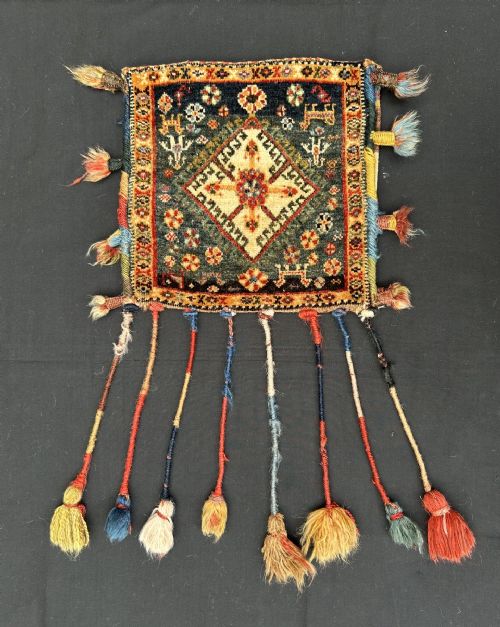
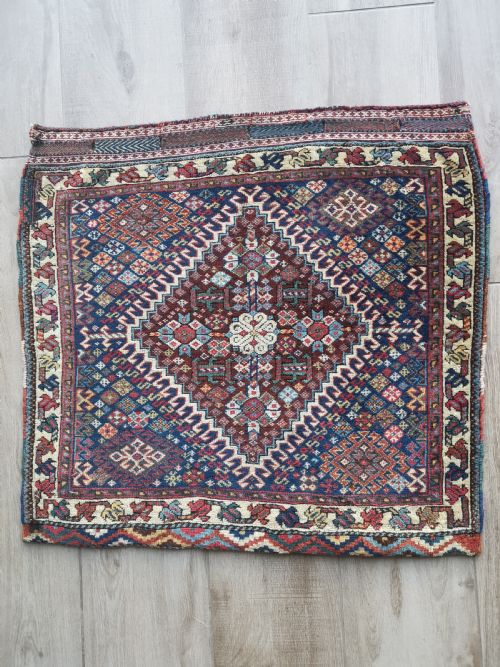
When you search for a qashqai bag face, you are looking at fragments and survivors of nomadic life in the Fars province of south-west Persia. These pieces represent the front panels of utilitarian storage sacks, saddlebags, and vanity bags that travelled with nomadic confederations. You will most frequently encounter single bag faces woven in tribal styles, often featuring central medallions or banded designs.
The evidence shows examples originating from sub-tribes and confederations such as the Bolvardi and Ard Kapan, spanning the nineteenth and early twentieth centuries. These textiles served practical purposes for storage during seasonal migrations before being separated from their original backs. Today, collectors preserve them as compact examples of tribal weaving traditions.
Materials and Construction
The materials recorded in the evidence rely primarily on wool, hand-spun wool, and cotton foundations, occasionally accompanied by silk wefts. Weavers utilised natural dyes to achieve the deep colour palettes characteristic of these Persian tribal textiles. Hand-knotting techniques create the dense pile seen on many examples, while other pieces incorporate flat-weave structures.
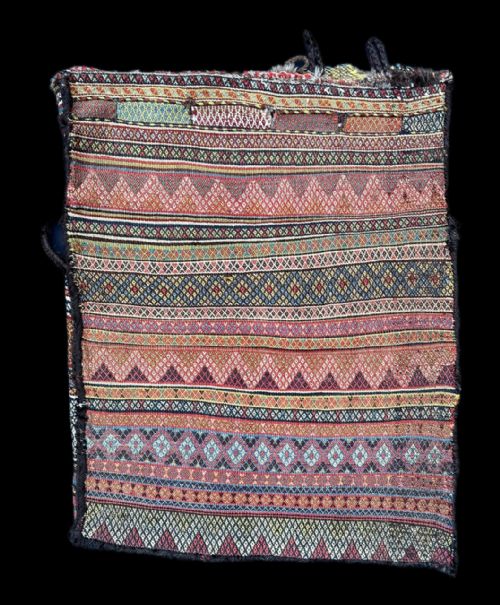
The construction reflects nomadic production methods intended for daily durability on animal transport or inside tents. Fine weaves require considerable time at the loom, resulting in structures that hold crisp geometric or pictorial motifs. Artisans combined these durable materials to withstand the rigours of tribal movement.
Listings feature pieces spanning from the nineteenth century through the 1930s, constructed from hand-spun wool, cotton, and natural dyes.
Evaluating Quality
Quality in these textiles rests upon the density of the knotting and the crispness of the design execution. Pieces with very fine weaves and well-defined motifs occupy the upper tier of the range, showing tighter control over the geometric and figurative elements. The vitality and variation of the natural dyes further separate standard examples from superior ones.
The preservation of the original pile and the integrity of the edges heavily influence the standing of any given piece. Better examples retain substantial depth in the wool and clarity in the secondary ornaments, such as birds or latch-hook medallions. The handling of the wool and the sophistication of the colour combinations dictate the overall visual strength.
The Qashqai Bag Face Glossary
- Bag face
- The decorative front panel of a nomadic storage bag or saddlebag, separated from its plain weave back. This is the primary surface that displays the tribal knotting and iconography.
- Fars province
- A historical region in south-west Persia associated with nomadic tribal confederations. It serves as the geographical origin for the majority of these woven pieces.
- Chanteh
- A small tribal vanity bag or personal container woven by nomads. Examples often appear in pairs or feature distinct bird and geometric motifs.
- Latch hook
- A stepped geometric motif commonly found projecting from medallions or borders. This design element is a staple of Persian tribal and Qashqai design vocabulary.
- Natural dye
- Colouring derived from plant, insect, or mineral sources rather than synthetic chemicals. These dyes produce the varied hues observed across nineteenth-century nomadic textiles.
Qashqai Bag Face: Frequently Asked Questions
What is a qashqai bag face?
A qashqai bag face is the decorated front of a nomadic storage sack or saddlebag woven in south-west Persia. These panels were separated from their original utility backs and survive as independent textile pieces.
They showcase the traditional patterns, natural dyes, and knotting techniques of tribal weavers from the nineteenth and early twentieth centuries.
How were these bags used?
Nomadic groups utilised these bags for transporting household goods, personal items, and provisions during seasonal migrations. They hung inside tents or rode loaded across the backs of animals.
Over time, changing domestic needs led to the front panels being preserved as decorative rugs or wall hangings.
How do I hang a bag face?
Most collectors mount these small textiles on fabric-covered stretcher bars or use specialised display clips that distribute weight evenly along the top edge. This prevents distortion of the wool foundation over time.
Keep them away from direct sunlight to protect the natural dyes from fading during long-term display.
How can I tell the age?
Age is determined by examining the materials, the handle of the wool, the structure of the foundation, and the complexity of the natural dye palette. Nineteenth-century examples often display hand-spun wool and specific structural traits associated with earlier nomadic weaving.
Comparative analysis with dated pieces in archives helps narrow down the period of production.