


Green Foliage Wall Tapestry
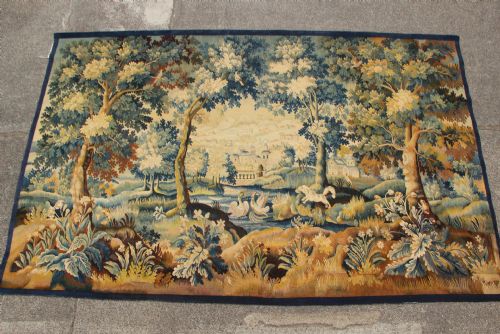
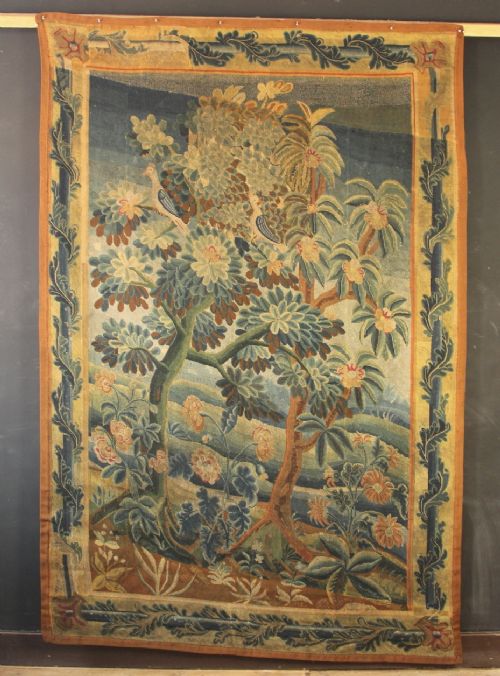
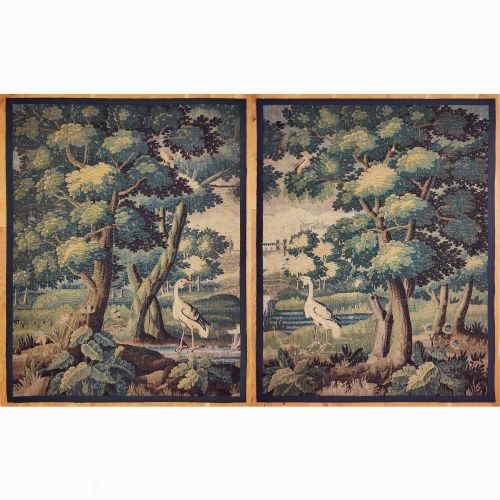
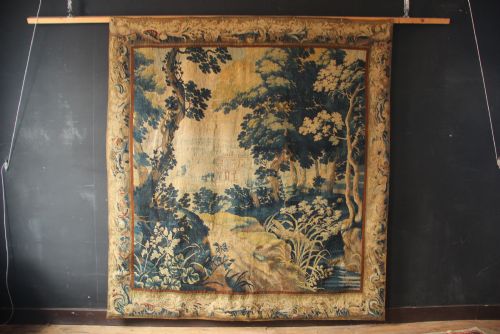
These green foliage wall tapestry panels bring centuries of pastoral calm indoors, woven with leafy woods and muted forest canopies.
Green Foliage Wall Tapestry
A green foliage wall tapestry depicts dense woodland scenes, leafy gardens and pastoral arbours designed to cover large interior walls. These verdure panels originate from European workshops spanning the seventeenth century through to the nineteenth century.
The pieces on this page are predominantly Flemish and French works, featuring Aubusson weaves and needlework panels. Buyers will find both grand room-sized hangings and narrower vertical panels suited to domestic spaces.
Materials and construction
These textiles rely on combinations of wool, silk, linen and cotton yarns to build texture and depth across the woven landscape. Wool provides the heavy structural weight and foundational greens, while silk threads introduce subtle highlights to foliage and distant foliage.
Weaving techniques involved manual looms where artisans built up complex leaf patterns and botanical details thread by thread. Needlework examples also appear, substituting the loom for hand-stitched canvas grounds.
Listings span seventeenth-century Flemish pieces through to mid-twentieth-century wall hangings, constructed from wool, silk, linen and cotton.
Assessing quality and depth
Quality rests in the intricacy of the botanical detail and the survival of the original dye palette. Softer shifts between shades of green indicate superior wool and silk selection.
The density of the weave dictates how well the textile holds its form across large surfaces. Tighter construction preserves the crispness of individual leaves and branches over centuries.
The Green Foliage Wall Tapestry Glossary
- Verdure
- A tapestry featuring a dominant landscape of plants, trees and foliage. These scenes often include small birds or distant architecture half-hidden among the leaves.
- Aubusson
- A traditional style and centre of tapestry weaving in France. Pieces from this origin often show refined floral borders and balanced garden compositions.
- Flemish Baroque
- A heavy, theatrical style of weaving originating in Flanders during the seventeenth century. Such works emphasise dramatic shadows and lush, oversized plant forms.
- Needlework tapestry
- A textile created by stitching yarn onto a canvas backing by hand rather than utilising a loom. This method produces a flat, dense surface.
Green Foliage Wall Tapestry: Frequently Asked Questions
How do I hang a heavy tapestry?
Large wall hangings require even weight distribution to prevent stretching the fabric over time. A concealed wooden batten or padded velcro strip sewn to the top edge usually achieves this safely.
Avoid hanging textiles directly in strong sunlight or against damp exterior walls. Proper clearance allows air circulation behind the panel.
What is a verdure tapestry?
A verdure tapestry focuses on plant life, trees and woodland foliage rather than historical figures or battles. These pieces served as movable forests that brought nature inside grand stone rooms.
Many incorporate subtle shades of green, blue and brown that have mellowed over hundreds of years. Birds and small animals frequently hide within the canopy.
How do I date an old tapestry?
Dating relies on stylistic clues within the border designs, the complexity of the foliage and the weaving materials. Seventeenth-century works often display heavier baroque motifs and darker palettes.
Later nineteenth-century revivals tend to use brighter botanical contrasts and crisper cotton or wool blends. Comparing border styles with documented workshop examples confirms the era.