


Green Enamel Charger
A green enamel charger brings striking colour and meticulous metalwork to a room, offering a focal point rooted in nineteenth-century decorative traditions.
Green Enamel Charger
When searching for a green enamel charger, a buyer encounters large decorative plates and trays spanning the late seventeenth century through to the early twentieth century. These substantial wall and table displays showcase extensive craftsmanship from Japanese and Chinese workshops.
The pieces most frequently met on this page are Japanese cloisonne enamel chargers from the Meiji period and the later decades of the nineteenth century. They display prominent green enamel grounds paired with intricate motifs of birds, dragons, and figures.
Materials and construction
These chargers rely on copper and brass bases shaped into broad plates and octagonal trays, providing a rigid foundation for applied decoration. Artisans then used fine wirework to partition the surface into distinct cells before filling them with coloured glass pastes.
Vitreous enamel glazes were fired at high temperatures to achieve a smooth, vitreous finish. Some examples incorporate hard-paste porcelain or employ specialised techniques such as Totai Shippo to replicate organic textures like tree bark beneath the glaze.
Listings feature copper and brass bases combined with cloisonne enamel and porcelain across the eighteenth and nineteenth centuries.
Distinguishing quality in decoration
Quality rests in the precision of the wirework and the depth of the enamel surface. Master craftsmen executed complex pictorial subjects with exact symmetry and varied colour shading.
Signatures on the reverse or base often distinguish exceptional studio output from standard commercial production. The intricacy of the subject matter, such as multi-coloured plumage or detailed landscape backgrounds, elevates certain pieces above simpler geometric designs.
The Green Enamel Charger Glossary
- Cloisonne Enamel
- A metalwork technique where thin wires are soldered to a metal base to create compartments filled with enamel paste. These wires remain visible on the finished surface to outline the design.
- Charger
- A large ornamental plate or tray traditionally used for display rather than dining. Their expansive surfaces suit detailed pictorial decoration.
- Totai Shippo
- A variation of cloisonne enamel where the ceramic or porcelain body replaces the usual metal base, sometimes finished to resemble natural textures. This method requires careful firing to bond the glaze directly to the vessel.
- Meiji Period
- A period of Japanese history spanning from 1868 to 1912 noted for expansive decorative arts production for export. Enamel work from this era achieved remarkable technical refinement.
- Famille Rose
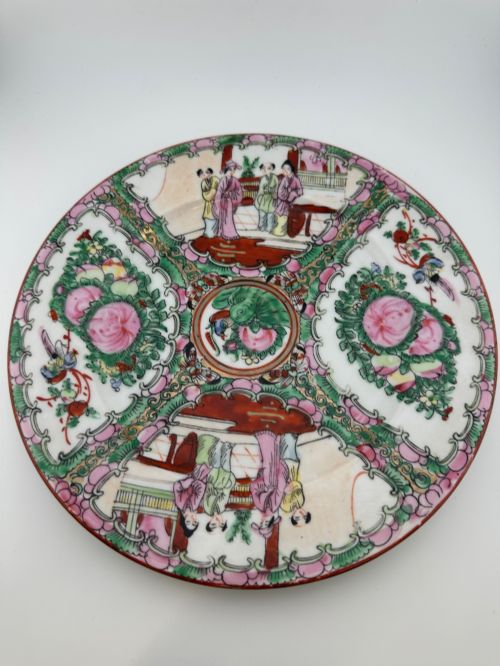
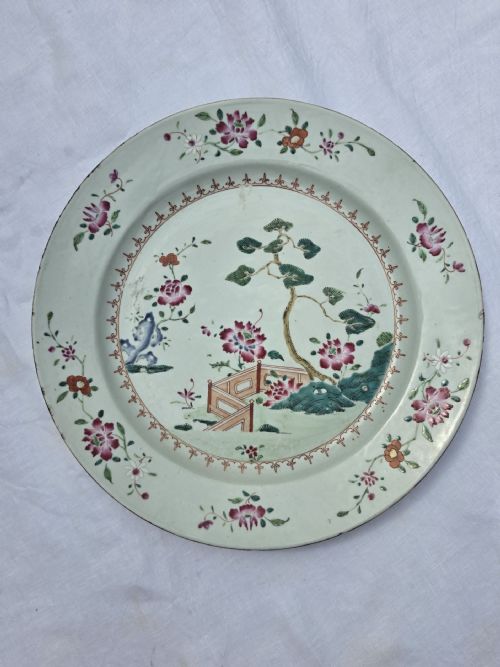
- A palette of Chinese ceramic glazes dominated by opaque pink enamel, introduced during the eighteenth century. Pieces featuring these enamels often display armorial bearings or export motifs.
Green Enamel Charger: Frequently Asked Questions
How were green enamel chargers displayed historically?
Large chargers were primarily used as decorative display items on walls, sideboards, or specially designed plate stands.
Their substantial size and rich colour palette allowed them to serve as prominent interior focal points in nineteenth-century homes.
What distinguishes Meiji period cloisonne from other styles?
Meiji period cloisonne is defined by exceptionally fine wirework and complex pictorial scenes featuring flora, fauna, and mythology.
Artisans during this time refined the technique to produce seamless gradients of colour across large copper surfaces.
Can these chargers be hung on a wall?
Many large chargers feature sturdy metal bases or historical hanging wires attached to the reverse for secure wall mounting.
When hanging a heavy enamel or porcelain charger, standard display brackets should support the entire rim weight.
How do porcelain chargers differ from metal ones?
Porcelain chargers rely on painted overglazes or famille rose enamels fired directly onto a hard-paste ceramic body.
Metal examples utilise copper or brass foundations fused with glass enamel pastes separated by thin wire partitions.