

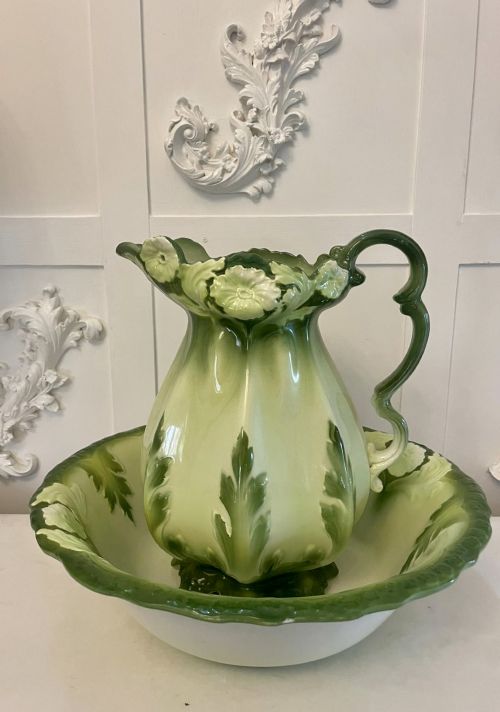
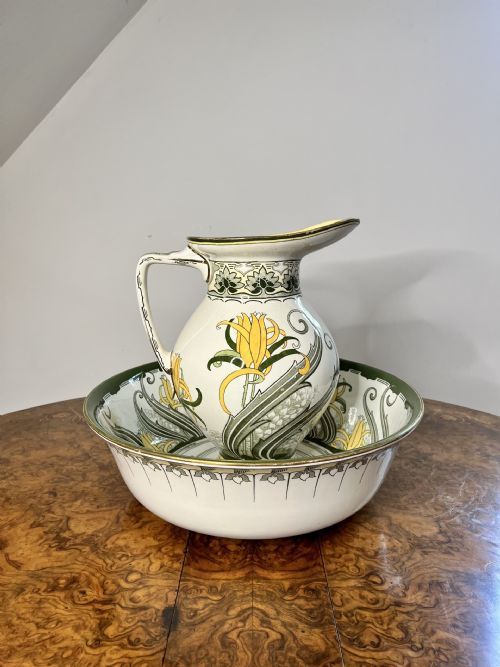



Green Ceramic Water Pitcher
These green ceramic water pitcher examples bring vibrant nineteenth and early twentieth-century colour to a washstand or table.
Green Ceramic Water Pitcher
A green ceramic water pitcher typically appears as part of a larger wash set, though standalone ewers and decorative jugs also surface.
The pieces on this page span the Regency, Victorian, and Edwardian eras, reaching into the early twentieth century.
Makers shaped these utilitarian and decorative vessels in earthenware, stoneware, porcelain, and majolica, often finished with a rich glaze.
Materials and construction methods
Potters utilised earthenware, porcelain, and stoneware bodies, shaping them into jugs, ewers, and wash sets.
Surfaces received decorative glazes, enamel work, and occasional gold leaf accents to enhance the visual depth of the green colour.
Green Ceramic Water Pitcher Retail Price Guide 2026
Typical asking prices for green ceramic water pitcher among the pieces listed under this phrase on Sellingantiques today, from the lower quarter to the upper quarter. They describe what is for sale here now, not the wider market.
Materials represented include earthenware, stoneware, porcelain, majolica, and ironstone.
Judgements of quality
Quality rests upon the crispness of moulded detail, particularly in botanical majolica motifs or classical relief forms.
The uniformity and richness of the glaze separation distinguish standard production pieces from finer studio or factory works.
Doulton Burslem·Doulton Lambeth·Mason·Chamberlain Worcester·Ridgway·Royal Worcester·George Jones
The Green Ceramic Water Pitcher Glossary
- Earthenware
- A porous pottery body fired at lower temperatures, requiring a glaze to achieve impermeability for water containment. It forms the basis of many nineteenth-century domestic wash vessels.
- Majolica
- A colourful, lead-glazed earthenware popular during the Victorian era, known for naturalistic plant and animal reliefs. The technique produces deep, glossy green tones well suited to floral designs.
- Ewer
- A large jug with a wide spout and elaborate handle, traditionally used for pouring water. Victorian examples often served a decorative purpose alongside matching basins.
- Ironstone
- A durable type of heavy earthenware patented in the nineteenth century to rival true porcelain. It provides a sturdy structure for large pouring vessels and jugs.
- Parian
- A fine white porcelain resembling carved marble, sometimes tinted with sage green. Ridgway produced notable examples of this tactile ceramic body.
Green Ceramic Water Pitcher: Frequently Asked Questions
What is a green ceramic water pitcher used for?
These vessels originally served to hold and pour water for personal washing at a bedroom washstand. Today they function as decorative interior centerpieces or as striking flower vases.
Their robust ceramic and earthenware construction makes them practical for holding large floral arrangements on tables or sideboards.
How do I date a green ceramic water pitcher?
Dating relies on identifying factory marks on the base, alongside stylistic clues from periods like the Victorian or Edwardian eras. Regency and Georgian pieces often display different handle forms and softer paste bodies compared to later wares.
Glaze chemistry and moulded motifs also shift noticeably between the eighteen-eighties and nineteen-ten, helping to narrow the decade of production.
Are these pitchers waterproof?
Glazed ceramic, stoneware, and porcelain bodies hold water effectively for daily use. Majolica and earthenware versions are generally suitable for holding cut flowers.
Care should be taken with antique pieces that show hairline cracks in the glaze, as prolonged moisture exposure can penetrate the porous body beneath.
What styles are common in these pitchers?
Styles range from classical Regency shapes and Georgian ironstone designs to naturalistic Victorian majolica featuring bullrushes and lilies. Edwardian sets lean towards cleaner domestic utility with decorative floral transfers.
Art Nouveau influences also appear in the flowing, organic handle shapes and muted green tones of the later nineteenth and early twentieth centuries.