

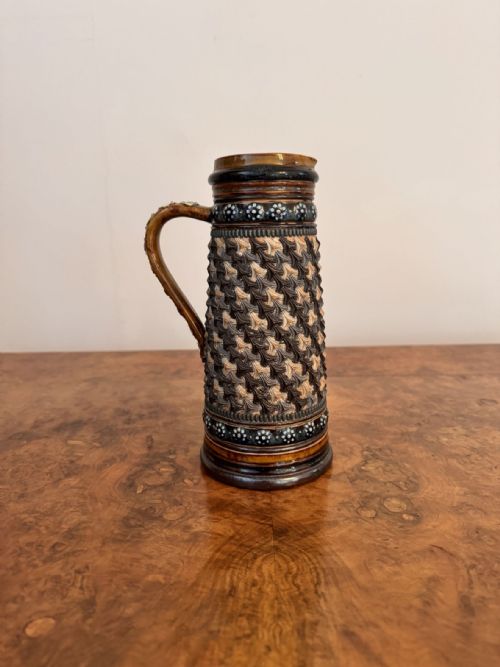
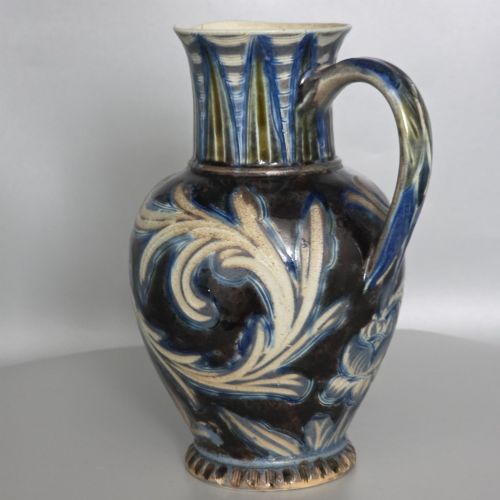



Victorian Doulton Lambeth Pitcher
These Victorian Doulton Lambeth pitchers combine robust salt-glazed stoneware with intricate incised decoration, offering tactile historical character for any collector.
Victorian Doulton Lambeth Pitcher
A victorian doulton lambeth pitcher is a ceramic vessel created during the nineteenth century, encompassing styles from the Aesthetic Movement to Art Nouveau. These pieces emerge from periods spanning the 1870s to 1900, reflecting the shifting design movements of the era.
The versions most commonly met on this page include standard jugs, harvest jugs with applied relief, and decorative ewers. Makers also produced tea and coffee sets alongside larger water jugs.
Moulded shapes often feature salt-glaze ceramic bodies, sometimes complemented by silver rims or paired with matching bowls. The forms range from small drinking vessels to large decorative display pieces.
How they were made
Potters utilised salt glaze and enamel upon heavy clay bodies to create durable stoneware surfaces. The firing process involved throwing salt into the kiln to produce a characteristic pitted, orange-peel texture.
Artisans applied incised patterns and relief decoration directly into the damp clay before firing. Many vessels also received hand-painted details or stamped marks denoting specific makers and patents.
Victorian Doulton Lambeth Pitcher Retail Price Guide 2026
Typical asking prices for victorian doulton lambeth pitcher among the pieces listed under this phrase on Sellingantiques today, from the lower quarter to the upper quarter. They describe what is for sale here now, not the wider market.
The documented periods on this page range from the 1870s through to 1900, encompassing Victorian and Edwardian manufacturing eras.
What varies in quality
The distinction between tiers rests upon the crispness of the incised ornament and the depth of the salt glaze. Pieces decorated by named artists display superior control over botanical and geometric motifs.
The presence of hallmarked silver rims or complete sets elevates the status of a vessel within its category. Heavier potting and balanced proportions separate standard production items from exhibition pieces.
Emma Shute·Doulton Slater
The Victorian Doulton Lambeth Pitcher Glossary
- Salt glaze
- A vitreous coating formed by throwing common salt into the kiln during high-temperature firing, resulting in a textured, glossy surface. This technique creates the durable finish typical of nineteenth-century stoneware.
- Stoneware
- A dense, impermeable ceramic fired at high temperatures until the clay vitrifies. It resists liquids without requiring a traditional interior glaze.
- Art Nouveau
- A decorative style characterised by fluid, organic lines and floral motifs popular around 1900. It influenced the curvature and surface patterning of later pottery.
- Incised
- A technique where designs are cut directly into the surface of the damp clay using a sharp tool. This method produces precise linear patterns before firing.
- Puzzle jug
- A traditional drinking vessel featuring a pierced neck and multiple spouts designed to confound the drinker. Fluid must be sucked through a hidden channel in the handle to prevent spilling.
Victorian Doulton Lambeth Pitcher: Frequently Asked Questions
What are victorian doulton lambeth pitchers made from?
These vessels are constructed primarily from heavy stoneware and ceramic bodies. Potters applied salt glazes and enamel highlights to achieve durable, textured surfaces.
The clay body is fired at high temperatures until vitrified, making the vessels completely waterproof without needing interior glaze coatings.
How do I identify the age of a jug?
Dating relies on recorded production periods, stylistic markers like Art Nouveau or Aesthetic Movement motifs, and stamped factory marks. References to specific patents also help narrow down the decade.
Items from the 1870s and 1880s often display distinct incised patterns, whereas pieces from around 1900 lean towards later stylistic influences.
Were these pitchers used for serving drinks?
Many examples functioned as utilitarian water jugs, harvest jugs, or components of tea and coffee sets. Their robust stoneware construction made them practical for daily household service.
Other variants served purely decorative roles as ewers or formed part of larger jug and bowl sets used in bedrooms.
What is a harvest jug?
A harvest jug is a traditional stoneware vessel typically adorned with applied relief scenes depicting rural life or hunting. These pieces often feature salt glazes and occasionally incorporate silver rims.
They gained popularity during the nineteenth century for serving ale during seasonal agricultural gatherings.