
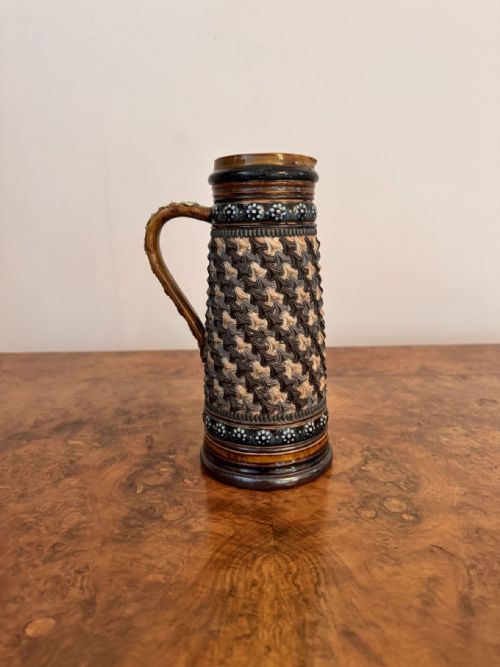
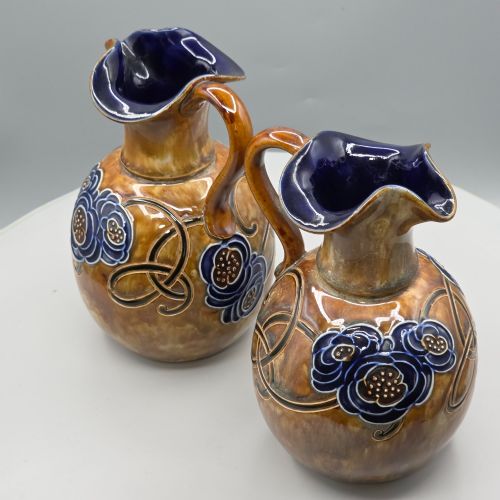
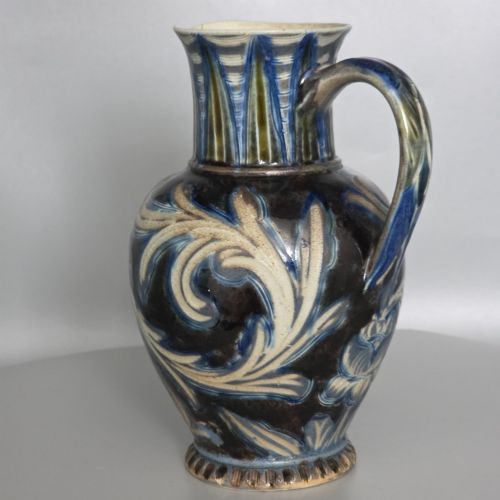
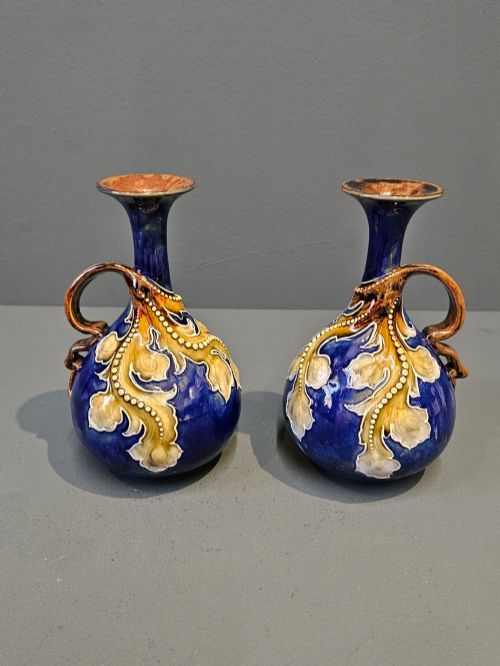
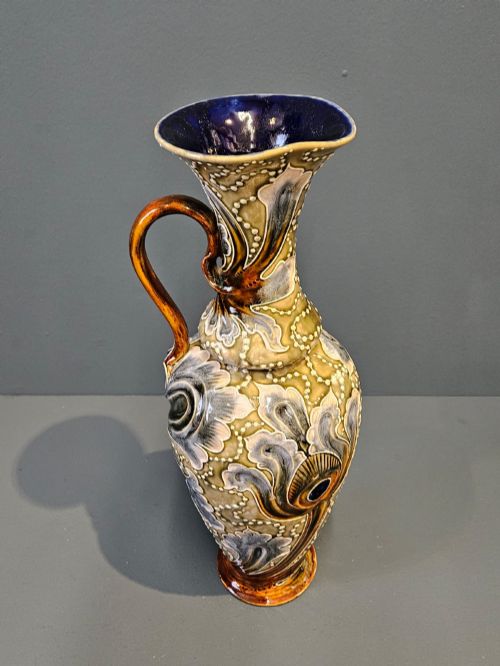


Doulton Lambeth Stoneware Jug
These doulton lambeth stoneware jug pieces bring tactile salt-glazed ceramics and rich Victorian craftsmanship straight into your home.

What They Are
A doulton lambeth stoneware jug is a utilitarian vessel elevated through decorative Victorian artistry, featuring distinct salt glaze finishes and robust ceramic bodies. You will frequently encounter Victorian examples from the late nineteenth century, spanning various forms such as large pitchers, commemorative jubilee editions, and complete jug and bowl sets.
The objects carry distinct stylistic markers of their era, including Victorian Arts & Crafts, Art Nouveau, and Aesthetic Movement designs. These pieces range from simple harvest jugs to specialised items bearing silver rims or specific makers' marks.

How They Were Made
These items are constructed from dense stoneware and ceramic materials, finished primarily with salt glaze or salt-glazed ceramic techniques. Common decorative elements include applied enamel work and incised patterns characteristic of the London pottery.
Makers utilised high-firing kilns to vitrify the clay body while introducing salt during the process to create the signature textured glaze. Selected pieces also incorporate hallmarked silver rims fitted to the top of the ceramic necks.
Retail Price Guide 2026
Typical UK retail prices for doulton lambeth stoneware jug, calculated from the Sellingantiques database of over a million retail prices indexed since 2003. This retail price guide relies exclusively on Sellingantiques data; no external sources or auction records are used, so the figures do not describe the wider market.
Listings show production dates spanning the decades from 1870 to 1900, predominantly utilising stoneware with salt glaze finishes.
What Varies in Quality
The distinction between standard production and exceptional work rests upon the crispness of the incised ornamentation and the depth of the salt glaze. Pieces carrying individual attribution to notable artists demonstrate superior hand-executed detail compared to factory-standard outputs.
Proportion and scale also dictate the standing of a piece, with larger commemorative vessels and matched sets representing greater ambition in the kiln. The addition of intact silver mounts provides an extra layer of material refinement.
Emma Shute·Doulton Slater
The Doulton Lambeth Stoneware Jug Glossary
- Salt Glaze
- A finish achieved by throwing common salt into the kiln during high-temperature firing, producing a characteristic textured orange-peel surface on the stoneware body.
- Stoneware
- A dense, hard ceramic material fired at high temperatures until vitrified, making the vessel completely impermeable to liquids.
- Aesthetic Movement
- A nineteenth-century design style focusing on beauty and artistic expression rather than narrative or moral function.
- Harvest Jug
- A traditional large vessel traditionally used for holding ale during agricultural gatherings, often decorated with hunting or rural motifs.
- Commemorative
- An object produced to mark a specific national event, reign, or jubilee, such as the Victorian issues recorded in the archive.
Frequently Asked Questions
What are these jugs made from?
These vessels consist of heavy stoneware and ceramic bodies finished with traditional salt glaze techniques. Many examples also incorporate applied enamel decoration and fitted silver rims.
The materials were chosen for both durability and their ability to hold liquids safely without requiring interior glazing.
How do I date a Doulton Lambeth piece?
Dating relies on stylistic clues such as Aesthetic Movement or Art Nouveau motifs, alongside impressed factory stamps and artist monograms found on the base. Archival records often connect specific dates of manufacture between eighteen seventy and nineteen hundred.
Commemorative pieces tied to Queen Victoria provide a fixed historical anchor for determining the production era.
Were these jugs used for daily dining?
Many of these vessels served practical roles on the table, holding liquids such as water, beer, or whisky as seen in surviving Dewar's Perth editions. Others functioned primarily as display items or commemorative pieces for special events.
Their robust stoneware construction meant they could easily transition from sideboard display to active household service.
What is a salt glaze finish?
A salt glaze is created by introducing common salt into the kiln at the peak of the firing process. The sodium reacts with the silica in the clay body to form a durable, glossy, slightly pebbled coating.
This chemical reaction gives traditional nineteenth-century stoneware its characteristic impervious surface and tactile texture.