




Gothic Revival Slope
These gothic revival slope pieces combine serious cabinetry with medieval architectural motifs, offering both practical workspace and striking decorative presence.
Gothic Revival Slope
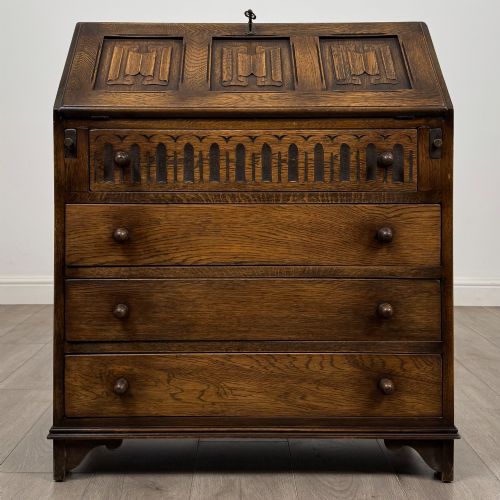
A gothic revival slope brings medieval architectural details like linenfold carving and pointed arches into nineteenth century furniture forms. These pieces range from writing slopes and lapdesks to larger Davenport desks, bureaux, lecterns, and stationery cabinets.
Makers adapted Gothic idioms for domestic use across several decades, resulting in varied forms from utilitarian pitch pine desks to heavily decorated stationary boxes and inkstands. The selection reflects diverse nineteenth and early twentieth century interpretations of medieval design.
Materials and construction
Makers relied heavily on solid oak, pitch pine, and walnut to build these robust carcasses, frequently applying deep relief carvings directly to the wood. Linenfold panels and green man motifs were hand-chiseled to create the characteristic medieval texture demanded by the style.
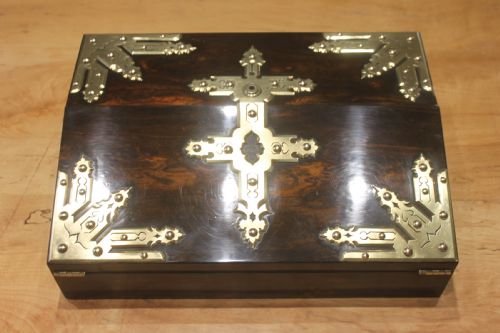
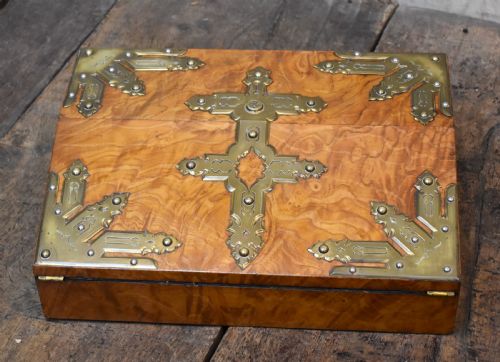
Finer items incorporate dense hardwoods like coromandel, embellished with brass overlay and inlaid mother of pearl to accent the sloping writing surfaces and cabinet doors. Interiors were fitted with specialised compartments for stationery, inkstands, and pen trays.
Stare too long into an oak Davenport and a Victorian green man will stare right back with foliage spilling from his jaws.
Distinctions in quality
The standard of a gothic revival slope rests on the depth and crispness of its wood carving, particularly around the linenfold panels and figural details. Heavy, well-seasoned oak with sharp chisel work stands apart from softer pine or later, flatter machine milling.
Material selection dictates the upper tier, where figured coromandel, precise brass overlay, and intact mother of pearl inlay elevate standard writing furniture into luxury desk accessories. Interior complexity and the retention of original brass hardware further separate utilitarian items from bespoke commissions.
Briggs·Rodman and co of Belfast
The Gothic Revival Slope Glossary
- Linenfold
- A style of wood carving that mimics folded parchment or linen, commonly used on panels in these pieces. It provides a distinct textured surface reminiscent of medieval church woodwork.
- Coromandel
- A dense, heavy tropical hardwood prized for its dark brown colour and striking black streaks. It was frequently used for luxury Victorian desk accessories and cabinets.
- Davenport
- A small compact desk featuring a sloping writing surface hinged above a pedestal of drawers. The form gained popularity in the nineteenth century for domestic studies and boudoirs.
- Green Man
- A sculptural motif depicting a human face carved with leaves, vines, or foliage emerging from the mouth. This ancient symbol of rebirth appears frequently in nineteenth century carved woodwork.
- Lectern
- A tall desk with a slanted top designed to support books or papers for reading standing up. Many examples from this period utilise solid oak construction.
Gothic Revival Slope: Frequently Asked Questions
What is a gothic revival slope?
A gothic revival slope is a desk or writing box decorated with medieval architectural motifs like pointed arches and linenfold panels. These pieces date primarily from the nineteenth and early twentieth centuries.
They were built in various forms, from portable lapdesks to heavy oak lecterns and Davenport desks. The style adapts Gothic cathedral aesthetics for Victorian and Edwardian domestic interiors.
How were these desks used?
These pieces served as dedicated workspaces for correspondence, record-keeping, and reading before the widespread adoption of modern office furniture. Sloping lids provided a comfortable angle for handwriting with dip pens.
Fitted interiors held inkwells, sanders, stamps, and letter paper, while larger cabinets organised stationary and envelopes. Lecterns held large volumes for study or display in home libraries.
How do I care for coromandel wood?
Coromandel is a dense, stable tropical hardwood that requires minimal maintenance beyond dusting with a soft, dry cloth. Avoid placing these items in direct sunlight or near heat sources to prevent the wood from drying out.
Keep humidity levels stable in the room to protect both the timber and any delicate mother of pearl inlay. Apply a neutral wax polish occasionally if the surface appears dry.
How do I distinguish Victorian from Edwardian pieces?
Victorian examples often display heavier, more dramatic carving such as green man motifs and darker finishes on oak or walnut. The styling tends to embrace dense ornamentation and robust proportions.
Edwardian pieces sometimes show a lighter touch influenced by the Arts and Crafts movement or simplified revival aesthetics. However, dates depend heavily on individual maker preferences and regional traditions.