
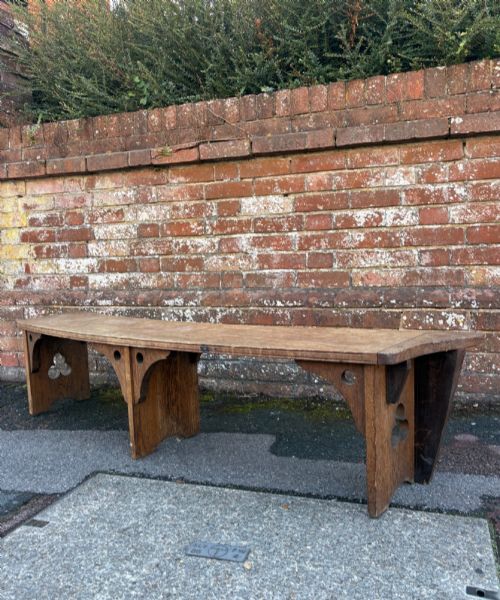
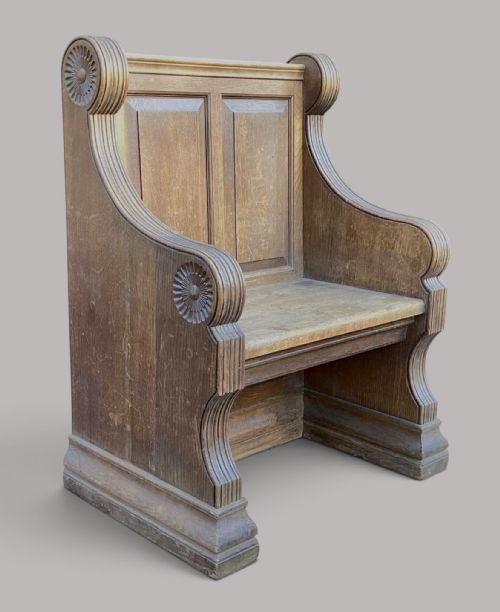
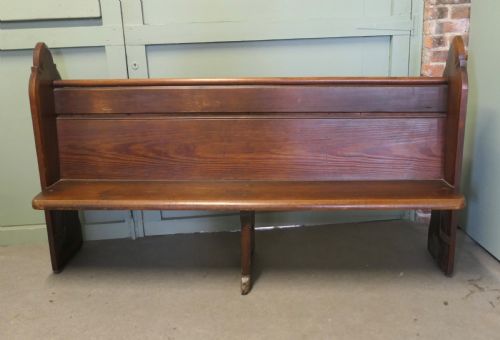
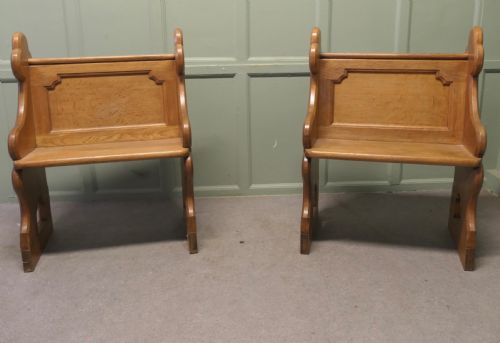
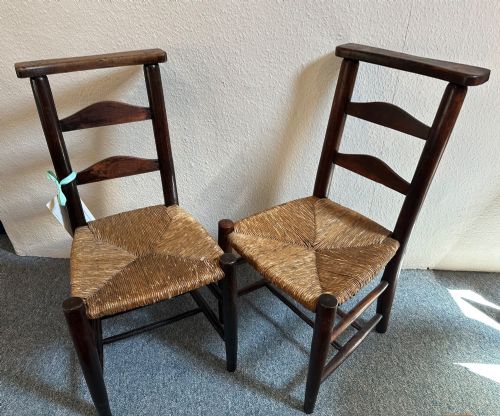
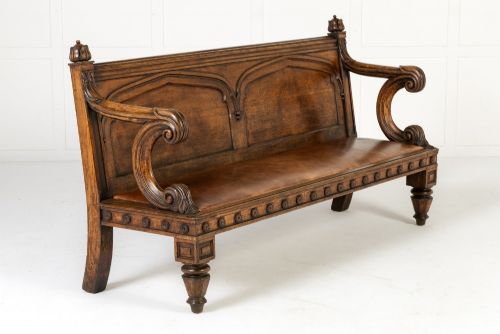


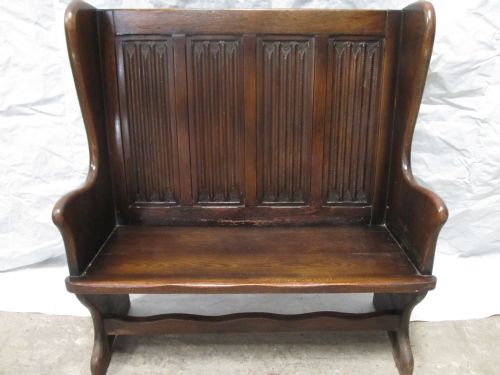
Gothic Revival Pew
These gothic revival pew options bring ecclesiastical architecture straight into the home, offering sturdy seating grounded in centuries of design history.
Gothic Revival Pew
A gothic revival pew takes the solemn architectural presence of a church bench and adapts it for domestic or institutional use. Buyers searching for a gothic revival pew find robust seating solutions ranging from simple pitch pine church benches to curved oak library seats and architectural hall benches. The forms span the nineteenth century into the Edwardian period, often reflecting Victorian ecclesiastical tastes or later Arts and Crafts interpretations.
Many examples emerge from the nineteenth century in solid oak or pitch pine, sometimes featuring high backs, carved panels, or poppy heads. Pieces may appear as single benches, pairs, or related hall chairs bearing direct provenance from historic institutions like St Paul's Cathedral. The construction serves both domestic hallways and larger spaces requiring substantial wooden seating with distinct ecclesiastical character.
Judging the standard of construction
Quality rests in the selection of timber and the precision of the joinery rather than mere decorative flourish. Superior examples display dense, well-seasoned oak or pitch pine with stable joints that have withstood decades of institutional or domestic service without excessive movement.
Carved details reveal the hand of the maker most clearly, separating standard utility church seating from bespoke pieces commissioned for cathedrals or important country houses. Crisp lines in trefoil motifs and sound structural framing indicate higher workshop standards.
One bench retains the precise physical footprint of St Paul's Cathedral, carrying an ink stamp that survived centuries of echoing footsteps.
The Gothic Revival Pew Glossary
- Gothic Revival
- An architectural and decorative style drawing inspiration from medieval design, featuring pointed arches and structural verticality. This movement dominated nineteenth-century ecclesiastical and domestic architecture.
- Poppy Head
- An ornamental carving atop the end of a bench or pew, typically taking a leaf, flower, or stylized bud shape. These carvings terminate the vertical woodwork in traditional church seating.
- Trefoil
- A graphic ornament composed of three overlapping rings or leaf-shaped lobes. Carpenters frequently pierced or carved this motif into bench supports and panelwork.
- Pitch Pine
- A resinous softwood utilised extensively in nineteenth-century joinery for its durability and strong grain pattern. It provided a resilient alternative to hardwoods for large church pews.
- Settle
- A wooden bench with a high back, solid arms, and often a storage box beneath the seat. This form protected sitters from draughts in large halls.
Gothic Revival Pew: Frequently Asked Questions
Where should I put a gothic revival pew?
These long benches suit large hallways, dining rooms, or extended corridors where their linear form and architectural backrests create a strong visual anchor.
They also function well against plain walls in living spaces, offering substantial seating without occupying excessive floor space.
How do I clean a wooden pew?
Dust the timber regularly with a dry cloth and apply a quality beeswax periodically to nourish the dry grain of older oak or pine.
Avoid modern liquid polishes containing silicone, which can build up on historic surfaces and dull the natural patina over time.
How do I date an antique pew?
Examine the tool marks, timber species, and construction methods, as nineteenth-century examples often display machine-sawn components alongside hand-finished details.
Stylistic cues like pointed arch panels and hardware such as brass pew end rails help narrow down the decade of production.