

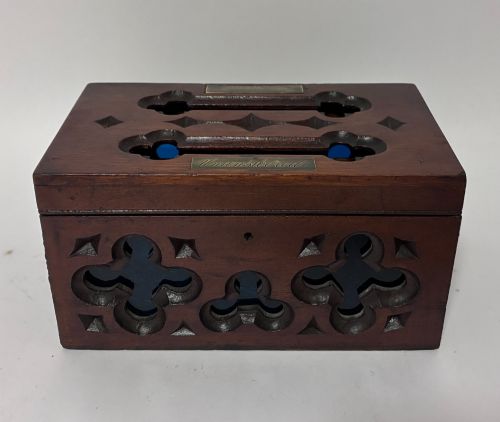



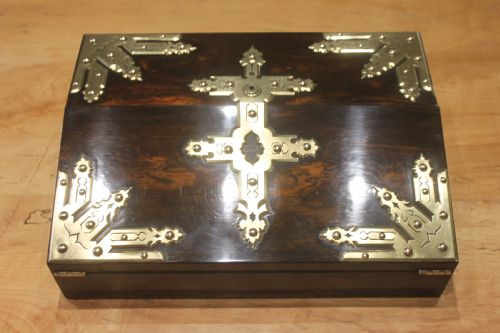


Gothic Revival Letter Box
These gothic revival letter box pieces are architectural desktop containers that organise post with mediaeval flair.
Gothic Revival Letter Box
A gothic revival letter box brings ecclesiastical pointed arches, strapwork, and heavy metal mounts to nineteenth-century desk organisation. These pieces take the form of correspondence boxes, letter caskets, and desk cabinets designed to sit upon writing tables.
Most examples encountered here belong to the Victorian era, spanning from eighteen sixty through to nineteen hundred. Workshops constructed these containers in durable timbers to house incoming post and writing materials securely.
Makers often paired the housing with matching desk accessories such as inkstands and writing slopes. Buyers select these items to introduce period character and functional storage to a modern study.
Materials and construction
Cabinet makers utilised dense exotic timbers including coromandel, burr walnut, pollard oak, and figured walnut for the primary structure. These rich woods provided a dark, textured background that suited the sombre aesthetic of the style.
Workers mounted heavy brass, ormolu, and metal strapwork across the surfaces, frequently securing the joints with visible hinges and corner plates. Glass inserts and fabric linings also appear inside the compartments of select cabinets.
Gothic Revival Letter Box Retail Price Guide 2026
Typical asking prices for gothic revival letter box among the pieces listed under this phrase on Sellingantiques today, from the lower quarter to the upper quarter. They describe what is for sale here now, not the wider market.
The documented forms span stationery boxes, writing slopes, and inkstands created within the Victorian period.
Assessing quality in desk boxes
Superior examples display dense grain matching in the coromandel or walnut veneer alongside crisply cast brass mounts. The weight of the metalwork and the precision of the mitre joints indicate the original maker's investment of time.
Internal complexity dictates the upper tier of the range, with drop fronts, fitted stationery dividers, and matching ink wells surviving intact. Lesser pieces rely on simpler box construction with minimal brass application and plain timber.
Briggs 27 Piccadilly London
The Gothic Revival Letter Box Glossary
- Coromandel
- A dense, heavily figured southeast Asian timber with dark brown and black striations utilised for high-end Victorian boxes. It provides a striking contrast against polished brass mountings.
- Ormolu
- Gilded bronze mountings applied to furniture and desk accessories for decorative effect. The technique involves mercury gilding on bronze bases to produce a durable metallic lustre.
- Stationery box
- A desk accessory featuring internal partitions designed to hold writing paper and envelopes upright. These containers often incorporate hinged lids or drop fronts.
- Writing slope
- A desktop box with an inclined lid that opens to reveal a sloping writing surface and storage wells for ink and pens. They share the decorative vocabulary of contemporary letter boxes.
- Burr walnut
- Timber taken from the growth excrescences of walnut trees, yielding highly swirling grain patterns. Cabinet makers prized this wood for decorative veneering on luxury desk items.
Gothic Revival Letter Box: Frequently Asked Questions
What is a gothic revival letter box?
A gothic revival letter box is a Victorian desk container built to store correspondence behind architectural woodwork and heavy metal mounts. These pieces reflect mediaeval design influences popularised during the nineteenth century.
Craftsmen shaped dense woods like coromandel and walnut into stationery cabinets and letter caskets for domestic and professional studies.
How were these letter boxes used?
Owners placed these boxes on large desks and writing tables to sort incoming letters, envelopes, and writing paper. The compartmentalised interiors kept personal and business correspondence organised.
Drop fronts and hinged lids allowed quick access while protecting valuable paper from dust and light.
How do I date a letter box?
Dating relies upon examining the timber choices, brass mount styles, and construction techniques typical of the nineteenth century. Pieces labelled with specific years or linked to makers offer clear chronological reference points.
The presence of coromandel wood and cast brass strapwork typically points towards the middle and later decades of the Victorian era.
Where should I place an antique letter box?
These boxes suit placement on a traditional desk, a library table, or a sideboard where their woodwork and metal mounts remain visible. They function effectively as desktop storage for modern letters and cards.
Keep the timber away from direct heat sources to prevent the veneers from drying and cracking.