



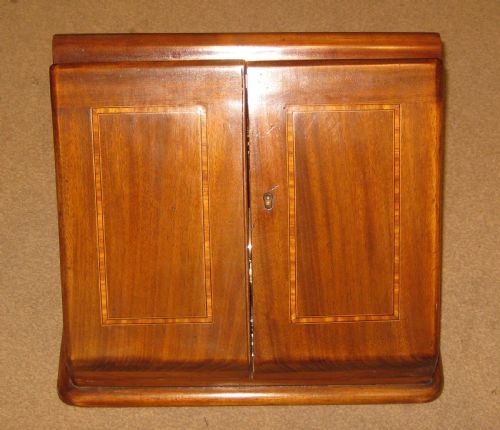


Mahogany Correspondence Box
A mahogany correspondence box brings order to the desk with timber-bound compartments built to hold daily post and writing sheets.
Mahogany Correspondence Box
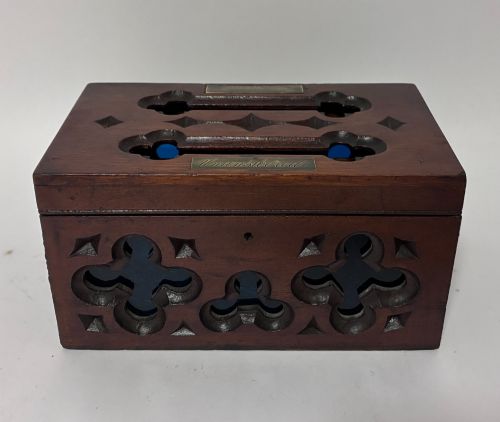
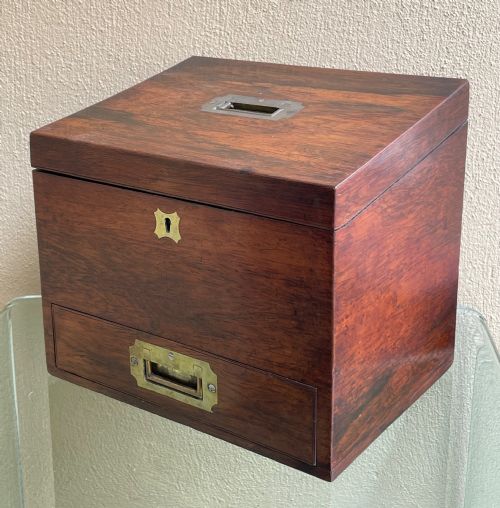
A mahogany correspondence box serves as a desktop cabinet or portable chest designed to organise letters, envelopes, and writing implements. These pieces emerge chiefly from Victorian and Edwardian workshops, spanning periods from the mid-nineteenth century through to the early twentieth century.
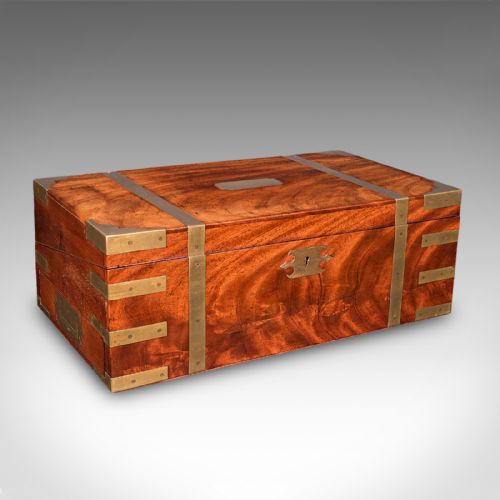
Buyers encounter forms ranging from simple stationery cabinets and letter boxes to elaborate campaign pieces and combined writing slopes. Country house examples and Gothic Revival styles appear frequently alongside brass-bound Campaign designs.
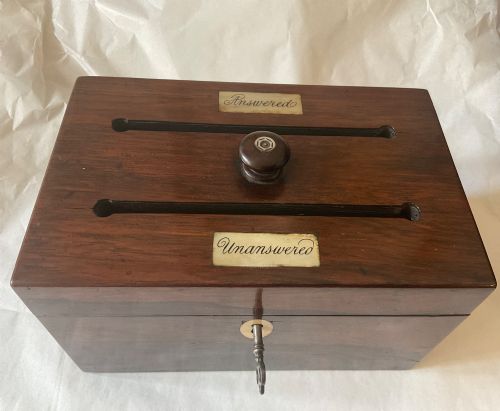
The objects combine practical internal dividers for answered and unanswered mail with compact desk accessories meant for daily correspondence.
How they were made
Cabinetmakers constructed these boxes primarily in solid or veneered mahogany, often selecting timber with rich grain patterns. Workshops integrated boxwood and satinwood stringing for decorative inlay on finer late Victorian and Edwardian cabinets.
Metalwork played a structural and decorative role, with heavy brass mounts, campaign corners, and campaign handles fitted to travel-ready pieces. Internal fittings frequently incorporated bone escutcheons, fabric-lined writing surfaces, and tailored wooden partitions.
Mahogany Correspondence Box Retail Price Guide 2026
Typical asking prices for mahogany correspondence box among the pieces listed under this phrase on Sellingantiques today, from the lower quarter to the upper quarter. They describe what is for sale here now, not the wider market.
Listings demonstrate a strong presence of Victorian and Edwardian pieces, utilising mahogany alongside brass, boxwood, satinwood, and bone.
What varies in quality
Quality rests upon the selection of timber, the precision of the dovetail joinery, and the weight of the brass hardware employed. Superior examples display carefully matched mahogany grains and intact internal partitions rather than plain secondary woods.
The presence of specialised internal mechanics, such as spring-loaded compartments for answered and unanswered letters, elevates a piece. Decorative elements like fine boxwood inlay and intact fabric linings distinguish high-tier stationery cabinets from utilitarian letter boxes.
The Mahogany Correspondence Box Glossary
- Mahogany
- A durable tropical hardwood prized for its deep reddish-brown colour and stable grain. Cabinetmakers relied on it extensively for fine nineteenth-century desktop pieces.
- Campaign
- A style of portable furniture fitted with recessed brass handles and corner brackets designed for travel. These boxes were built to withstand transport during military service or colonial administration.
- Writing slope
- A desk accessory featuring an angled, hinged surface that opens to reveal storage for paper and inkwells. Many correspondence boxes integrated this form directly into their base.
- Escutcheon
- A protective plate surrounding a keyhole, frequently fashioned from brass or bone on these cabinets. It prevents the wood around the lock from splitting through repeated use.
- Stationery cabinet
- A tabletop storage piece with vertical slots and pigeonholes for organising writing paper and envelopes. They became increasingly common in homes during the Victorian era.
Mahogany Correspondence Box: Frequently Asked Questions
What is a correspondence box?
A correspondence box is a dedicated wooden container designed to hold writing paper, envelopes, and incoming or outgoing post. They sit upon a desk or table to keep desktop clutter contained.
Most examples feature internal dividers, partitions, and sometimes compartments labeled for answered and unanswered mail.
How do I date a mahogany box?
Dating relies on observing construction methods, timber choices, and hardware styles across different periods. Victorian pieces often show heavier brass mounts and Gothic or country house influences, while Edwardian examples lean towards lighter stationery cabinets.
Archival comparisons with documented pieces from the mid-nineteenth to early twentieth century help confirm the era.
Were these boxes used for travel?
Certain variants, particularly campaign correspondence boxes, were explicitly built for travel by officers and officials. They feature flush brass corners and recessed handles to withstand movement.
Stationery cabinets and country house letter boxes, by contrast, remained stationary on desks and sideboard tops.
How should I care for mahogany?
Mahogany requires stable room humidity and protection from direct sunlight to prevent the wood from drying or fading. Periodic dusting with a soft, dry cloth preserves the finish.
Avoid liquid polishes containing silicones, allowing the natural grain and age patina to show clearly.