
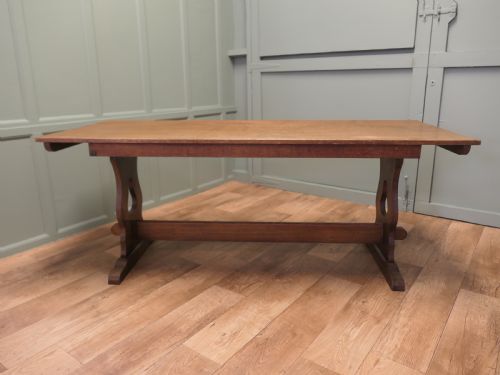
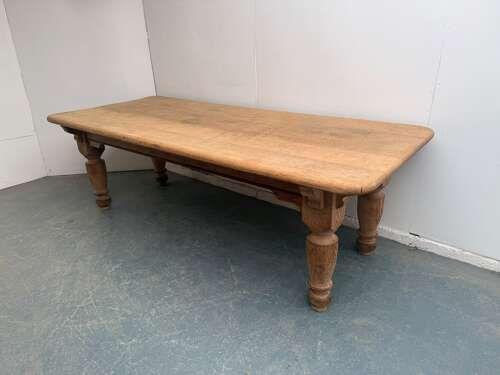
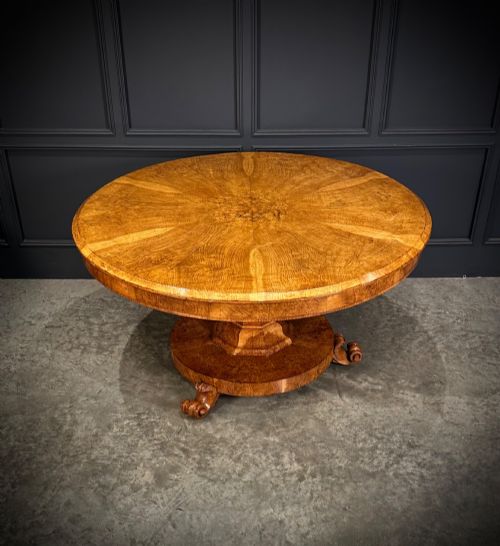


Golden Oak Dining Table
A golden oak dining table brings warmth to a room through honeyed grain and solid construction, offering a practical centrepiece for daily meals.

What these tables are
A golden oak dining table serves as a robust surface for family meals and gatherings, shaped by decades of domestic use. When exploring these listings, buyers encounter various formats designed to accommodate modest kitchens or spacious dining rooms.
The pieces appearing here span the Victorian era through the early decades of the twentieth century. Examples include extending wind-out tables, gateleg designs, refectory boards, and farmhouse tables originating from diverse regions.
Victorian and Edwardian extending variants dominate the selection, often featuring multiple leaves to expand seating capacity. Buyers frequently meet refectory and rustic farmhouse versions alongside drop-leaf wake tables.

How they were made
Cabinet makers utilised solid timber, selecting oak, burr oak, and pollard oak for their strength and distinctive grain patterns. Selected pieces incorporate brass hardware to assist mechanical functions like extending mechanisms.
Construction techniques combine traditional joinery with mechanical innovations of the nineteenth and twentieth centuries. Wind-out systems utilise internal wooden tracks and metal screws to separate the top evenly when inserting extra leaves.
Retail Price Guide 2026
Typical UK retail prices for golden oak dining table, calculated from the Sellingantiques database of over a million retail prices indexed since 2003. This retail price guide relies exclusively on Sellingantiques data; no external sources or auction records are used, so the figures do not describe the wider market.
Some extending tables require a secret metal crank handle, turning an invisible wooden interior like a Victorian magic trick to make room for dinner.
What varies in quality
The standard of timber selection and complexity of internal mechanics divide the range. Superior examples exhibit carefully matched grain across additional leaves and robust turning on legs or pedestals.
Proportion and finish dictate visual appeal, with finer pieces retaining a clear wax polish that enhances the natural warmth of the wood. Tables displaying balanced proportions and seamless leaf integration represent the upper tier.
J & T Scott Edinburgh·Maple & Co
The Golden Oak Dining Table Glossary
- Wind-out table
- An extending dining table operated by a mechanical handle that turns an internal screw thread to separate the halves.
- Refectory table
- A long, narrow dining table historically used in communal dining halls, adapted for domestic kitchens and dining rooms.
- Gateleg table
- A drop-leaf table where the hinged legs swing out like a gate to support the raised flaps.
- Pollard oak
- Timber taken from trees that have been pollarded, producing a dense grain filled with clustered growth rings.
- Burr oak
- Wood harvested from tree growths that yield highly figured, swirling grain patterns across the surface.
Frequently Asked Questions
How do wind-out tables work?
These tables use an internal metal screw mechanism operated by a detachable crank handle. Turning the handle drives the two halves apart along wooden runners.
Once separated, additional leaves drop into the central gap to increase seating capacity. The mechanism then closes tight to secure the leaves in place.
What is pollard oak?
Pollard oak comes from trees pruned near the trunk to encourage dense branching. This process creates tight, mottled grain patterns across the timber.
Cabinet makers valued this wood for tabletops where decorative figures added visual depth. It provides a distinct contrast to straight-grained oak.
How do I care for a golden oak surface?
Maintain the finish by applying natural beeswax periodically to nourish the dry wood. Avoid placing hot items or liquids directly onto the bare timber.
Routine dusting with a soft cloth preserves the sheen without building up residue. Promptly wiping spills prevents water marks from settling into the grain.
How can I tell a Victorian table from an Edwardian one?
Victorian examples often display heavier carvings, bulbous turned legs, and darker patination developed over decades of use. They frequently utilise wind-out systems for large seating capacities.
Edwardian pieces tend to show lighter tones, simpler Arts and Crafts influences, and restrained ornamentation. Proportions became slightly more refined as dining habits shifted toward domestic informality.